
2027 Solar Cable Industry Outlook: Materials, Standards & Emerging Technologies

The global solar industry is entering a new stage of development. As photovoltaic installations expand across utility-scale projects, commercial rooftops, industrial facilities, and emerging applications, the requirements for solar cable systems are also becoming more diverse.
Solar cables are essential components of photovoltaic installations. They connect solar modules, combine electrical strings, transmit DC power to inverters, and support the reliable operation of solar power systems throughout their service life. Their performance directly affects electrical losses, installation safety, and long-term system reliability.
According to the International Energy Agency (IEA), global renewable power capacity is projected to expand by more than 4,770 GW between 2026 and 2031, with solar PV accounting for more than three-quarters of the expected expansion. Utility-scale solar is forecast to add approximately 2,075 GW, while distributed solar applications are expected to add another 1,530 GW.
This growth creates opportunities across the photovoltaic supply chain, but it also raises important questions about cable materials, voltage ratings, international standards, manufacturing quality, and environmental performance.
Looking ahead to 2027, several developments deserve particular attention: the continued use of 1500V DC systems, emerging 2000V photovoltaic wire applications, improvements in cross-linked insulation materials, evolving certification requirements, and more specialized cable solutions for solar tracking and floating photovoltaic systems.
For project developers, EPC contractors, distributors, and solar cable manufacturers, understanding these developments is essential for making informed technical and purchasing decisions.

1. Global Solar Cable Industry Outlook for 2027
The outlook for the solar cable industry is closely connected to the expansion and changing structure of the global photovoltaic market.
As more solar installations are developed across different regions, cable requirements increasingly depend on project scale, system configuration, operating conditions, and local electrical regulations.
1.1 Growth of Utility-Scale Solar Projects
Utility-scale solar farms remain an important driver of photovoltaic deployment. These projects typically involve large numbers of solar modules, extensive DC cable networks, centralized or distributed inverter configurations, and long-term outdoor exposure.
The growing scale of these installations makes several cable engineering considerations particularly important:
Electrical efficiency: Cable resistance and conductor sizing influence voltage drop and resistive power losses.
Installation distance: Long cable routes require careful consideration of conductor cross-section and system configuration.
Environmental durability: Cables must withstand UV radiation, temperature fluctuations, moisture, and other site-specific conditions.
Operational reliability: Cable insulation, connectors, and installation practices influence maintenance requirements and potential failure risks.
In large solar installations, choosing a cable based only on its nominal current rating is not sufficient. Engineers also need to consider cable length, installation method, ambient temperature, grouping, allowable voltage drop, and the requirements of the complete electrical system.
1.2 Distributed Solar and Commercial Rooftop Applications
Distributed photovoltaic systems are expanding across residential, commercial, and industrial buildings.
Unlike large ground-mounted solar farms, rooftop installations often involve limited routing space, complicated cable pathways, different roof materials, and proximity to building electrical infrastructure.
These applications place greater emphasis on:
Flexible and manageable cable construction.
UV and weather resistance.
Suitable insulation temperature ratings.
Safe cable routing and mechanical protection.
Compliance with applicable building and electrical requirements.
For commercial and industrial projects, installation conditions can vary significantly between sites. Cable selection should therefore reflect the actual operating environment rather than relying on a single standard configuration.

1.3 Global Market Diversification
Solar deployment is not limited to traditional high-volume markets. India, Southeast Asia, the Middle East, Africa, and other developing photovoltaic markets are becoming increasingly important parts of the global renewable energy landscape.
These markets present different challenges for cable manufacturers and suppliers.
For example, installations in hot and arid environments may require particular attention to continuous operating temperatures, UV exposure, and dust. Coastal projects may introduce additional corrosion concerns, while industrial rooftop systems may require more detailed consideration of fire performance and building regulations.
As a result, the solar cable industry is likely to place greater emphasis on market-specific product configurations, certification coverage, and technical documentation.
Solar Cable Industry Trends: 2027 Overview
Industry Trend | Technical Impact | Buyer Consideration |
Growth of utility-scale PV | Longer cable routes and large DC networks | Conductor sizing and electrical losses |
Distributed solar expansion | More diverse installation conditions | Flexibility and environmental resistance |
Higher voltage applications | Different insulation and equipment requirements | Voltage rating and certification |
Solar tracking systems | Repeated mechanical movement | Cable routing and mechanical protection |
Floating solar development | Moisture and movement-related exposure | Insulation durability and connection reliability |
Sustainability requirements | Greater attention to materials and manufacturing | Product traceability and environmental performance |
The central issue for 2027 is not simply how many solar cables will be installed, but how cable specifications and quality requirements will evolve as photovoltaic applications become more diverse.
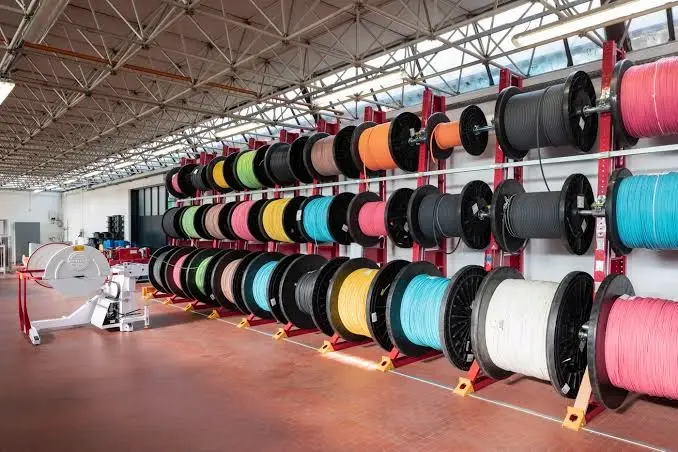
2. Solar Cable Materials: Copper, Aluminum, XLPO and XLPE
Cable materials determine important electrical, mechanical, and environmental characteristics.
For photovoltaic cables, two major material groups deserve separate consideration: conductor materials and insulation or sheath compounds.
2.1 Copper vs. Aluminum Conductors
Copper and aluminum are both used in electrical power transmission, but their properties make them suitable for different applications and cable configurations.
Copper remains widely used in photovoltaic string cables because of its high electrical conductivity, mechanical properties, and compatibility with flexible stranded conductor designs.
Aluminum offers a lower material weight and can be considered for certain larger power distribution applications where a suitable cable design and connection system are available.
Comparison Factor | Copper Conductor | Aluminum Conductor |
Electrical conductivity | Higher | Lower |
Weight | Heavier | Lighter |
Required cross-section | Generally smaller for equivalent resistance | Generally larger for equivalent resistance |
Mechanical characteristics | Good flexibility in suitable stranded designs | Requires attention to mechanical design and connections |
Connection requirements | Compatible terminals and connectors required | Aluminum-rated or approved compatible connections required |
Typical consideration | Compactness and electrical performance | Weight and material considerations in suitable applications |
Why does copper remain widely used in PV cables?
Copper has higher electrical conductivity than aluminum. For a given conductor length and cross-sectional area, copper generally offers lower electrical resistance.
This can be important in photovoltaic systems where cable length and voltage drop affect overall electrical performance.
Tinned copper stranded conductors are commonly found in photovoltaic cables designed for outdoor applications. Tin coating can help protect copper strands against oxidation and corrosion, while stranded construction provides the flexibility needed for cable handling and installation.
Where can aluminum solar cables be considered?
Aluminum can offer advantages in selected larger power transmission and distribution circuits, particularly where weight and conductor material costs are important considerations.
However, aluminum conductors generally require a larger cross-section to achieve comparable electrical resistance. Their connections also need particular attention because aluminum oxide formation, thermal expansion, and terminal compatibility can affect connection reliability.
Aluminum should never be treated as a direct, size-for-size replacement for copper.
Buyers should confirm the applicable product standard, conductor design, terminal compatibility, connector approval, and electrical calculations before selecting an aluminum photovoltaic cable.
2.2 XLPO vs. XLPE Insulation
Insulation materials play a critical role in solar cable performance because photovoltaic cables are often exposed to sunlight, temperature changes, moisture, and other outdoor conditions for extended periods.
Two commonly discussed material terms are XLPO and XLPE.
XLPO: Cross-linked polyolefin.
XLPE: Cross-linked polyethylene.
XLPE is a type of polyolefin-based material, while XLPO usually refers to a broader group of cross-linked polyolefin compounds.
Both can be used in electrical cable insulation and sheathing, depending on the cable design and applicable product requirements.
Material | Characteristics | Important Considerations |
XLPO | Formulated for different electrical, thermal, and environmental requirements | Performance depends on compound formulation and qualification |
XLPE | Cross-linked polyethylene with established electrical insulation applications | Requires verification of UV, temperature, and environmental performance |
Halogen-free cross-linked compounds | Can help reduce halogen-containing gases and smoke under specified test conditions | Actual fire performance depends on testing and classification |
For photovoltaic cables, the compound name alone does not establish whether a product is suitable for outdoor solar installations.
Buyers should examine the complete cable construction and verify its performance against the relevant requirements, including:
Thermal aging resistance.
UV resistance.
Ozone resistance, where required.
Water and moisture resistance.
Insulation resistance.
Electrical withstand performance.
Mechanical properties before and after aging.
The insulation and outer sheath may use different compound formulations. Both layers should be evaluated as part of the complete cable construction.
2.3 Halogen-Free and Low-Smoke Materials
Environmental and fire-safety considerations are also influencing cable material selection.
Halogen-free and low-smoke compounds are used in various cable applications to help reduce the release of corrosive halogen-containing gases and dense smoke during fire exposure.
However, several characteristics should not be confused:
Halogen-free performance.
Smoke emission performance.
Flame propagation performance.
Reaction-to-fire classification.
These properties are evaluated through different test methods and standards.
For example, a cable described as halogen-free should not automatically be assumed to have a particular CPR reaction-to-fire classification.
Project specifications should identify the required properties and testing standards separately.
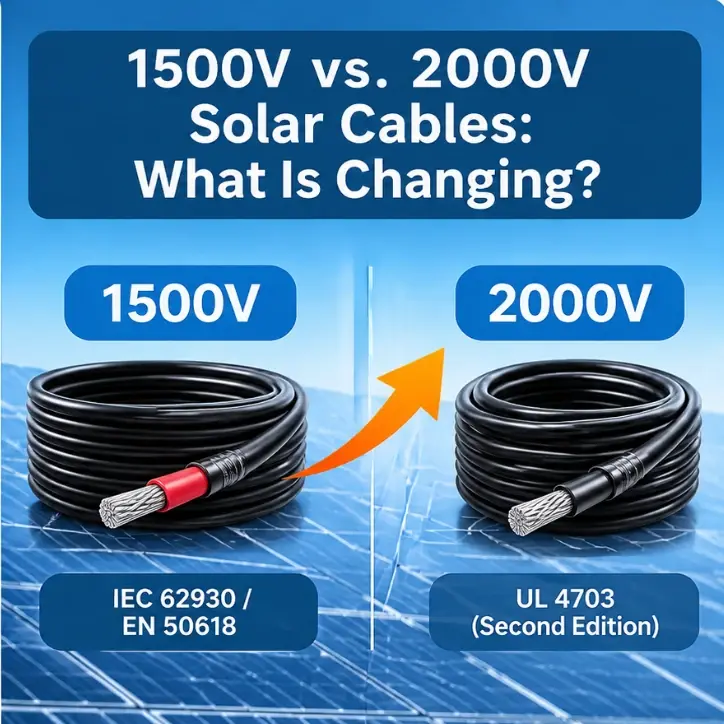
3. 1500V vs. 2000V Solar Cables: What Is Changing?
Voltage ratings are becoming an important discussion in the development of photovoltaic cable systems.
For years, 1500V DC has been an established system voltage level for many utility-scale photovoltaic applications. More recently, 2000V photovoltaic wire has attracted attention in North American standards and product development.
However, 1500V and 2000V cables should not be treated as interchangeable products. Their application depends on the relevant standard, equipment ratings, system design, and local electrical requirements.
3.1 Why 1500V DC Systems Became Important
Increasing the DC system voltage can reduce current for a given power level.
Since resistive power losses are related to the square of current, reducing current can help reduce cable losses when other conditions remain comparable.
This is one reason why higher-voltage DC architectures have become attractive for large photovoltaic installations.
A 1500V system can potentially reduce the number of strings connected in parallel and influence the design of combiner equipment and DC electrical infrastructure.
However, the actual benefits depend on module configuration, inverter specifications, electrical protection, cable length, and the complete system design.
Higher voltage does not automatically mean that every cable can use a smaller conductor. Cable selection must still satisfy current-carrying capacity, voltage-drop limits, short-circuit requirements, installation conditions, and applicable regulations.
3.2 Understanding 1500V Photovoltaic Cable Standards
Two important references for 1500V photovoltaic cables are IEC 62930 and EN 50618.
IEC 62930:2017 applies to single-core cross-linked insulated power cables with cross-linked sheaths for the DC side of photovoltaic systems. Its rated DC voltage scope extends up to and including 1.5 kV between conductors and between conductor and earth.
The standard specifies a normal continuous maximum conductor temperature of 90°C, with use at 120°C limited to 20,000 hours under the specified conditions.
EN 50618 is also widely referenced in photovoltaic cable product specifications, particularly for H1Z2Z2-K cables.
These standards provide requirements related to cable construction and performance, helping manufacturers and buyers evaluate whether a product is suitable for the intended application.
3.3 What Does 2000V PV Wire Mean for the Industry?
A notable development occurred on October 7, 2026, when UL 4703, Second Edition, was published and ANSI-approved.
The updated standard covers single-conductor photovoltaic wire with voltage ratings of:
600V
1000V
2000V
It also specifies applicable dry and wet temperature ratings, including ratings up to 150°C dry and 90°C wet within its scope.
This provides a formal UL 4703 standard framework for 2000V-rated photovoltaic wire in applications covered by the National Electrical Code.
For manufacturers, this development creates an important technical reference when evaluating higher-voltage photovoltaic wire designs for the North American market.
For buyers, however, the presence of a 2000V rating in a standard does not mean that every 2000V product is automatically approved for every solar project.
The exact product listing, construction, temperature rating, installation method, and project requirements still need to be verified.
3.4 1500V vs. 2000V: Key Differences
Comparison Factor | 1500V DC PV Cable | 2000V PV Wire |
Important standard reference | IEC 62930 / EN 50618 | UL 4703, Second Edition |
Application context | International photovoltaic DC applications | Applicable North American PV wire applications |
Voltage rating | Up to 1.5 kV DC under IEC 62930 | 2 kV rating within UL 4703 scope |
Main consideration | Standard compliance and system compatibility | Product listing and compatibility with the complete system |
Buyer priority | Verified 1500V product specifications | Verified 2000V product approval and application suitability |
Will 2000V solar cables replace 1500V cables?
Not necessarily.
The adoption of a higher DC voltage requires coordination across the entire photovoltaic system, including solar modules, inverters, connectors, isolation equipment, protection devices, and cable assemblies.
A cable with a 2000V rating cannot make an otherwise 1500V-rated system suitable for 2000V operation.
Therefore, 1500V cables will continue to have an important role in projects designed around applicable 1500V standards and equipment.
The direction of future development will depend on system-level engineering, product certification, project economics, and market requirements.

4. International Solar Cable Standards and Regulations in 2027
International standards help establish consistent expectations for electrical safety, cable construction, and performance.
However, different standards have different scopes. A product tested or certified under one standard should not automatically be assumed to satisfy the requirements of another market.
For solar cable buyers, understanding the difference between IEC, EN, UL, and CPR requirements is essential.
4.1 IEC 62930: International Photovoltaic Cable Requirements
IEC 62930:2017 specifies requirements for single-core cross-linked insulated photovoltaic cables with cross-linked sheaths.
Its scope covers DC-side photovoltaic cables rated up to 1.5 kV DC.
Important characteristics include:
Cross-linked insulation and sheath construction.
Electrical withstand performance.
Conductor resistance.
Insulation resistance.
Thermal aging performance.
Mechanical and environmental testing.
IEC 62930 is an important technical reference for manufacturers supplying photovoltaic cable products to international markets.
Buyers should check the complete product specification rather than relying only on an IEC reference printed on the cable jacket.
4.2 EN 50618 and H1Z2Z2-K Solar Cables
EN 50618 is a European standard for photovoltaic cables, and H1Z2Z2-K is a familiar cable designation in the European solar market.
These cables are designed for DC-side photovoltaic applications and use cross-linked insulation and sheathing compounds.
Common product features include:
1.5 kV DC rated voltage.
Flexible stranded conductors.
Cross-linked insulation and outer sheath.
UV and weather resistance.
Halogen-free construction in accordance with the applicable requirements.
H1Z2Z2-K cables are commonly available with different conductor cross-sections and colors to meet installation requirements.
When sourcing these products, buyers should confirm the exact standard edition, construction, test documentation, and product certification.
4.3 UL 4703: Photovoltaic Wire for the North American Market
UL 4703 is an important product standard for photovoltaic wire used in applications covered by the US National Electrical Code.
Its scope includes requirements for:
Single-conductor photovoltaic wire.
Insulation and jacket construction.
Sunlight resistance.
Temperature ratings.
Voltage ratings.
Relevant electrical and physical performance.
The Second Edition, published in October 2026, includes 2000V-rated photovoltaic wire within its scope.
For North American buyers, product verification should include the applicable UL certification or listing information, exact wire type, voltage rating, temperature rating, and approved construction.
A general statement that a product is manufactured according to UL 4703 is not a substitute for checking its actual certification status.
4.4 European CPR and Cable Fire Classification
The Construction Products Regulation (CPR) establishes a framework for assessing and declaring the performance of construction products in the European market.
For cables, EN 50575 addresses power, control, and communication cables intended for general applications in construction works where reaction-to-fire performance requirements apply.
Cable reaction-to-fire classes can include classifications such as:
Cca
Dca
Eca
Additional classifications may describe smoke production, flaming droplets, and acidity.
However, CPR should not be treated as a universal certification requirement for every photovoltaic cable.
Its applicability depends on the intended use of the product, whether the cable falls within the relevant harmonized standard and regulatory scope, and the applicable market requirements.
The revised European Construction Products Regulation, Regulation (EU) 2024/3110, entered into force in January 2025, with its main application date on January 8, 2026, and a staged transition for different provisions and product families.
Manufacturers and importers should therefore monitor the applicable harmonized standards, official regulatory references, and transition arrangements when supplying cables for European construction applications.
Solar Cable Standards: What Buyers Should Verify
Standard or Framework | Main Application | Important Verification |
IEC 62930 | DC photovoltaic cables up to 1.5 kV | Product scope and test requirements |
EN 50618 | European photovoltaic cables | H1Z2Z2-K construction and documentation |
UL 4703 | North American photovoltaic wire | UL listing, wire type, and voltage rating |
EN 50575 | Cables for construction works subject to reaction-to-fire requirements | CPR applicability and declared fire performance |
CPR | European construction product regulatory framework | Applicable product category and Declaration of Performance |
One of the most important procurement principles is that a certification logo alone is not enough.
Buyers should verify certificate numbers, issuing organizations, product scope, rated voltage, approved cable construction, manufacturing location, and current certification status.

5. Emerging Technologies Shaping Solar Cable Applications
The development of photovoltaic technology is creating more diverse installation environments.
Solar cables that perform well in conventional ground-mounted installations may face additional challenges when used in floating solar plants, moving tracker systems, or complex commercial rooftop installations.
Understanding these differences is important when specifying cable products.
5.1 Utility-Scale Solar Power Plants
Large photovoltaic plants require extensive electrical infrastructure connecting modules, strings, combiner boxes, inverters, and grid connection equipment.
Cable routing and electrical performance become increasingly important as project capacity and installation distance increase.
Major considerations include:
DC cable sizing.
Voltage drop and resistive losses.
Installation temperature.
Cable grouping and current-carrying capacity.
Connector and termination compatibility.
Outdoor environmental exposure.
For EPC contractors, early cable specification during system design can help avoid unnecessary material costs, installation difficulties, and later performance problems.
5.2 Solar Tracking Systems
Solar tracking systems rotate photovoltaic modules to follow the sun's position.
Unlike fixed-tilt systems, trackers introduce repeated mechanical movement into parts of the electrical installation.
This creates additional challenges for cable management.
Cables routed between moving and fixed structures may experience:
Repeated bending.
Mechanical tension.
Abrasion against structural components.
Inadequate slack or excessive bending.
Stress near connectors and termination points.
Cable selection should therefore consider more than electrical ratings.
The complete cable routing arrangement, support structures, protective accessories, minimum bending radius, and movement range should be evaluated.
IEC 62817 is an important reference for the design qualification of photovoltaic solar trackers. Its 2026 consolidated edition incorporates Amendment 2, published on September 28, 2026.
This is a tracker qualification standard, not a photovoltaic cable product certification. Nevertheless, the development of tracker technology reinforces the importance of evaluating cable management as part of the complete system design.
5.3 Floating Solar Photovoltaic Systems
Floating photovoltaic systems are installed on reservoirs, lakes, industrial water facilities, and other suitable bodies of water.
These projects introduce environmental conditions that can differ significantly from conventional ground-mounted solar plants.
Potential challenges include:
High humidity and continuous moisture exposure.
Corrosion risks around electrical connections.
Movement caused by waves, wind, and changing water levels.
Mechanical stress on cable supports and connectors.
Long-term UV exposure on floating structures.
A 2025 IEA PVPS review of floating PV reliability identifies continuous movement and humid, corrosive environments as potential stress factors for cables and other balance-of-system components.
For example, repeated movement can accelerate cable jacket wear and contribute to insulation degradation or electrical faults.
Cable and connector specifications for floating PV installations should therefore be based on actual exposure conditions.
Standard rooftop or ground-mounted PV cable specifications should not automatically be assumed suitable for every floating solar project.
5.4 Commercial and Industrial Rooftop Solar
Commercial and industrial rooftop systems are influenced by building design, roof materials, electrical infrastructure, and installation constraints.
In these projects, solar cables may be routed across rooftops, through cable trays, into conduits, and through building electrical spaces.
Important considerations include:
UV and outdoor weather resistance.
Suitable operating temperature range.
Mechanical protection.
Cable routing and support.
Applicable fire-performance requirements.
Compatibility with connectors and electrical equipment.
For installations involving permanent building wiring, project designers should also evaluate applicable building codes and construction product requirements.
As commercial solar deployment expands, the ability to match cable specifications to local installation conditions will remain an important part of system reliability.
6. Sustainability and Long-Term Solar Cable Performance
Sustainability is becoming an important consideration throughout the photovoltaic supply chain.
Although solar power generates electricity without direct combustion during operation, the environmental impact of a photovoltaic installation also depends on the materials, manufacturing processes, transportation, maintenance, and end-of-life management of its components.
Solar cable manufacturers therefore face an important challenge: improving material and production efficiency without compromising electrical safety or long-term reliability.
6.1 Recyclable Copper and Aluminum
Copper and aluminum are valuable conductive materials that can be recovered and recycled.
Effective material recovery can reduce the need for virgin raw materials and support more circular manufacturing practices.
However, recovering conductors from finished cables requires separation from insulation and sheath materials.
This is particularly relevant for photovoltaic cables using cross-linked polymer compounds, which cannot simply be remelted and reprocessed like conventional thermoplastics.
Improving cable material efficiency and developing suitable end-of-life recovery processes are therefore important areas for future industry development.
6.2 Low-Carbon Cable Manufacturing
Manufacturing energy consumption, raw material sourcing, production waste, and transportation all contribute to the environmental footprint of electrical cables.
Solar cable manufacturers can evaluate opportunities to improve production efficiency through:
More efficient extrusion and manufacturing processes.
Better control of raw material consumption.
Reduced production scrap.
Improved energy management.
Material traceability.
Waste segregation and recovery.
Environmental claims should be supported by measurable evidence, such as production data, environmental management systems, or product carbon footprint assessments.
Terms such as low-carbon, recyclable, and environmentally friendly should not be used as substitutes for verifiable performance information.
6.3 Long-Term Cable Reliability and Service Life
The service life of a photovoltaic installation depends partly on the reliability of its electrical connections and cable systems.
A cable exposed to high temperatures, UV radiation, moisture, or mechanical damage may experience accelerated degradation if its construction and installation are unsuitable.
Long-term performance therefore depends on several factors:
Correct cable selection.
Compliance with the applicable product standard.
Suitable installation and mechanical protection.
Correct conductor sizing.
Proper connector termination.
Environmental exposure.
Inspection and maintenance practices.
IEC 62930 and EN 50618 provide defined product requirements and test conditions, but compliance with a cable standard should not be interpreted as a universal guarantee of actual field service life.
Project conditions and installation quality remain important.
For solar cable buyers, long-term reliability should be evaluated through product qualification, manufacturing consistency, testing evidence, and technical documentation rather than relying on a claimed service-life figure alone.

7. What Solar Cable Buyers Should Look for in 2027
As photovoltaic installations become more diverse, selecting a solar cable manufacturer requires more than comparing prices and product dimensions.
Buyers should evaluate technical compliance, manufacturing capability, quality control, and the supplier's ability to meet project-specific requirements.
The following checklist provides a practical starting point.
7.1 Product Standards and Certification
Confirm that the cable meets the standards required for the destination market and intended application.
Check:
IEC 62930 or EN 50618 for applicable 1500V DC photovoltaic cable products.
UL 4703 for applicable North American photovoltaic wire.
CPR-related documentation where applicable.
Certificate validity and product scope.
Rated voltage and temperature ratings.
Do not assume that a manufacturer has certification for every cable size, conductor material, color, or construction simply because one product in its range is certified.
7.2 Conductor Material and Cable Construction
Compare the actual cable construction rather than relying on a product's commercial name.
Important information includes:
Copper or aluminum conductor.
Conductor stranding and class.
Conductor cross-sectional area.
Insulation material.
Outer sheath material.
Rated voltage.
Operating temperature.
UV and environmental performance.
Buyers should also confirm that the selected conductor and connection system are compatible with the project's electrical design.
7.3 Quality Control and Testing Capability
Manufacturing quality has a direct influence on cable consistency.
Buyers should ask suppliers about their inspection procedures and relevant testing capabilities.
Depending on the product standard, technical verification may include:
Conductor resistance testing.
Insulation thickness measurement.
Outer sheath thickness measurement.
High-voltage withstand testing.
Insulation resistance testing.
Tensile strength and elongation tests.
Thermal aging tests.
UV and environmental resistance tests.
It is also useful to understand how production batches are identified, how test records are maintained, and how nonconforming products are controlled.
7.4 Manufacturing Capacity and OEM Customization
For distributors, wholesalers, and large EPC projects, product customization and delivery reliability can be important purchasing considerations.
A qualified manufacturer should be able to clearly communicate the available product configurations and the limitations of its customization options.
Typical OEM requirements include:
Conductor size and cable construction.
Cable length and packaging.
Jacket color.
Cable marking and branding.
Reel or coil specifications.
Product documentation.
Destination-market compliance requirements.
The final product must still satisfy the applicable certification and product requirements. Customized markings or packaging do not automatically extend an existing certification to an unapproved cable construction.
7.5 Supplier Reliability and Technical Support
A competitive quotation is only one part of the purchasing decision.
Solar cable buyers should also evaluate:
Manufacturing experience.
Consistency of product specifications.
Access to technical documentation.
Certification transparency.
Production and delivery planning.
Communication and after-sales support.
For long-term supply relationships, a manufacturer's ability to maintain consistent product quality can be more valuable than a small difference in initial purchase price.
Solar Cable Supplier Evaluation Checklist
Evaluation Area | Questions to Ask |
Certification | Can the supplier provide current certificates and product scope? |
Voltage Rating | Does the product match the system voltage? |
Conductor | Is the conductor copper or aluminum, and what is its construction? |
Insulation | What compounds are used for insulation and sheathing? |
Testing | Which product tests are performed, and are records available? |
Quality Control | How are production batches inspected and traced? |
OEM Service | Are custom sizes, colors, marking, and packaging available? |
Supply Capability | Can the supplier meet the required quantity and delivery schedule? |
A structured evaluation process helps buyers reduce specification errors and select products that are technically suitable for their projects.
8. What Will Define the Solar Cable Industry from 2027 to 2030?
Looking beyond 2027, several developments are likely to influence solar cable product requirements and the competitive position of manufacturers.
These trends should be understood as areas to monitor rather than guaranteed market outcomes.
8.1 Greater Attention to Higher-Voltage Applications
Higher-voltage photovoltaic wire and system architectures are receiving increased technical attention.
The publication of the second edition of UL 4703 in 2026, including its 2000V rating, provides an important reference for North American product development.
Future adoption will depend on system equipment compatibility, electrical code requirements, project economics, and product certification.
8.2 More Specialized Cable Solutions
The continued development of utility-scale solar, tracking systems, floating PV, and distributed installations is creating different technical requirements.
A single standard cable construction may not be optimal for every application.
Manufacturers may increasingly need to provide application-specific solutions supported by suitable product testing and technical documentation.
8.3 Greater Focus on Material Consistency
As solar projects become larger and more demanding, consistent conductor resistance, insulation thickness, compound quality, and manufacturing control remain critical.
For cable manufacturers, process control and product traceability will continue to be important competitive factors.
8.4 Stronger Emphasis on Certification Transparency
International solar markets have different electrical regulations and certification requirements.
Manufacturers serving multiple regions need to understand these differences and maintain accurate documentation for each product.
Buyers are also likely to place greater importance on certificate verification, approved product scope, and traceable quality records.
8.5 Sustainability Across the Manufacturing Process
Material efficiency, energy management, waste reduction, and traceability are increasingly relevant to procurement decisions.
Manufacturers that can support environmental claims with measurable information will be better positioned to respond to sustainability requirements from project developers and international buyers.
Overall, future competition in the solar cable industry will not be determined by production volume alone. Product compliance, material consistency, testing capability, customization, and supply reliability will all remain important factors.
9. Frequently Asked Questions About the Solar Cable Industry in 2027
1. What are the major solar cable trends for 2027?
Major trends include continued development of higher-voltage photovoltaic systems, improvements in insulation materials, greater attention to cable certification, and more specialized solutions for utility-scale, floating, and tracking-based solar installations. Sustainability, manufacturing consistency, and traceability are also important considerations.
2. What materials are used in modern solar PV cables?
Modern photovoltaic cables commonly use stranded copper conductors, often with tinned copper strands, and cross-linked insulation and sheath compounds such as XLPO-based or XLPE-based materials. Specialized cable designs may use other conductor materials where permitted by the applicable product standard and project requirements.
3. What is the difference between IEC 62930 and EN 50618?
IEC 62930 is an international standard for DC-side photovoltaic cables rated up to 1.5 kV DC. EN 50618 is a European photovoltaic cable standard commonly associated with H1Z2Z2-K products. Although their applications and technical requirements have similarities, their certification and compliance status should be verified separately.
4. Will 2000V solar cables become more common in the future?
2000V-rated photovoltaic wire is an important development in the North American market. UL 4703, Second Edition, published in October 2026, includes a 2000V rating within its scope. However, wider adoption depends on system design, equipment compatibility, applicable electrical codes, and product certification. It does not mean that all photovoltaic systems will move from 1500V to 2000V.
5. What is the difference between UL 4703 and IEC 62930?
UL 4703 is a North American photovoltaic wire standard used within the applicable NEC framework. IEC 62930 is an international standard for photovoltaic DC cables rated up to 1.5 kV DC. They have different scopes and requirements and should not be treated as interchangeable certifications.
6. How long should a solar PV cable last?
There is no single service-life figure that applies to every solar cable and installation. Cable longevity depends on its construction, material quality, environmental exposure, system design, and installation practices. Buyers should review the applicable product standard, qualification tests, manufacturer documentation, and actual project conditions rather than relying on a generic lifetime claim.
7. What should buyers look for when choosing a solar cable manufacturer?
Buyers should check product certification, voltage ratings, conductor material, insulation and sheath construction, testing capability, quality control, production traceability, and delivery reliability. It is also important to verify that certificates cover the exact product construction and intended application.
Conclusion: Preparing for the Next Stage of Solar Cable Development
The solar cable industry is evolving alongside the global photovoltaic market.
As utility-scale solar, distributed PV, and specialized applications continue to develop, manufacturers and buyers will need to pay closer attention to material performance, voltage ratings, international standards, environmental conditions, and long-term reliability.
The latest developments in UL 4703, the continued importance of IEC 62930 and EN 50618, and the growing technical requirements of tracking and floating solar installations demonstrate why cable selection is becoming an increasingly specialized part of photovoltaic system design.
For solar cable manufacturers, the challenge is to combine reliable electrical performance with consistent manufacturing, verified compliance, and application-specific product development.
For buyers and project developers, a careful evaluation of cable construction, certification, testing records, and supplier capability will remain essential to building safe and dependable solar power systems.
As the industry moves toward 2027 and beyond, the most competitive solar cable solutions will be those designed around the real requirements of photovoltaic projects—not simply the lowest purchase price or the highest nominal voltage rating.
Looking for solar cables for your next photovoltaic project? Explore FRCABLE's solar cable and PV wire products and solar cable datasheets to review product specifications and identify suitable cable options for your application.
Technical References and Further Reading
International Energy Agency (IEA) — Renewables 2026
UL Standards & Engagement — UL 4703, Second Edition: Photovoltaic Wire
International Electrotechnical Commission — IEC 62930:2017
International Electrotechnical Commission — IEC 62817:2014 + AMD1:2017 + AMD2:2026
European Commission — Construction Products Regulation Overview
IEA PVPS — Floating PV Power Plants: A Review of Energy Yield, Reliability, and Maintenance


Comments