
Why Are Aluminum Conductors Used in High-Voltage Power Transmission?

Aluminum conductors are widely used in overhead electrical transmission and distribution because they provide a practical combination of electrical conductivity, low weight, mechanical design flexibility, and cost. Aluminum does not conduct electricity as well as copper on an equal cross-sectional-area basis, but its much lower density gives it a strong conductivity-to-weight advantage for long transmission spans. The U.S. Department of Energy and Pacific Northwest National Laboratory both identify weight, conductivity, and cost as important factors behind the widespread use of aluminum in transmission conductors.
The distinction between overhead transmission conductors and insulated high-voltage power cables is important. Aluminum is especially common in overhead lines, while both copper and aluminum are used for insulated underground and other high-voltage cable systems depending on project requirements.
So why does the power industry use aluminum when copper has higher electrical conductivity?
The answer is not based on conductivity alone. It is a trade-off between electrical performance, conductor weight, mechanical strength, material cost, and installation requirements.
Is Aluminum More Conductive Than Copper?
No. Copper has higher electrical conductivity than aluminum for the same cross-sectional area.
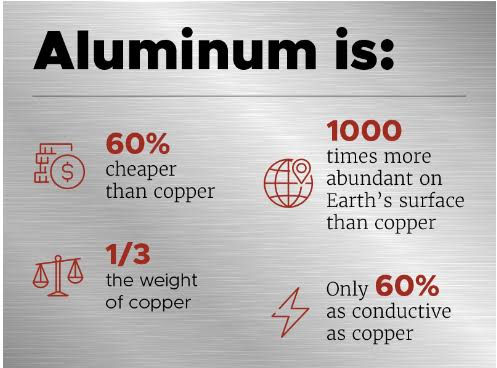
Aluminum has approximately 60% of the conductivity of copper, according to PNNL and U.S. Department of Energy technical materials. However, aluminum is much lighter. PNNL notes that aluminum's conductivity-to-weight ratio is approximately twice that of copper.
This distinction is critical.
A transmission engineer does not simply ask:
Which metal conducts electricity better?
The more useful question is:
Which conductor provides the required electrical performance with an acceptable combination of weight, strength, cost, and line-design requirements?
When these factors are considered together, aluminum becomes highly attractive for overhead transmission.
Why Is Low Weight Important for Transmission Lines?
Weight is one of the major reasons aluminum is widely used for overhead conductors.
A transmission conductor may need to span substantial distances between towers or poles. Its weight creates mechanical loads on:
Towers
Poles
Crossarms
Insulators
Hardware
Foundations
Conductor support systems
A heavier conductor can increase mechanical loading and influence structural design.
PNNL explains that copper's high density is a disadvantage for overhead transmission because heavier conductors require larger and stronger supporting structures. Aluminum, by contrast, offers a much more favorable conductivity-to-weight ratio.
This is especially important for long transmission spans.
Conductivity-to-weight ratio matters
Although copper can carry more current per unit cross-sectional area, aluminum can provide considerable current-carrying capability at substantially lower weight.
The result is an important engineering advantage:
Lower conductor weight can be combined with an appropriately larger aluminum cross section to achieve the required electrical performance without imposing the same mass on the supporting structures.
That is a major reason aluminum became a dominant material for overhead transmission conductors.
Why Is Aluminum Less Expensive Than Copper?
Cost is another important factor.
Large transmission projects require substantial quantities of conductor material. Even a relatively small difference in material cost can become significant when multiplied across hundreds or thousands of kilometers of line.
PNNL describes aluminum as lighter, less expensive, and more abundant than copper.
The choice is therefore not simply:
Copper = better conductivity
versus:
Aluminum = lower conductivity
Instead, utilities and engineers evaluate the overall system economics.
A conductor that meets the required electrical and mechanical performance with lower material cost and lower structural loading can offer a practical advantage at transmission scale.
Why Is Aluminum Widely Used for Overhead Transmission?
Aluminum's characteristics align particularly well with overhead-line requirements.
For overhead applications, engineers have to balance:
Electrical resistance
Ampacity
Conductor weight
Tensile strength
Sag
Span length
Wind loading
Ice loading
Tower loading
Material cost
Installation requirements
IEEE describes aluminum-based conductors as the most common conductors used on distribution lines because of their favorable ratio of conductivity to weight and cost relative to copper. It also identifies ACSR as a common overhead-line design in which aluminum strands carry current while a steel core supplies tensile strength.
This combination is one of the defining characteristics of modern overhead power transmission.
Why Does ACSR Use Aluminum and Steel Together?
One of the best-known overhead conductor designs is ACSR, which stands for:
Aluminum Conductor Steel Reinforced
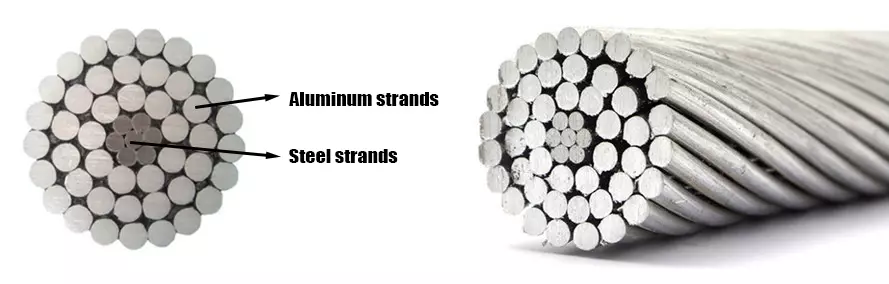
An ACSR conductor normally consists of aluminum strands surrounding a steel core.
The two materials perform different functions.
Aluminum strands
The aluminum strands are primarily responsible for:
Electrical conductivity
Carrying current
Forming the main conductive section of the conductor
Steel core
The steel core primarily provides:
Tensile strength
Mechanical support
Improved span capability
Resistance to mechanical loading
Southwire describes ACSR as aluminum 1350-H19 wires concentrically stranded around a steel core and specifies its use as a bare overhead transmission and distribution conductor.
This is an important engineering concept:
The material that carries the electrical current does not necessarily need to provide all of the mechanical strength.
By separating these functions between aluminum and steel, the conductor can provide both electrical conductivity and high mechanical strength.
Why Does ACSR Need a Steel Core?
Pure electrical-grade aluminum is relatively weak compared with the mechanical demands of many long-span overhead transmission applications.
PNNL notes that electrical-grade aluminum is typically not strong enough by itself for transmission conductors without a strengthening core.
The steel core addresses this limitation.
For a long overhead span, the conductor must withstand tension while remaining within acceptable sag and clearance limits. The steel core substantially increases mechanical strength without requiring the entire conductor to be made from a heavier, highly conductive metal such as copper.
Southwire also notes that variable steel-core stranding can be used to achieve desired strength without sacrificing the conductor's ampacity.
Does the Steel Core Carry Electricity?
The steel core in ACSR is not primarily intended to carry the electrical current.
Steel is much less conductive than aluminum, so the outer aluminum strands provide most of the useful electrical conducting path.
The steel core's main role is mechanical.
This division can be summarized as:
Aluminum → electrical conductivity
Steel → tensile strength
That simple principle explains much of the design logic behind ACSR.
Aluminum vs Copper Conductors for Power Transmission
When comparing aluminum and copper, it is important to consider more than electrical conductivity.
Property | Aluminum | Copper |
Electrical conductivity | Lower | Higher |
Density | Much lower | Much higher |
Conductivity-to-weight ratio | High | Lower than aluminum |
Material cost | Generally lower | Generally higher |
Overhead transmission use | Very common | Used in selected applications |
Mechanical reinforcement | ACSR, ACSS and other designs | Different conductor designs |
Long-span weight | Advantageous | Less advantageous |
PNNL reports that aluminum has about 60% of copper's conductivity but about twice the conductivity-to-weight ratio. DOE materials likewise describe conductor selection as a balance between performance, cost, and weight.
This is why saying “aluminum is better than copper” would be too simplistic.
Each conductor material can be appropriate for different applications.
Why Can't Engineers Simply Make the Aluminum
Conductor Larger?
They often can—and this is part of the engineering trade-off.
Because aluminum has lower conductivity per unit area, an aluminum conductor may require a larger cross-sectional area than a copper conductor for comparable electrical performance.
DOE technical material notes that aluminum can require a larger cross-sectional area to achieve the same current rating as copper, while still maintaining a significant weight advantage.
The important point is that:
Larger cross-sectional area does not automatically mean greater overall weight.
Because aluminum is substantially less dense than copper, a larger aluminum conductor can still weigh less than a smaller copper equivalent.
This is one of the central reasons aluminum works well for large-scale overhead transmission.
What Are the Main Types of Aluminum Overhead Conductors?
Aluminum-based transmission conductors are not limited to ACSR.
Several conductor designs are used for different electrical and mechanical requirements.
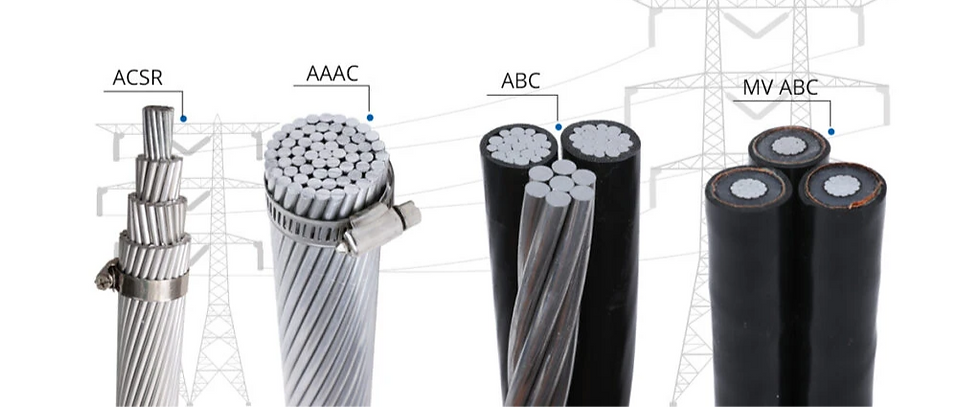
AAC: All Aluminum Conductor
AAC uses aluminum strands without a separate steel reinforcing core.
It can provide good conductivity and low weight, but its mechanical strength is lower than reinforced designs.
AAAC: All Aluminum Alloy Conductor
AAAC uses aluminum alloy rather than conventional electrical-grade aluminum alone.
The alloy is selected to improve mechanical characteristics while retaining good electrical performance.
ACSR: Aluminum Conductor Steel Reinforced
ACSR combines aluminum conductive strands with a steel reinforcing core.
It is widely used for overhead transmission and distribution applications. Southwire's ACSR products are manufactured to ASTM specifications including B230, B232 and B498.
ACSS: Aluminum Conductor Steel Supported
ACSS is another aluminum-and-steel conductor design developed for high-temperature applications.
PNNL describes ACSS as similar to ACSR but capable of carrying higher current at higher operating temperatures.
The appropriate conductor depends on the electrical, mechanical, thermal, and environmental requirements of the transmission line.
Why Is Sag Important in High-Voltage Transmission?
Conductor sag is an important mechanical consideration.
When an overhead conductor heats up, it expands. Increased temperature can therefore increase sag.
Excessive sag can reduce the clearance between the conductor and:
Ground
Roads
Buildings
Vegetation
Other conductors
Structures
This is one reason modern conductor technologies focus not only on electrical conductivity but also on thermal performance and low-sag behavior.
CIGRE's work on high-temperature low-sag conductors identifies thermal rating, line losses, sag and tension, vibration, ice accumulation, and hardware as important technical considerations in overhead-line design.
What Are High-Temperature Low-Sag Conductors?
Modern power networks sometimes need to transmit more power through existing transmission corridors.
One approach is to use HTLS — High Temperature Low Sag conductors.
These conductors are designed to operate at higher temperatures while controlling thermal expansion and sag.
Examples include:
ACSS
ACCC
ACCR
Other advanced composite-core conductors
PNNL describes advanced conductor technologies such as ACCR and ACCC as solutions intended to improve transmission capacity while controlling weight and thermal effects.
CIGRE also identifies HTLS conductor selection as a field involving electrical, mechanical, environmental, operational, and economic considerations.
Are All High-Voltage Power Cables Made With Aluminum?
No.
This distinction is important.
High-voltage transmission conductors used for overhead lines are commonly aluminum-based, but insulated high-voltage power cables can use either aluminum or copper conductors.
For underground and specialized cable systems, conductor selection depends on factors such as:
Required ampacity
Cable diameter
Weight
Installation method
Electrical losses
Mechanical requirements
Environmental conditions
Project cost
Voltage level
DOE technical materials note that copper remains relevant in underground applications and certain higher-voltage cable applications because of its higher conductivity and other characteristics.
Therefore, the technically accurate statement is:
Aluminum is widely used for overhead high-voltage transmission conductors, but aluminum is not the universal conductor material for every high-voltage power cable.
Aluminum Conductors for Underground High-Voltage Cables
Underground high-voltage cables operate under different conditions from bare overhead conductors.
An underground cable typically includes multiple functional layers, such as:
Conductor
Conductor screen
Insulation
Insulation screen
Metallic screen or sheath
Protective outer layers
The conductor can be manufactured from copper or aluminum depending on the project specification.
In an underground system, overall cable diameter, installation weight, thermal dissipation, bending requirements, and jointing technology become particularly important.
This is why conductor selection must be evaluated as part of the complete cable system rather than viewed as a simple aluminum-versus-copper decision.
What Are the Advantages of Aluminum Conductors?
The principal advantages of aluminum for transmission applications include:
Lower weight
Aluminum's low density is particularly beneficial for long overhead spans.
Favorable conductivity-to-weight ratio
Although aluminum is less conductive than copper by cross-sectional area, its low density provides a strong conductivity-to-weight relationship.
Lower material cost
Aluminum is generally less expensive than copper and can be attractive for large quantities of conductor material.
Flexible conductor designs
Aluminum can be used in several overhead conductor architectures, including AAC, AAAC, ACSR and advanced conductor designs.
Compatibility with large-scale transmission
The combination of electrical and mechanical characteristics makes aluminum particularly suitable for overhead transmission infrastructure.
What Are the Disadvantages of Aluminum Conductors?
Aluminum also has limitations that engineers must consider.
Lower conductivity per cross-sectional area
A larger aluminum cross section may be required to achieve comparable electrical performance to copper.
Mechanical strength
Pure electrical-grade aluminum does not provide the mechanical strength required for many long-span transmission applications, which is why reinforced or alloy designs are used.
Connection and joint considerations
Connections between aluminum conductors and fittings require appropriate engineering and installation practices.
CIGRE notes that corrosion mechanisms can affect aluminum strands and conductor fittings and that conductor joints require particular attention because temperature and installation quality can influence reliability.
Thermal behavior
Conductor temperature affects resistance, sag, and allowable operating current, so thermal performance must be considered during conductor selection.
How Does Aluminum Conductor Design Affect Transmission Efficiency?
Transmission efficiency is not determined by conductor material alone.
Power losses in a conductor are closely related to current and resistance.
The basic relationship is:
P loss = I²R
where:
P loss is resistive power loss
I is conductor current
R is conductor resistance
For a fixed amount of transmitted power:
P = V × I
Therefore, increasing transmission voltage allows the same power to be transmitted at lower current.
Lower current reduces resistive losses for a given conductor resistance.
DOE explains this principle directly: transmitting a given amount of electrical power at higher voltage reduces current and therefore reduces heat-related transmission losses.
This means aluminum conductors are only one part of the overall efficiency strategy.
The complete system involves:
Transmission voltage + conductor resistance + conductor size + thermal performance + line length + mechanical design
Why Aluminum Is Important for Modern Power Grids
Power transmission networks are under pressure to transport more electricity while making efficient use of existing infrastructure.
This has increased interest in:
Higher-capacity conductors
High-temperature conductors
Low-sag conductors
Composite-core conductors
Improved conductor materials
Advanced aluminum alloys
PNNL's transmission-infrastructure work identifies ACSR, ACSS, ACCR and ACCC among important conductor technologies and explains how advanced materials can improve the relationship between conductivity, strength, weight, and thermal performance.
CIGRE likewise identifies conductor selection as a multidisciplinary issue involving electrical performance, mechanical behavior, environmental loading, operation, maintenance and economics.
Is Aluminum Also Used in Solar Cables?
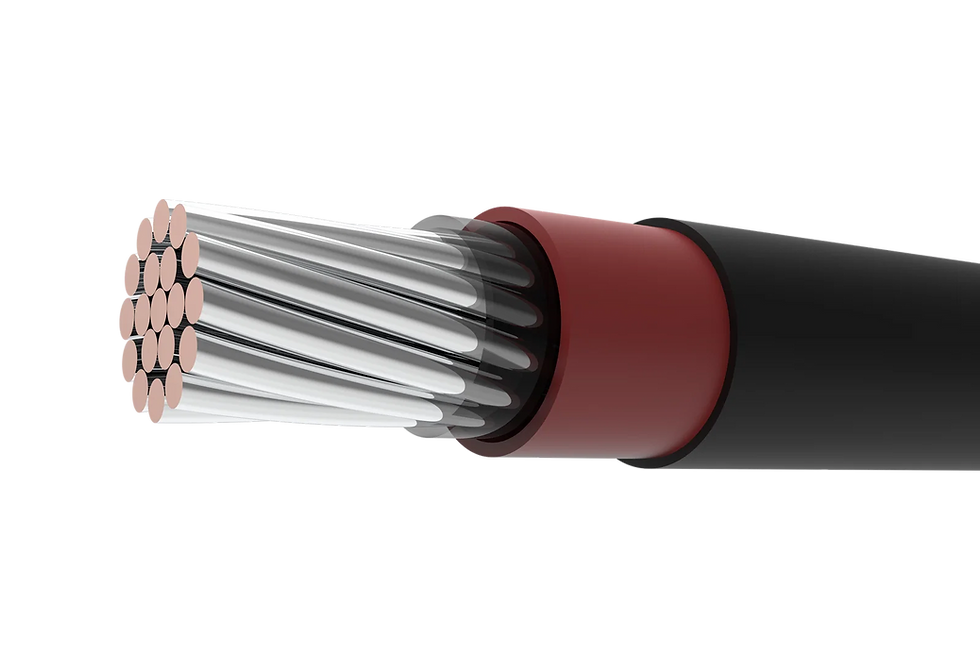
Yes, aluminum conductors can also be used in photovoltaic applications, but the engineering requirements are different from overhead transmission conductors.
In a PV system, conductor selection may depend on:
Current
DC voltage
Cable length
Voltage drop
Temperature
Installation method
UV exposure
Conductor material
Connector compatibility
Applicable PV cable standard
The underlying engineering principle is similar: select a conductor that provides the required electrical performance while meeting the mechanical, thermal, environmental, and economic requirements of the application.
However, an aluminum overhead transmission conductor such as ACSR should not be treated as equivalent to an insulated aluminum PV cable. Their constructions and intended applications are different.
How Should Buyers Choose an Aluminum Power Cable?
For power-cable procurement, aluminum should not be selected solely because it is lighter or less expensive.
Buyers should evaluate:
Electrical requirements
Check:
Rated voltage
Continuous current
Conductor resistance
Short-circuit requirements
Allowable voltage drop or losses
Mechanical requirements
Consider:
Tensile strength
Installation tension
Bending requirements
Span requirements for overhead systems
Cable pulling conditions for underground installations
Thermal requirements
Review:
Maximum conductor temperature
Ambient temperature
Heat dissipation
Installation environment
Required ampacity
Material and construction
Verify:
Aluminum grade
Strand construction
Reinforcement method
Insulation material
Sheath
Corrosion protection
Cable accessories
Applicable standards
The cable should be manufactured and tested according to the standards applicable to the intended market and application.
For example, Southwire's ACSR products reference ASTM standards including ASTM B230, ASTM B232 and ASTM B498.
Aluminum vs Copper: The Right Question to Ask
The question is not:
“Is aluminum better than copper?”
A more useful engineering question is:
Which conductor material and construction provide the required electrical, mechanical, thermal, environmental, and economic performance for the specific application?
Copper may be preferred where high conductivity, compact dimensions, or particular installation characteristics are important.
Aluminum is particularly attractive where low weight, conductivity-to-weight ratio, material cost, and large-scale overhead transmission are important.
The correct choice depends on the application.
Frequently Asked Questions
Why are aluminum conductors used in high-voltage power transmission?
Aluminum is widely used because it combines good electrical conductivity with low density and relatively low material cost. Its favorable conductivity-to-weight ratio is particularly valuable for overhead transmission lines.
Is aluminum better than copper for power transmission?
Neither material is universally better. Copper has higher conductivity per unit area, while aluminum is much lighter and generally less expensive. Conductor selection depends on electrical, mechanical, thermal, installation and economic requirements.
Why is aluminum used instead of copper in overhead transmission lines?
Aluminum offers a strong balance of conductivity, low weight and cost. Its low density reduces conductor weight, which is important for long overhead spans and supporting structures.
Why does ACSR use a steel core?
The steel core provides tensile and mechanical strength, while the surrounding aluminum strands provide most of the electrical conductivity.
What does ACSR stand for?
ACSR stands for Aluminum Conductor Steel Reinforced. It is a stranded overhead conductor consisting of aluminum wires around a steel reinforcing core.
What is the difference between ACSR and AAAC?
ACSR uses a steel core for mechanical reinforcement, while AAAC uses aluminum alloy conductors without a separate steel core. Their mechanical and electrical properties therefore differ.
Does aluminum have higher resistance than copper?
For the same cross-sectional area and comparable conditions, aluminum has higher electrical resistivity than copper. This is why an aluminum conductor may require a larger cross-sectional area to achieve similar electrical performance.
Are underground high-voltage cables made of aluminum?
They can be. Underground high-voltage cable systems may use either aluminum or copper conductors depending on the electrical, thermal, mechanical, installation and economic requirements.
Are aluminum conductors used in solar cables?
Yes. Aluminum conductors can be used in certain PV cable applications, but the cable must be designed for the voltage, current, environmental exposure, connector system and applicable photovoltaic standards of the project.
What is ACSS cable?
ACSS stands for Aluminum Conductor Steel Supported. It is an aluminum-steel overhead conductor designed for applications requiring higher-temperature operation and controlled sag characteristics.
What are HTLS conductors?
HTLS means High Temperature Low Sag. These conductors are designed to carry higher electrical loads at elevated operating temperatures while limiting thermal sag compared with conventional conductor designs.
Conclusion
Aluminum is widely used in high-voltage power transmission because it offers a practical combination of electrical conductivity, low weight, conductivity-to-weight ratio, mechanical design options and cost.
Copper remains more conductive on an equal cross-sectional-area basis, but aluminum's much lower density makes it particularly attractive for overhead transmission. PNNL reports that aluminum has roughly 60% of copper's conductivity but about twice the conductivity-to-weight ratio, while DOE materials emphasize the trade-offs among conductivity, weight and cost in conductor selection.
For long-span overhead lines, designs such as ACSR combine conductive aluminum strands with a strong steel core, allowing one material to provide most of the electrical function and another to provide mechanical reinforcement. Advanced designs such as ACSS, ACCC and other HTLS conductors extend these principles to applications requiring greater current capacity or improved thermal and sag performance.


Comments