
Is 8 AWG the Same as 8 Gauge Wire? A Cable Engineer's Complete Answer

If you've ever compared a spec sheet to a hardware store label and found the numbers didn't line up, you're not alone. "8 AWG" and "8 gauge" get used interchangeably online, in supplier catalogs, and even on some product packaging — but they are not automatically the same thing, and treating them as identical can lead to a wire that's undersized for the load it's meant to carry.
The short answer: in most consumer and industrial contexts in North America, "8 gauge wire" is shorthand for 8 AWG, and the two terms refer to the same wire size. But that shorthand breaks down the moment you're comparing wire from a different numbering system — most commonly British Standard Wire Gauge (SWG) — or working with metric cable specifications common outside the US.
This guide breaks down exactly what AWG means, how it differs from other gauge systems, what 8 AWG actually measures out to in millimeters and mm², and how to avoid the sizing mistakes that trip up even experienced buyers.

What Does "AWG" Actually Mean?
AWG stands for American Wire Gauge, a standardized system for describing the diameter of round, solid, non-ferrous conductors — primarily copper and aluminum wire. It was established in the 19th century and remains the dominant sizing standard across the United States, Canada, and much of the electrical industry that trades with North America.

The system works on an inverse scale: the smaller the AWG number, the thicker the wire. A 20 AWG wire is thin enough for low-voltage signal wiring, while a 4/0 AWG cable is thick enough to serve as a service entrance conductor for a residential main panel. This inverse relationship is the single most common source of confusion for people new to wire sizing — it feels counterintuitive that "8" is thicker than "12."
Each step down in AWG number roughly increases the cross-sectional area by a factor of 1.26, and every six-gauge decrease doubles the wire's diameter. That mathematical consistency is what makes AWG a genuinely engineered standard rather than an arbitrary labeling convention.
Where AWG Applies
AWG is used to size:
Building wire (THHN, THWN, NM-B)
Automotive and marine cable
Battery and welding cable
Solar and photovoltaic (PV) cable
Appliance cords and extension cords

Is "Gauge" the Same Thing as "AWG"?
This is where the real ambiguity lives. "Gauge" is a generic term for any numbered wire-sizing system — and AWG is only one of several gauge systems that have existed historically.
The most common alternative is SWG (Standard Wire Gauge), also called British Standard Wire Gauge, which was historically used throughout the UK, parts of Europe, and Commonwealth countries. SWG and AWG use different diameter values for the same number. An 8 SWG wire is not the same diameter as an 8 AWG wire — the gap is small at some sizes and meaningful at others, and assuming they're interchangeable is a common and costly sourcing mistake.
There have also been now-obsolete systems like the Birmingham Wire Gauge (BWG), used mainly for tubing and needle sizing, and various steel wire gauge standards used in fencing and music wire manufacturing.
In practice, when someone in the US, Canada, or a country that follows US electrical conventions says "8 gauge wire," they almost always mean 8 AWG. The ambiguity mostly surfaces in cross-border sourcing, translated spec sheets, or older engineering documents that didn't specify which standard was in use.
Key takeaway: "8 gauge" is a colloquial shorthand. "8 AWG" is the precise engineering specification. Always confirm which standard a supplier is quoting when the documentation isn't explicit — especially on international orders.
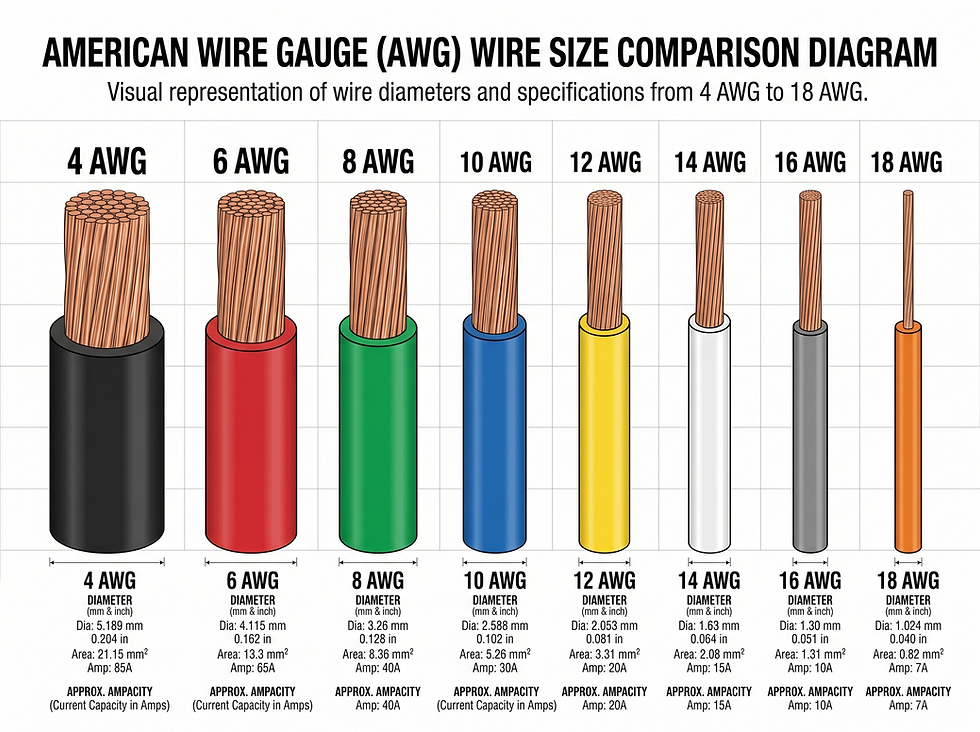
8 AWG Wire Diameter — mm, Inches & mm² Conversion
Once you're confident you're talking about AWG specifically, the numbers become exact and predictable. Here's what 8 AWG measures out to across the units you're most likely to encounter.
Specification | Value |
AWG size | 8 AWG |
Diameter (inches) | 0.1285 in |
Diameter (mm) | 3.264 mm |
Cross-sectional area (mm²) | ~8.37 mm² |
Cross-sectional area (circular mils) | 16,510 CM |
Nearest metric cable equivalent | 8 mm² or 10 mm² (rounded, market-dependent) |
Approximate weight (copper, per 100 ft) | ~5.03 lbs |
A few practical notes on this table:
Stranded vs. solid conductors of the same AWG size have essentially the same electrical cross-sectional area, but stranded cable has a slightly larger overall outer diameter due to the air gaps between individual strands and the jacket thickness. If you're matching a connector or conduit fill to a diameter spec, always confirm whether the number you're working from is for solid or stranded construction.
mm² conversion is never a perfect round number. This is why metric markets often round 8 AWG up or down to the nearest standard metric cable size (commonly 8 mm² or 10 mm²) rather than manufacturing an exact-equivalent cable. That rounding can create a small under- or over-rating depending on which direction the supplier rounds.
Circular mils remain the standard unit for ampacity calculations in NEC-based tables, which is why US electricians and engineers often think in circular mils even when a spec sheet is labeled in AWG.
8 AWG Ampacity & Current-Carrying Capacity
Diameter tells you how thick the wire is; ampacity tells you how much current it can safely carry without overheating the insulation. These are related but distinct specifications, and conflating them is one of the more consequential mistakes in wire selection.
Per common NEC-based ampacity tables (values vary by insulation type, ambient temperature, and installation method — always verify against the applicable code table for your project):
Copper 8 AWG, 60°C insulation: approximately 40 amps
Copper 8 AWG, 75°C insulation: approximately 50 amps
Copper 8 AWG, 90°C insulation: approximately 55 amps
Aluminum 8 AWG: generally rated lower than copper at the same gauge, due to aluminum's higher resistivity
These figures assume free air or standard conduit conditions with no more than three current-carrying conductors bundled together. Ampacity drops with derating factors such as:
Ambient temperature above 30°C (86°F) — high-heat environments reduce the safe current rating
Conductor bundling — more than three current-carrying conductors in a single conduit or cable triggers derating factors under most electrical codes
Continuous vs. non-continuous load — continuous loads (running 3+ hours) typically require sizing at 80% of the wire's rated ampacity as a safety margin
Insulation temperature rating — 60°C, 75°C, and 90°C insulated cable of the same AWG size will have different ampacity limits even though the copper conductor is physically identical
This is also where solar and photovoltaic cable specifications diverge meaningfully from general building wire. PV cable is typically rated for higher continuous operating temperatures (often 90°C or higher) and outdoor UV exposure, which changes both the ampacity and the expected service life compared to standard THHN/THWN building wire of the same AWG size.
AWG vs SWG — Key Differences by Region
Because so much cable sourcing now happens across borders, understanding where each gauge standard is expected to appear matters as much as understanding the numbers themselves.
United States and Canada: AWG is the near-universal standard for building wire, automotive cable, and most industrial applications.
United Kingdom (historical) and some Commonwealth markets: SWG appears in older documentation and some legacy industries, though most modern UK and EU electrical work has shifted to metric mm² sizing rather than either gauge system.
Europe, and most of Asia including China: Cable is specified almost exclusively in mm², not AWG or SWG. When a Chinese manufacturer quotes "10 mm² cable" as the equivalent of 8 AWG, that's a rounded approximation, not an exact match — worth confirming against your project's tolerance requirements.
Solar and renewable energy markets globally: Because major PV component manufacturers (inverters, connectors, combiner boxes) are often designed to metric or mixed standards, solar cable is frequently available in both AWG and mm² sizing, which is one of the more common places installers encounter direct AWG-to-metric conversion questions.
If you're sourcing internationally, don't rely on a supplier's stated "equivalent" without checking the underlying mm² or diameter figure yourself — rounding conventions differ by manufacturer, and a 5–10% variance in cross-sectional area can be the difference between a code-compliant installation and an undersized one.
8 AWG Wire Applications
8 AWG sits in a practical middle ground — thick enough for meaningful current-carrying applications, but still manageable to route and terminate without specialized heavy-cable tooling. Common applications include:
Sub-panel and feeder circuits in residential and light commercial electrical systems
Electric range, dryer, and large appliance circuits in many jurisdictions
Automotive and marine battery cable, particularly in high-draw accessory circuits
Welding cable, where flexibility and high strand count matter as much as gauge
Solar PV string and combiner wiring, especially in mid-sized residential and small commercial arrays
In photovoltaic installations specifically, 8 AWG solar cable is commonly used in string-to-combiner-box runs and DC home-run wiring, where system designers are balancing current capacity, voltage drop over cable run length, and outdoor durability. Solar-rated cable at this gauge typically uses cross-linked polyolefin (XLPO) or similar UV- and weather-resistant insulation rather than standard PVC, since it's expected to remain outdoors and exposed to temperature cycling for the 20–30 year lifespan of a typical solar installation.
How to Choose the Right Wire Gauge for Your Project
Selecting the correct gauge isn't just about matching a number on a chart — it's a decision that balances several interacting factors.
1. Start With Load Requirements, Not Wire on Hand
Calculate the actual current draw of the circuit first. Sizing a wire based on what's available or what "seems about right" is one of the most common causes of undersized installations.
2. Account for Voltage Drop Over Distance
Longer cable runs lose more voltage, which can push you toward a thicker gauge than ampacity alone would suggest — this is especially relevant in solar installations where string runs can extend well beyond typical building wiring distances.
3. Match Insulation Rating to the Environment
An 8 AWG conductor rated for 90°C insulation carries more current safely than the same copper rated for 60°C insulation. Outdoor, high-heat, or direct-burial applications typically require higher-temperature or specifically rated cable jackets.
4. Confirm the Gauge Standard With Your Supplier
If you're sourcing across borders, explicitly ask whether a quoted size is AWG, SWG, or mm² — don't assume the "gauge" label defaults to the American
standard.
5. Verify Certification for Your Market
Cable destined for different regions often needs different compliance marks — UL for North America, TÜV for much of Europe, CE marking, or country-specific approvals. A cable that's electrically equivalent but lacks the correct certification can still hold up customs clearance or fail inspection.
Common mistakes to avoid:
Assuming "8 gauge" always means 8 AWG without confirming the source standard
Sizing wire for continuous loads using the standard (non-derated) ampacity rating
Ignoring voltage drop on long runs, particularly in solar and off-grid systems
Mixing aluminum and copper ampacity tables interchangeably
Purchasing cable based on a rounded metric "equivalent" without checking actual mm²
Frequently Asked Questions
Is 8 AWG bigger than 10 AWG?
Yes. AWG uses an inverse numbering scale, so a lower number indicates a thicker wire. 8 AWG has a larger diameter and greater current-carrying capacity than 10 AWG.
What gauge is 8 AWG equivalent to in metric sizing?
8 AWG has a cross-sectional area of approximately 8.37 mm². Depending on the manufacturer's rounding convention, it's commonly sold as a rounded equivalent to 8 mm² or 10 mm² metric cable — always verify the exact mm² figure rather than relying on the rounded label alone.
Is American Wire Gauge the same everywhere?
No. AWG is the standard in the US and Canada, but many other regions, including most of Europe and Asia, size cable in mm² instead. The historical British SWG standard also assigns different diameters to the same gauge number as AWG.
What is 8 AWG wire typically used for?
8 AWG is commonly used for sub-panel feeders, large household appliance circuits, automotive and marine battery cable, welding cable, and mid-sized solar PV string and combiner wiring.
How thick is 8 gauge wire in millimeters?
Assuming "8 gauge" refers to 8 AWG, the conductor diameter is approximately 3.264 mm, with a cross-sectional area of roughly 8.37 mm².
Can I use 8 AWG copper wire for a 50-amp circuit?
It depends on the insulation temperature rating and installation conditions. 8 AWG copper with 75°C-rated insulation is commonly rated around 50 amps under standard conditions, but derating factors for ambient temperature, bundling, and continuous load can lower that figure — always confirm against the applicable code table for your specific installation.
Conclusion
So, is 8 AWG the same as 8 gauge wire? In the vast majority of real-world contexts — particularly across North America and in most solar and electrical sourcing conversations — yes, "8 gauge" is simply informal shorthand for 8 AWG, and the two terms describe the same conductor size. The exceptions arise when you're working across gauge standards like SWG, or converting between AWG and metric mm² sizing used throughout Europe and Asia.
The safest approach is to never rely on the word "gauge" alone. Confirm the standard, check the exact diameter or cross-sectional area, and verify the ampacity rating against the insulation type and installation conditions for your specific project — especially when sourcing cable internationally or specifying solar and PV wiring where outdoor durability and long service life raise the stakes of getting it wrong.
Need 8 AWG Solar Cable You Can Trust the Specs On?
FRCABLE manufactures UL- and TÜV-certified solar and photovoltaic cable with precise, verified AWG and mm² specifications — so you never have to guess at a rounded "equivalent." Whether you're sourcing string cable, combiner wiring, or full project quantities, our engineering team can confirm exact conductor sizing, ampacity, and certification requirements for your target market before you order.


Comments