
8 AWG Wire in mm: Diameter, Cross-Section, Ampacity & Conversion Chart

Introduction
If you are working with electrical cables, solar wiring, battery systems, or international cable specifications, you may often need to convert 8 AWG wire in mm. The quick answer is simple: 8 AWG wire has a conductor diameter of approximately 3.264 mm and a cross-sectional area of about 8.37 mm².
However, there is one important detail many buyers miss: 8 AWG is not exactly the same as 10 mm² cable, although 10 mm² is often used as the nearest common metric equivalent in commercial cable selection.
This difference matters when you are choosing cables for solar systems, DC battery wiring, inverters, control panels, automotive power connections, or industrial electrical projects. A small misunderstanding between AWG, mm, and mm² can lead to incorrect cable sizing, higher voltage drop, overheating risk, or compliance problems.
In this guide, FRCABLE explains 8 AWG wire size in mm, its cross-sectional area, ampacity, metric equivalent, common applications, and how to choose the right cable for your project.

Quick Answer: What Is 8 AWG Wire in mm?
8 AWG wire is approximately 3.264 mm in conductor diameter and about 8.37 mm² in cross-sectional area. In practical metric cable selection, it is commonly compared with 10 mm² cable, but the two sizes are not identical.
Parameter | 8 AWG Wire Value |
AWG size | 8 AWG |
Conductor diameter | Approx. 3.264 mm |
Conductor diameter | Approx. 0.1285 inch |
Cross-sectional area | Approx. 8.37 mm² |
Common metric equivalent | 10 mm² |
Common conductor materials | Copper, tinned copper, aluminum |
Typical applications | Solar cable, battery cable, inverter cable, power cable |
The most important point is this: mm measures diameter, while mm² measures cross-sectional area. These two values are related, but they are not the same.
Many users search “8 AWG to mm” when they actually need “8 AWG to mm².” If you are comparing cable capacity, ampacity, voltage drop, and resistance, the mm² value is usually more important than diameter alone.
8 AWG Diameter in mm: Understanding the Physical Size
The 8 AWG diameter in mm is approximately 3.264 mm for a solid round conductor. This is the bare conductor diameter, not necessarily the total cable outside diameter.
8 AWG Diameter vs Cable Outer Diameter
A common mistake is assuming that the 3.264 mm value represents the full cable diameter. It does not.
The actual outside diameter of an 8 AWG cable depends on:
Insulation material
Insulation thickness
Single-core or multi-core structure
Solid or stranded conductor design
Sheath material
Voltage rating
Cable standard
For example, an 8 AWG solar cable with XLPO insulation will usually have a larger outer diameter than a bare 8 AWG copper conductor. A battery cable with flexible insulation may also have a different outside diameter from a THHN building wire.
Solid 8 AWG Wire Diameter
A solid 8 AWG conductor has one single metal core. Its conductor diameter is easier to define because the cross-section is a solid circular shape.
Solid wire is often used in fixed electrical installations where flexibility is not the main concern. However, it is usually less flexible than stranded wire and may not be ideal for vibration-prone applications.
8 AWG Stranded Wire Diameter
The 8 AWG stranded wire diameter can be more complicated. The total metal cross-sectional area may still equal approximately 8.37 mm², but the physical bundle diameter can vary depending on the number of strands and stranding pattern.
For example, a flexible stranded copper cable may use many fine copper strands. This improves flexibility, but the conductor bundle may not have the exact same compact diameter as a solid conductor.
That is why engineers and buyers should check the manufacturer’s datasheet instead of relying only on a generic AWG chart.
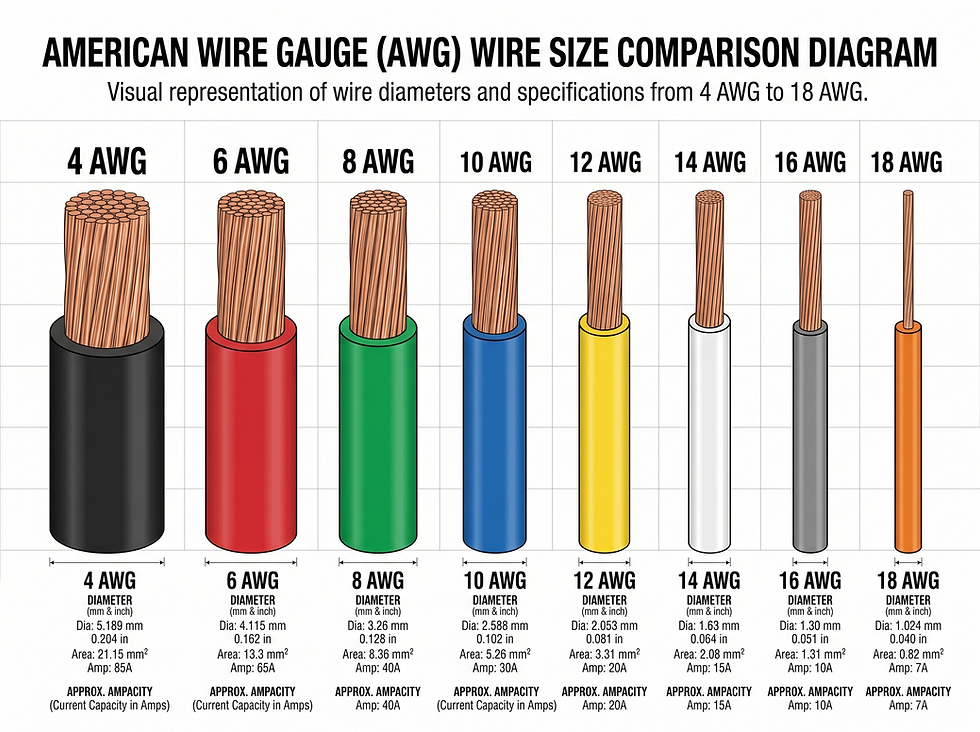
8 AWG to mm²: Cross-Section Explained
When people ask for 8 AWG wire mm2, they usually want to know the conductor’s cross-sectional area. For 8 AWG, the area is approximately 8.37 mm².
This value is important because cross-sectional area directly affects:
Current carrying capacity
Electrical resistance
Heat generation
Voltage drop
Mechanical strength
Cable weight
Suitability for DC or AC power systems
Why mm² Matters More Than Diameter
Cable performance is closely related to cross-sectional area. A larger cross-sectional area allows the conductor to carry more current with lower resistance.
For example, if two cables have the same material and insulation rating, the cable with the larger conductor area usually has:
Lower resistance
Lower voltage drop
Better current capacity
Less heat under the same load
Better performance over longer cable runs
This is especially important in solar PV systems, battery banks, and inverter connections, where DC current and voltage drop can significantly affect system efficiency.
8 AWG to Square mm Formula
For a round conductor, the cross-sectional area can be calculated using:
Area = π × diameter² / 4
Using the approximate 8 AWG conductor diameter of 3.264 mm:
Area ≈ 3.1416 × 3.264² / 4Area ≈ 8.37 mm²
This is why 8 AWG is often listed as 8.36 mm² or 8.37 mm², depending on rounding.
8 AWG Equivalent in mm²
The exact equivalent of 8 AWG is about 8.37 mm². However, metric cable systems usually use standardized sizes such as 6 mm², 10 mm², 16 mm², and 25 mm².
Since 8.37 mm² is not a common metric cable size, buyers often choose 10 mm² cable as the nearest commercial metric equivalent.

Is 8 AWG the Same as 10 mm² Cable?
No, 8 AWG is not exactly the same as 10 mm² cable. This is one of the most important points in any 8 AWG wire conversion.
8 AWG has an area of about 8.37 mm², while 10 mm² cable has a larger conductor area. This means 10 mm² cable normally has lower resistance and may support better current performance, depending on the cable type and installation conditions.
8 AWG vs 10 mm² Cable
Comparison Item | 8 AWG Wire | 10 mm² Cable |
Measurement system | American Wire Gauge | Metric system |
Cross-sectional area | Approx. 8.37 mm² | 10 mm² |
Which is larger? | Smaller | Larger |
Common use | US-style cable sizing | IEC/metric cable sizing |
Replacement relationship | Not exactly equal | Often nearest metric equivalent |
Buyer note | Check ampacity and standard | Check datasheet and compliance |
If your project specification requires 8 AWG, do not automatically replace it with 10 mm² unless the project engineer, code requirement, or equipment manufacturer allows it.
If your project specification requires 10 mm², using 8 AWG may be risky because 8 AWG has a smaller conductor area.
When 10 mm² May Be a Better Choice
In many international projects, 10 mm² may be selected instead of 8 AWG because it is a standard metric size and offers a larger conductor area.
10 mm² may be preferred when:
The system follows IEC or metric cable standards
A little extra conductor area is beneficial
Voltage drop needs to be reduced
The cable run is relatively long
The buyer wants a standard metric inventory size
The supplier’s product range is based on mm² instead of AWG
When You Should Stay with 8 AWG
You should stay with 8 AWG when:
The equipment manual specifically requires 8 AWG
The project is designed under AWG-based specifications
The cable is part of a UL or NEC-governed installation
The terminal size is designed for 8 AWG
The purchasing document clearly requests 8 AWG
For international cable procurement, the safest approach is to confirm both the AWG size and mm² equivalent before ordering.

8 AWG Wire Ampacity: How Many Amps Can It Carry?
The 8 AWG wire ampacity depends on many factors. There is no single amp rating that applies to every 8 AWG cable in every installation.
Ampacity is affected by:
Copper or aluminum conductor
Insulation temperature rating
Ambient temperature
Number of current-carrying conductors
Installation method
Conduit fill
Free air or enclosed installation
AC or DC system design
Local electrical code
Terminal temperature rating
As a general reference, 8 AWG copper conductors are often discussed in the range of 40–55 amps, depending on the temperature column and installation conditions. However, final cable selection should always follow the applicable electrical code, manufacturer datasheet, and engineering calculation.
8 AWG Copper Wire Ampacity
Copper has better conductivity than aluminum, so an 8 AWG copper wire typically carries more current than an 8 AWG aluminum wire under comparable conditions.
Copper is often preferred for:
Solar PV cable
Battery cable
Inverter cable
Electrical panels
Industrial power connections
Marine and automotive wiring
For demanding environments, tinned copper may be selected to improve corrosion resistance, especially in outdoor, marine, or humid installations.
8 AWG Aluminum Wire Ampacity
Aluminum is lighter and often more cost-effective than copper, but it has higher resistance. For the same ampacity, aluminum conductors usually need a larger size compared with copper.
If a project originally specifies 8 AWG copper, do not replace it with 8 AWG aluminum without recalculating ampacity, voltage drop, terminal compatibility, and code requirements.
8 AWG Wire Current Rating in Real Applications
In real projects, current rating should not be judged only by the AWG number. For example, an 8 AWG solar cable installed outdoors on a rooftop may face high temperature, UV exposure, and long cable runs. A battery cable inside an enclosure may face heat buildup and high DC current.
That is why FRCABLE recommends checking:
Required load current
System voltage
Cable length
Permitted voltage drop
Installation environment
Cable insulation temperature rating
Applicable standard or certification
Terminal and connector rating
This process helps avoid undersized cables and improves long-term system reliability.
8 AWG Wire Applications: Solar, Battery, Inverter and DC Power
8 AWG cable is widely used in power systems where moderate current capacity and manageable flexibility are required. It is larger than 10 AWG and smaller than 6 AWG, making it a practical middle-size conductor for many electrical applications.
8 AWG Solar Cable
An 8 AWG solar cable may be used in photovoltaic systems where the current, voltage drop, and cable length require a larger conductor than smaller sizes such as 10 AWG or 12 AWG.
Solar cable selection should consider:
PV system voltage
String current
Maximum short-circuit current
Rooftop temperature
UV exposure
Outdoor durability
XLPO or similar insulation
Connector compatibility
Voltage drop target
For solar applications, cable insulation is just as important as conductor size. A cable used outdoors should be designed for sunlight resistance, weather exposure, and long service life.
8 AWG Battery Cable
An 8 AWG battery cable is commonly used in DC systems, backup power setups, RV systems, automotive wiring, and small inverter connections.
Battery cables often need flexibility because they may be routed through tight spaces or connected to equipment that experiences vibration.
Important battery cable considerations include:
Fine-stranded copper conductor
Flexible insulation
Correct lug size
Proper crimping
Heat resistance
Short-circuit protection
Voltage drop control
In low-voltage DC systems, voltage drop can become a major issue. Even if the cable ampacity is acceptable, the cable may still be too small if the run is long.
8 AWG Wire for Inverter Connection
An 8 AWG wire for inverter connection may be suitable for some small to medium power systems, but the correct size depends on inverter wattage, DC voltage, surge current, and cable length.
For example, a 12V inverter system draws much higher current than a 48V inverter system at the same power level. This means cable sizing for low-voltage DC systems must be calculated carefully.
8 AWG Cable for DC Power Systems
8 AWG cable is often used in DC power distribution because it offers a balance between size, flexibility, and current capacity.
Common DC applications include:
Solar charge controllers
Battery banks
Inverters
DC distribution panels
RV electrical systems
Marine power systems
Automotive auxiliary power
UPS and backup systems
For DC systems, always check voltage drop. A cable that is safe from overheating may still be inefficient if the voltage drop is too high.
AWG to mm Conversion Chart
The following chart compares common AWG sizes with approximate metric cross-sectional areas and common metric equivalents.
AWG Size | Diameter Approx. | Area Approx. | Common Metric Equivalent |
12 AWG | 2.05 mm | 3.31 mm² | 4 mm² |
10 AWG | 2.588 mm | 5.26 mm² | 6 mm² |
8 AWG | 3.264 mm | 8.37 mm² | 10 mm² |
6 AWG | 4.115 mm | 13.3 mm² | 16 mm² |
4 AWG | 5.189 mm | 21.2 mm² | 25 mm² |
2 AWG | 6.544 mm | 33.6 mm² | 35 mm² |
1 AWG | 7.348 mm | 42.4 mm² | 50 mm² |
This table is useful for quick reference, but it should not replace engineering judgment. Cable performance depends on conductor material, insulation type, installation method, and electrical standard.
8 AWG vs 6 AWG
6 AWG is larger than 8 AWG. It has lower resistance and can usually carry more current, depending on the installation.
Choose 6 AWG instead of 8 AWG when:
Current is higher
Cable run is longer
Voltage drop must be reduced
Equipment manual specifies 6 AWG
Future capacity expansion is expected
8 AWG vs 10 AWG
8 AWG is larger than 10 AWG. It has more conductor area and lower resistance.
Choose 8 AWG instead of 10 AWG when:
Load current is higher
The installation requires better voltage drop performance
The cable length is longer
The application involves battery or inverter wiring
The project specification requires 8 AWG
8 AWG vs 8 mm² Cable
8 AWG is about 8.37 mm², so it is slightly larger than 8 mm² cable. However, 8 mm² is not always a standard cable size in every market.
In many purchasing situations, buyers compare 8 AWG with 10 mm² rather than 8 mm² because 10 mm² is a more common metric cable size.
How to Choose the Right 8 AWG Cable
Choosing the right 8 AWG cable is not only about converting AWG to mm. A correct cable choice should consider electrical performance, environment, compliance, and long-term reliability.
Step-by-Step Cable Selection Process
Confirm the required current
Identify the continuous current, peak current, and safety margin.
Check the system voltage
Low-voltage DC systems often require larger cables to reduce voltage drop.
Measure the cable length
Longer cable runs increase resistance and voltage drop.
Choose conductor material
Copper offers better conductivity; aluminum may reduce cost and weight.
Select insulation type
Consider temperature, UV exposure, flame resistance, flexibility, and chemical resistance.
Verify ampacity
Check the applicable ampacity table, installation condition, and derating factors.
Check terminals and connectors
Make sure lugs, breakers, connectors, and equipment terminals accept the selected cable size.
Confirm standards and certifications
Depending on the market, you may need UL, IEC, TÜV, RoHS, or other compliance requirements.
Request a manufacturer datasheet
Always verify conductor construction, insulation thickness, outer diameter, resistance, and voltage rating.
Consult a qualified engineer when needed
For high-current, code-regulated, or safety-critical systems, professional verification is essential.
Common Mistakes When Buying 8 AWG Cable
Many cable selection problems happen because buyers focus only on one number.
Avoid these common mistakes:
Confusing conductor diameter with cable outside diameter
Assuming 8 AWG equals exactly 10 mm²
Ignoring voltage drop in DC systems
Using copper ampacity values for aluminum cable
Forgetting temperature derating
Choosing cable without checking terminal compatibility
Selecting indoor cable for outdoor solar applications
Buying based only on price per meter
Ignoring insulation material and voltage rating
Replacing AWG cable with metric cable without engineering approval
A cable may look similar from the outside, but its internal conductor structure, insulation quality, and certification can make a major difference in performance.
What to Ask a Cable Manufacturer
Before purchasing 8 AWG cable, ask the supplier for:
Conductor material
Conductor diameter
Cross-sectional area
Number of strands
Insulation material
Cable outside diameter
Voltage rating
Temperature rating
Ampacity reference
Applicable standards
MOQ and lead time
Custom printing options
Packaging method
Test reports or certificates
FRCABLE can support buyers with cable selection, customization, and manufacturing for solar cable, PV cable, battery cable, power cable, and other electrical cable applications.
8 AWG Cable Buying Guide for International Projects
International buyers often face confusion because AWG and metric cable systems are used in different markets.
The United States commonly uses AWG sizing, while many international projects use metric sizes such as mm². If a project involves imported equipment, international contractors, or mixed documentation, conversion must be handled carefully.
For US-Based Specifications
If the specification uses AWG, confirm:
Exact AWG size
Copper or aluminum conductor
Insulation type
Temperature rating
NEC-related requirements
Terminal compatibility
Listed or certified cable type
Do not replace 8 AWG with a random metric size without approval.
For IEC or Metric Specifications
If the specification uses mm², confirm:
Required conductor area
Voltage rating
Cable class
Insulation and sheath material
Flame-retardant or halogen-free requirements
Environmental conditions
Required certification
For example, if the document requires 10 mm² cable, 8 AWG may be close but smaller. The safer approach is to use the specified metric size unless engineering approval allows another option.
For Solar and Renewable Energy Projects
Solar projects need special attention because cables may operate outdoors for many years.
A good solar cable should offer:
UV resistance
Weather resistance
Suitable temperature rating
Low smoke or halogen-free performance where required
Flexible stranded copper conductor
Stable insulation material
Reliable long-term electrical performance
For PV systems, the cable is not just a conductor. It is part of the system’s long-term safety and energy efficiency.
FAQ About 8 AWG Wire in mm
What is 8 AWG wire in mm?
8 AWG wire is approximately 3.264 mm in conductor diameter. This refers to the bare conductor diameter, not the total insulated cable outside diameter.
What size is 8 AWG wire in mm²?
8 AWG wire has a cross-sectional area of approximately 8.37 mm². This value is more useful than diameter when comparing ampacity, resistance, and voltage drop.
Is 8 AWG the same as 10 mm² cable?
No. 8 AWG is about 8.37 mm², while 10 mm² cable is larger. However, 10 mm² is often used as the nearest common metric equivalent.
How many mm is 8 AWG wire?
The conductor diameter of 8 AWG wire is about 3.264 mm.
What is the nearest metric size to 8 AWG?
The nearest common commercial metric size is usually 10 mm², although the exact area of 8 AWG is about 8.37 mm².
How many amps can 8 AWG wire carry?
The ampacity of 8 AWG wire depends on conductor material, insulation rating, ambient temperature, installation method, and local electrical code. For copper conductors, 8 AWG is often discussed in the range of 40–55 amps depending on conditions, but the final value must be verified for the specific installation.
Is 8 AWG wire good for solar systems?
8 AWG wire can be suitable for some solar systems, especially where current and voltage drop requirements justify a larger conductor. However, solar cable selection should also consider UV resistance, temperature rating, insulation material, voltage rating, and connector compatibility.
Can I use 8 AWG wire for battery connection?
Yes, 8 AWG wire can be used for some battery connections, but the correct size depends on current, voltage, cable length, and acceptable voltage drop. Low-voltage battery systems often require careful sizing because current can be high.
What is the difference between 8 AWG and 10 AWG?
8 AWG is larger than 10 AWG. It has more conductor area, lower resistance, and generally better current-carrying ability under comparable conditions.
What is the difference between 8 AWG and 6 AWG?
6 AWG is larger than 8 AWG. It is usually selected for higher current, longer cable runs, or lower voltage drop requirements.
What is 8 AWG copper wire in mm?
8 AWG copper wire has the same standard conductor diameter of approximately 3.264 mm and an area of about 8.37 mm². Copper refers to the conductor material, not a different AWG size.
What is 8 AWG stranded wire diameter in mm?
The total conductor area remains about 8.37 mm², but the physical bundle diameter of stranded wire may vary depending on strand count and construction. Always check the manufacturer datasheet.
Can I replace 8 AWG with 10 mm² cable?
In many cases, 10 mm² is larger and may be acceptable as a metric alternative, but replacement should be confirmed against the project specification, terminal size, electrical code, and equipment requirements.
How do I choose between AWG and metric cable sizes?
Use the cable size system required by the project standard. If the project is AWG-based, follow AWG specifications. If it is metric-based, follow mm² specifications. For international projects, ask the cable manufacturer to provide both AWG and metric data.
Where can I buy 8 AWG cable?
You can buy 8 AWG cable from professional cable manufacturers and suppliers. FRCABLE provides cable solutions for solar cable, PV cable, battery cable, power cable, and custom cable requirements.
Conclusion
Understanding 8 AWG wire in mm is essential when comparing American Wire Gauge sizes with metric cable specifications. The key values are simple: 8 AWG wire is approximately 3.264 mm in diameter and about 8.37 mm² in cross-sectional area.
However, cable selection should not stop at conversion. In real projects, you also need to consider ampacity, conductor material, insulation type, voltage drop, installation environment, temperature rating, and applicable electrical standards.
The most common metric comparison for 8 AWG is 10 mm² cable, but this does not mean the two are exactly the same. 8 AWG is smaller than 10 mm², so any substitution should be checked carefully.
For solar systems, battery connections, inverter wiring, and DC power applications, choosing the right cable size can improve safety, efficiency, and long-term reliability.
CTA Closing
Need help selecting the right 8 AWG cable or metric equivalent for your project?
FRCABLE provides professional cable manufacturing and customization support for solar cable, PV cable, battery cable, power cable, and electrical wiring solutions. Whether you need 8 AWG cable, 10 mm² cable, or a custom specification, our team can help you compare conductor size, insulation type, voltage rating, ampacity, and application requirements.
Contact FRCABLE today to request a cable datasheet, quotation, or professional cable selection support for your next projec


Comments