
How Many Strands Are in 8 Gauge Wire? A Complete 8 AWG Wire Guide

If you are wondering how many strands are in 8 gauge wire, the most accurate answer is: there is no single universal strand count.
An 8 AWG conductor can be solid or made from multiple smaller copper strands. Depending on the conductor design, flexibility class, manufacturing standard, and intended application, an 8 gauge stranded wire may contain 7 strands, 19 strands, or dozens to more than 100 finer strands.
For example, commercially manufactured 8 AWG copper conductors are available in 7-strand and 19-strand constructions, while flexible 8 AWG products can use 84, 133, or 168 strands.
The key point is simple:
8 AWG describes the conductor size—not one fixed number of strands.
Understanding this distinction matters when selecting electrical wire for power distribution, photovoltaic systems, battery connections, industrial equipment, and other applications where flexibility, termination, resistance, and cable construction all influence performance.
How Many Strands Are in 8 Gauge Wire?
Quick Answer: 8 AWG Does Not Have One Fixed Strand Count
So, how many strands are in 8 gauge wire?
Common examples include:
1 conductor for solid 8 AWG wire
7 strands in certain concentric-lay stranded conductors
19 strands in many stranded 8 AWG constructions
84, 133, 168, or other higher strand counts in more flexible conductor designs
These are examples rather than a universal rule. Southwire, for instance, specifies a 7-strand Class B 8 AWG bare copper conductor, while its 8 AWG THHN/THWN-2 copper product uses 19 strands. Its flexible MTW range also lists 8 AWG constructions with 84, 133, and 168 strands.
That means two cables can both legitimately be labeled 8 AWG while having very different internal strand structures.
Common 8 AWG Strand Count Examples
8 AWG Construction | Example Strand Count | Relative Flexibility | Typical Design Characteristic |
Solid conductor | 1 | Low | Single continuous conductor |
Concentric stranded | 7 | Moderate | Fewer, relatively larger strands |
Stranded conductor | 19 | Higher | Common multi-strand construction |
Fine-stranded conductor | 84+ | High | Many smaller individual strands |
Extra-flexible construction | 133–168+ | Very high | Designed where increased flexibility is required |
The exact construction must always be verified from the manufacturer's datasheet, conductor specification, or cable standard rather than inferred from the AWG number alone.
Why There Is No Universal 8 AWG Strand Count
The American Wire Gauge designation primarily describes conductor size. ASTM B258 establishes nominal diameters and cross-sectional areas for AWG sizes of solid round electrical conductors, while standards such as ASTM B8 separately address the construction of concentric-lay-stranded copper conductors.
This distinction explains why asking only for the gauge number does not reveal the complete conductor construction.
A useful way to think about it is:
AWG answers “How large is the conductor?” while strand count answers “How is that conductor constructed?”
What Does 8 AWG Mean?

8 AWG Refers to Conductor Size, Not Cable Diameter
8 AWG, or 8 gauge wire, belongs to the American Wire Gauge system used to describe electrical conductor size.
A nominal 8 AWG conductor has a cross-sectional area of approximately 8.37 mm². NIST technical documentation uses 8 AWG as equivalent to approximately 8.37 mm².
However, this value relates to the conductive cross-sectional area—not the overall outside diameter of an insulated cable.
The finished cable diameter can vary substantially depending on:
insulation thickness
jacket construction
shielding
conductor stranding
voltage rating
temperature rating
environmental protection requirements
Therefore, 8 AWG wire size and 8 AWG cable outside diameter are not the same specification.
How Stranded 8 AWG Wire Is Constructed
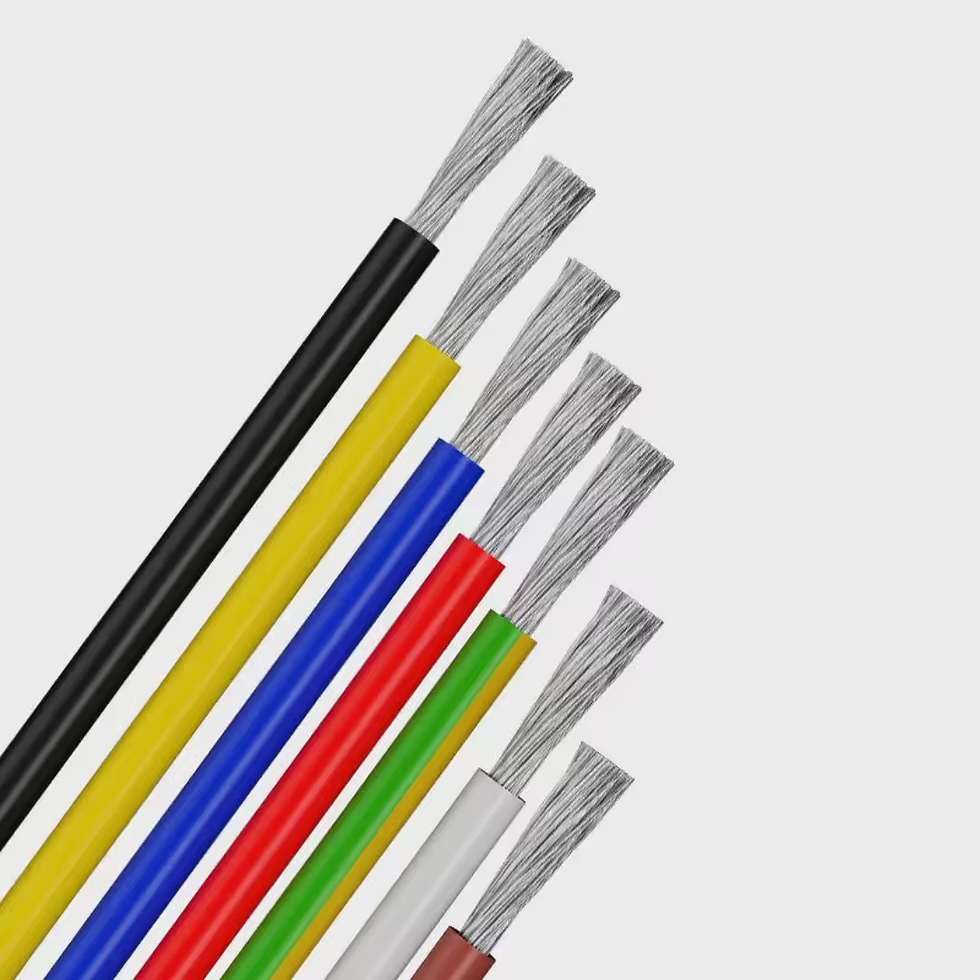
Instead of using one solid piece of copper, a stranded conductor divides the conductive material into multiple individual wires that are twisted, bunched, or concentrically laid together.
ASTM B8 describes concentric-lay-stranded copper conductors as constructions with a central core surrounded by one or more helically laid layers of wire. The standard also distinguishes conductor classes according to construction and intended flexibility.
A 7-strand 8 AWG conductor therefore uses relatively few larger component wires, while an 84-strand or 168-strand conductor uses many much finer component wires to achieve the required overall conductor size.
Does Strand Count Change the AWG Size?
Not by itself.
An 8 AWG conductor remains an 8 AWG conductor when its compliant construction provides the required conductor size, even though manufacturers may achieve that construction using different strand configurations.
This is why comparing 8 AWG wire strand count without checking the conductor class and specification can be misleading.
For procurement and engineering decisions, buyers should review both:
8 AWG size + conductor construction
rather than relying on either parameter independently.

7-Strand vs. 19-Strand vs. Fine-Stranded 8 AWG Wire
7-Strand 8 AWG Wire
A 7-strand 8 AWG conductor typically consists of one central wire surrounded by six wires in a concentric arrangement.
Southwire lists an 8 AWG Class B bare copper construction with seven conductor strands, demonstrating that 7-strand 8 AWG is a valid commercial configuration.
Compared with very finely stranded wire, this structure is relatively simple and uses larger individual strands.
It can be suitable where significant repeated movement is not a primary requirement and where the applicable cable construction allows this strand class.
19-Strand 8 AWG Wire
19-strand 8 AWG wire is another widely encountered configuration.
For example, Southwire's SIMpull THHN/THWN-2 copper specification identifies 8 AWG conductors with 19 strands, while its MTW product range also includes a 19-strand 8 AWG flexible copper conductor.
Compared with a 7-strand construction, dividing the conductor into more individual wires can provide greater flexibility when other construction variables are comparable.
However, 19 strands should never be treated as the universal answer to how many strands are in 8 AWG wire.
Fine-Stranded 8 AWG Wire
Some applications require much greater conductor flexibility.
In these cases, manufacturers can construct 8 AWG conductors from substantially more individual copper strands. Southwire's MTW range, for example, lists 8 AWG constructions with 84, 133, and 168 strands in addition to a 19-strand option.
Fine-stranded designs can be useful where the cable must accommodate tighter routing, equipment movement, repeated handling, or installation conditions in which a relatively rigid conductor would be inconvenient.
The practical lesson for cable buyers is important:
A higher strand count primarily tells you something about conductor construction and flexibility. It does not automatically mean the cable is electrically superior.
How Does Strand Count Affect 8 AWG Wire Performance?
Flexibility and Bendability
One of the most important reasons for using more, finer strands is flexibility.
When the same conductor size is divided among a larger number of smaller wires, the resulting conductor can generally bend more readily than a comparable construction using fewer, larger strands.
That distinction can matter in:
equipment wiring
control cabinets
battery systems
photovoltaic installations
inverter connections
cable harnesses
industrial machinery
installations with limited routing space
ASTM conductor classifications recognize different constructions and flexibility requirements rather than treating all stranded copper conductors as identical.
Does More Strands Mean More Current Capacity?
No—not automatically.
This is one of the most common misconceptions about stranded copper wire.
When comparing conductors of the same nominal gauge, buyers should not assume that a wire with 100 strands can carry more current simply because another 8 AWG conductor has only 19 strands.
Current-carrying capability depends on the complete electrical and installation design, including conductor material, conductor size, insulation temperature rating, ambient conditions, installation method, number of current-carrying conductors, and the requirements of the applicable electrical code or standard.
Even among commercially manufactured 8 AWG products, conductor constructions and published electrical characteristics can differ, which is why the manufacturer's technical specification should govern product selection.
Terminals, Lugs, and Crimping Matter
Higher flexibility does not eliminate the need for correct termination.
The conductor must be compatible with the specified:
terminal
cable lug
connector
ferrule, where applicable
crimping tool
crimp profile
stripping dimension
Using an unsuitable terminal with fine-stranded wire can create a poor mechanical or electrical connection even if the conductor itself is correctly sized.
UL's Wire and Cable Application Guide emphasizes selecting certified wire and cable appropriate for the specific installation.
For this reason, strand count should be considered together with terminal compatibility and the manufacturer's installation requirements.
Resistance, Voltage Drop, and Cable Length
Strand count is also not a substitute for proper voltage-drop calculations.
When selecting 8 gauge copper wire for a long cable run, engineers should consider conductor resistance, circuit current, one-way cable length, system voltage, allowable voltage drop, and operating temperature.
A larger conductor may be selected in some installations to reduce resistive losses and voltage drop, but whether 8 AWG is appropriate must be determined from the actual circuit rather than from strand count alone.
Is 8 AWG Wire Suitable for Solar and Energy Storage Systems?
8 AWG Wire in Photovoltaic Applications
An 8 AWG wire can be used in certain solar applications, but AWG size alone does not make a cable suitable for photovoltaic service.
PV cable selection must also consider its insulation system, environmental durability, temperature rating, voltage rating, applicable certification, routing conditions, and project electrical design.
IEC 62930 applies to single-core cross-linked insulated power cables used on the DC side of photovoltaic systems with rated DC voltage up to and including 1.5 kV between conductors and between conductor and earth.
In the U.S. context, UL 4703 covers sunlight-resistant photovoltaic wire for interconnection wiring in photovoltaic power systems and includes specified voltage and temperature ratings within its scope.
Therefore, the correct question is not simply:
“Is 8 AWG big enough?”
It is:
“Does this 8 AWG cable meet the electrical, environmental, mechanical, and compliance requirements of this PV installation?”
Why Flexible Conductors Matter in PV Cable Routing
Photovoltaic installations often require cables to route around module frames, support structures, combiner boxes, inverter inputs, and other system components.
A suitably stranded copper conductor can make installation and routing more manageable, particularly where cable bends must be accommodated.
However, flexibility must still be balanced with:
minimum bend radius
connector compatibility
cable support
UV exposure
outdoor durability
mechanical protection
conductor temperature
voltage rating
IEC 62548-1 addresses PV array design considerations including DC array wiring, electrical protection, switching, and earthing provisions, reinforcing the need to treat cable selection as part of the complete PV system design.
8 AWG Solar Cable and FRCABLE
FRCABLE supplies photovoltaic cable solutions designed for solar DC connections, including products specified for IEC 62930 and UL 4703 requirements.
For buyers comparing 8 AWG solar cable, the strand count should therefore be evaluated alongside other specifications such as:
conductor material
insulation and sheath material
rated voltage
temperature performance
UV and weather resistance
applicable PV cable certification
required cable length
connector and termination system
installation environment
FRCABLE also provides dedicated guidance on whether 8 AWG wire can be used for solar panels, emphasizing that AWG size alone does not determine photovoltaic suitability.
How to Choose the Right 8 AWG Stranded Wire
A Practical 8 AWG Wire Selection Process
When purchasing 8 gauge stranded wire, avoid selecting a cable only because the product name contains “8 AWG.”
Instead, use the following sequence:
Define the application. Determine whether the cable is intended for photovoltaic systems, battery wiring, industrial machinery, building wiring, or another electrical application.
Confirm the required conductor size. Verify that 8 AWG satisfies the electrical design, including current, circuit length, voltage drop, and applicable installation rules.
Check the conductor material. Confirm whether the design requires bare copper, tinned copper, aluminum, or another approved conductor material.
Review strand construction and flexibility. Determine whether a conventional stranded conductor or fine-stranded flexible conductor is more suitable for the routing and movement requirements.
Verify insulation and environmental ratings. Consider voltage, temperature, moisture, sunlight, abrasion, and outdoor exposure where applicable.
Check the relevant standard or certification. For PV applications, specifications such as IEC 62930 or UL 4703 may be relevant depending on the market and installation.
Confirm connector and terminal compatibility. Verify that the strand construction, conductor diameter, lug, connector, and crimping system are designed to work together.
Compare the complete datasheet—not just strand count. Review conductor resistance, cable diameter, bend requirements, temperature rating, voltage rating, approvals, and installation limitations before ordering.
This process is far more reliable than choosing between 7-strand and 19-strand wire solely by counting individual conductors.
Common Mistakes When Buying 8 Gauge Wire
Avoid these common specification errors:
Assuming every 8 AWG wire contains 19 strands
Assuming a higher strand count automatically means higher ampacity
Confusing conductor diameter with finished cable outside diameter
Treating 8 AWG and a nearby metric cable size as automatically interchangeable
Choosing a cable without checking voltage-drop requirements
Ignoring terminal and connector compatibility
Using ordinary electrical wire where certified PV cable is required
Selecting wire based only on current rating without considering installation conditions
Ignoring insulation temperature and environmental ratings
Comparing prices without comparing conductor material and cable construction
FRCABLE's existing technical guidance on common 8 AWG selection mistakes likewise stresses that cable specifications must match the actual project requirements.
8 AWG vs. 10 AWG: Strand Count Is Not the Main Difference
Another common comparison is 8 AWG vs. 10 AWG wire.
The primary difference is conductor size—not the number of strands.
A manufacturer could produce both gauges using different stranded constructions, so buyers should not compare them using strand count alone.
When deciding between 8 AWG and 10 AWG, evaluate:
conductor cross-sectional area → circuit current → cable length → voltage drop → temperature → installation method → applicable standard
rather than asking which gauge has more strands.
Frequently Asked Questions About 8 AWG Wire Strand Count
How many strands are in 8 gauge wire?
There is no universal number of strands in 8 gauge wire.
Depending on conductor construction, an 8 AWG wire can be solid or stranded. Commercial examples include 7-strand, 19-strand, 84-strand, 133-strand, and 168-strand constructions.
Therefore, always check the manufacturer's cable specification when you need the exact 8 AWG strand count.
Is 8 AWG wire always 19 strands?
No.
Although 19-strand 8 AWG wire is a real and commonly available construction, it is not the only one. Southwire's product specifications demonstrate both 7-strand and 19-strand 8 AWG conductors as well as finer-stranded options.
The number of strands depends on how the conductor is engineered.
Is 19-strand 8 AWG more flexible than 7-strand 8 AWG?
When comparing otherwise similar constructions, dividing the conductor into more, smaller individual strands generally allows greater flexibility.
However, real cable flexibility also depends on the strand diameter, lay design, conductor class, insulation system, jacket material, and overall cable construction.
For that reason, strand count is a useful indicator—but not the only parameter engineers should use to compare cable flexibility.
Does a Higher Strand Count Make 8 AWG Wire Better?
Not necessarily.
A fine-stranded 8 AWG conductor may be preferable when flexibility is important, but a lower-strand-count conductor may be entirely appropriate for a fixed installation designed for that construction.
“Better” means better matched to the application, not simply more strands.
The correct choice should consider electrical performance, mechanical requirements, standards, installation method, environmental exposure, and termination compatibility.
Conclusion: How Many Strands Are in 8 Gauge Wire?
So, how many strands are in 8 gauge wire?
The technically correct answer is that 8 AWG does not have one fixed strand count. An 8 gauge conductor may be solid, 7-strand, 19-strand, or constructed from many more fine copper strands depending on its conductor class and intended application. Commercial 8 AWG products demonstrate this wide variation clearly.
What matters most is understanding that AWG defines conductor size, while strand count describes conductor construction.
For engineers, installers, distributors, and cable buyers, the best 8 AWG wire is therefore not automatically the cable with the most strands. It is the cable whose conductor material, strand design, electrical characteristics, insulation, certifications, flexibility, connectors, and environmental ratings match the application.
This distinction becomes especially important in photovoltaic and energy applications, where cable selection must be based on the complete system specification rather than gauge number alone. IEC 62930 and UL 4703 provide application-specific frameworks for photovoltaic cable and PV wire.
Need the Right 8 AWG Cable for Your Project?
FRCABLE provides professional cable solutions for photovoltaic, solar DC, and energy applications, with cable configurations designed around real project requirements rather than AWG size alone.
If you are selecting 8 AWG solar cable, stranded copper wire, PV cable, or customized cable assemblies, contact FRCABLE with your required voltage, cable length, conductor size, installation environment, certification requirements, and order quantity.
Talk to FRCABLE about your cable specification and get the right conductor construction for your application.


Comments