
How to Identify Different Types of Solar PV Connectors

Updated: 3 days ago
1. Introduction to Solar PV Connectors
Solar photovoltaic (PV) connectors play an important role in establishing reliable electrical connections throughout a solar power system. They connect solar panels to photovoltaic cables, join cable sections, create branch connections, and integrate protective components into DC circuits. Although they are relatively small components, their electrical and mechanical performance can directly affect the safety, efficiency, and long-term reliability of a PV installation.
Different solar projects require different connector configurations depending on the system design, cable routing, voltage level, current rating, and installation environment. For example, standard MC4 connectors are commonly used for connecting solar modules to PV cables, while Y-branch and T-branch connectors provide additional connection options for parallel and other branch wiring arrangements. In-line fuse connectors serve a different purpose by integrating overcurrent protection into designated PV circuits.
Choosing the right connector involves more than checking whether its plug fits another connector. The connector must be suitable for the cable's conductor cross-section, insulation diameter, voltage and current requirements, and environmental conditions. Compatibility between connector manufacturers and product families must also be verified.
This guide explains five common types of solar PV connectors, how they work with photovoltaic cables, where they are typically used, and what buyers and installers should consider when selecting them.

2. Five Common Types of PV Connectors and How They Are Used
PV connectors are available in different configurations to meet the connection requirements of residential, commercial, and utility-scale solar installations. The following five types illustrate some of the most common cable connection and protection applications.
2.1 MC4 Connectors – Standard Connections for Solar PV Cables
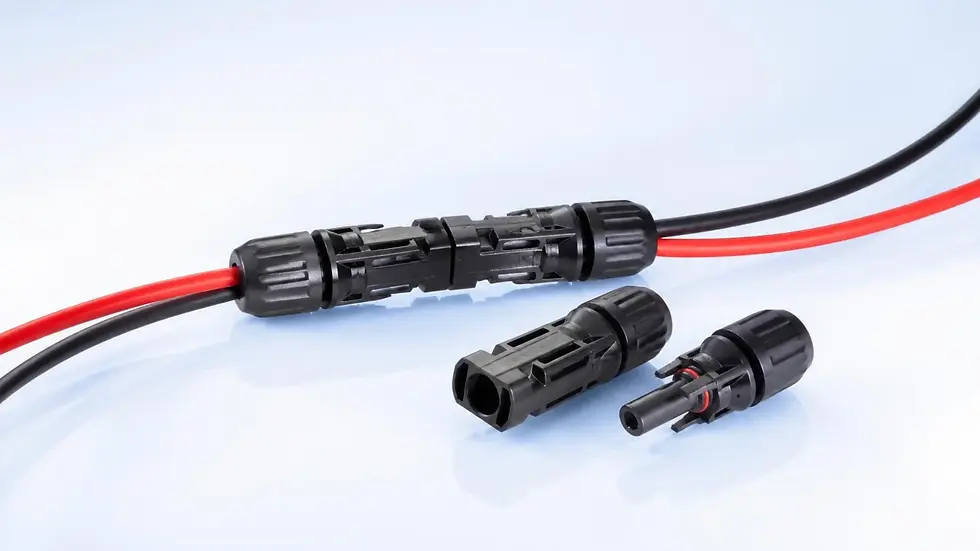
MC4 connectors are among the most widely recognized connector systems used in photovoltaic installations. They provide detachable electrical connections between solar modules, PV extension cables, and other compatible components in a solar DC circuit.
An MC4 connector pair consists of a pin contact and a socket contact housed in insulated connector bodies. In commercial product descriptions, these are commonly referred to as male and female connectors. The contacts are connected to the cable conductors through a specified crimping process, while the connector housings provide insulation, mechanical locking, and environmental protection when properly assembled and mated.
How MC4 Connectors Work with Solar Cables
Solar panels are generally supplied with factory-installed output cables and connectors. During installation, compatible extension cables can be connected to these outputs to establish the electrical path between individual modules and the rest of the PV system.
For example, a typical rooftop installation may require additional cable length to connect panels positioned across different sections of a roof. An installer can use appropriately assembled PV extension cables with matching MC4 connector systems to complete the connections without making an exposed conductor joint.
MC4 cable assemblies are also used in:
Connecting solar panel output cables to extension cables.
Connecting compatible modules within a photovoltaic string.
Connecting PV strings to suitable DC input equipment.
Extending cable routes between module arrays and inverter locations.
Common Applications
MC4 connectors are widely used in residential rooftop systems, commercial solar installations, and utility-scale photovoltaic projects. They are particularly useful when installers need standardized, secure, and weather-resistant connections between solar modules and PV cables.
What to Consider When Selecting MC4 Connectors
The connector must match the PV cable's conductor cross-section and outer diameter. For example, 4mm² and 6mm² photovoltaic cables are common in many solar installations, but not every connector model supports both sizes. The actual cable construction, conductor stranding, and insulation dimensions must be checked against the connector manufacturer's specifications.
It is also important to verify the connector's rated voltage, current, temperature range, and applicable certifications. A connector should always be assembled using the specified contact, crimping tool, and installation procedure.

2.2 MC4-Evo2 Connectors – High-Voltage Solar Cable Connections
MC4-Evo2 connectors are a specific connector product family developed for photovoltaic applications, including high-voltage DC systems. They are designed to provide secure electrical connections between compatible PV cables and solar power equipment.
Compared with conventional MC4 products, MC4-Evo2 connectors have their own product specifications, contact configurations, and assembly requirements. Certain MC4-Evo2 models are rated for 1500V DC applications under the applicable IEC and UL requirements, making them suitable for appropriately designed high-voltage solar installations.
How MC4-Evo2 Connectors Work with Solar Cables
In a large photovoltaic installation, multiple solar modules are connected in series to form a PV string. The string produces a higher DC voltage, and the output is transmitted through dedicated photovoltaic cables toward the inverter or combiner equipment.
MC4-Evo2 connectors can be used at designated connection points in these cable systems when the connector model, cable type, and equipment interface are compatible.
For example, a utility-scale solar project may use 1500V DC-rated PV cable assemblies to connect module strings to the DC collection system. An appropriate MC4-Evo2 connector assembly can provide the required cable termination and mating connection, subject to the project's electrical design and product approvals.
Common Applications
MC4-Evo2 connectors are suitable for applications such as:
Utility-scale solar power plants.
Large commercial and industrial PV installations.
High-voltage DC photovoltaic string connections.
Solar cable assemblies designed for compatible 1500V DC systems.
What to Consider When Selecting MC4-Evo2 Connectors
The first consideration is the connector's exact model and voltage rating. Not every product in a connector family necessarily has identical electrical specifications.
Cable compatibility is equally important. The conductor cross-section, strand construction, insulation material, and outer cable diameter must fall within the manufacturer's approved assembly range.
Installers should also confirm that the connector is intended for the relevant PV cable standard and that the assembled cable connection meets the project's certification and installation requirements.
One important point is that an MC4-Evo2 connector should not automatically be considered interchangeable with every connector marketed as MC4-compatible. Approved mating combinations must be confirmed through the manufacturer's documentation.

2.3 Y-Branch Connectors – Connecting Multiple PV Cables in Parallel
Y-branch connectors are designed to combine or distribute electrical connections between multiple photovoltaic cables. Their characteristic branching structure provides a practical way to establish connections between two cable paths and a common connection point.
A typical Y-branch configuration has two branch connections and one common connection. Depending on the connector's polarity and arrangement, it can be used for parallel or series-parallel PV wiring configurations.
How Y-Branch Connectors Work with Solar Cables
In a parallel photovoltaic connection, the positive terminals of two compatible module circuits are connected together, and their negative terminals are connected together. This increases the available output current while maintaining the same nominal voltage as the individual parallel circuits.
A suitable pair of positive and negative Y-branch connectors can simplify this type of connection.
For example, consider a solar array with two module strings that need to be combined into a common output cable. Instead of routing each branch independently to the next connection point, the system designer may specify Y-branch connectors to combine the corresponding positive and negative cable paths.
The resulting common cable must be sized to handle the combined operating current and any applicable design current.
Common Applications
Y-branch connectors are commonly considered for:
Parallel connections between compatible solar module circuits.
Combining two PV cable branches.
Series-parallel photovoltaic array configurations.
Distributed solar installations where multiple cable paths need to be connected.
What to Consider When Selecting Y-Branch Connectors
The most important factor is the electrical configuration. Installers must confirm the connector's polarity, port arrangement, and intended connection method before installation.
Current capacity is another critical consideration. When two branches are connected in parallel, the common output path may carry the combined current of both branches. Therefore, the connector and downstream PV cable must be selected according to the maximum expected current and applicable design requirements.
Cable size, voltage rating, connector compatibility, and environmental protection must also be checked.
Y-branch connectors should not be used simply to reduce cable length or simplify wiring without verifying the electrical design. The arrangement of parallel strings may affect reverse-current conditions and the need for overcurrent protection.
2.4 T-Branch Connectors – Flexible Branch Connections for PV Wiring
T-branch connectors provide another way to organize cable connections in photovoltaic installations. Their T-shaped structure allows a branch cable to connect to a main connection path, making them useful in specific PV wiring layouts.
Although Y-branch and T-branch connectors both provide branching functions, their physical configurations and port arrangements may differ. The appropriate choice depends on the connector's design and the required electrical connection.
How T-Branch Connectors Work with Solar Cables
In some photovoltaic installations, the cable routing layout requires a branch to be connected to an existing line. A T-branch connector can provide a dedicated connection point for this arrangement.
For example, an array may contain several groups of solar modules positioned along different mounting rows. Depending on the system architecture, the designer may use branch connections to organize cable routing between these groups and the DC collection system.
A suitable T-branch connector can help establish the specified electrical connection while reducing the need for separately constructed cable junctions.
However, the actual wiring configuration must follow the connector's terminal arrangement and the system's electrical schematic. A T-shaped body alone does not determine whether the connection is series or parallel.
Common Applications
T-branch connectors may be used in:
Specific PV array branch wiring arrangements.
Distributed solar module cable layouts.
Cable routing systems requiring a defined branching point.
Customized solar cable assemblies.
What to Consider When Selecting T-Branch Connectors
Before selecting a T-branch connector, installers should check the number and type of ports, positive and negative polarity, rated current, rated voltage, and supported cable dimensions.
It is also necessary to determine whether the connector is suitable for the actual wiring topology. A branch connection should never be designed based solely on the physical shape of the connector.
For larger PV systems, the combined electrical load on the main cable and branch cables should be evaluated to ensure that each component is appropriately rated.
2.5 Solar In-Line Fuse Connectors – Overcurrent Protection for PV Cable Circuits
Unlike standard MC4 connectors and branch connectors, solar in-line fuse connectors incorporate a fuse holder or fuse assembly into the DC cable connection. Their primary purpose is to provide overcurrent protection in photovoltaic circuits where the system design requires it.
They combine a cable connection function with a protective component, helping protect PV modules and associated conductors against certain fault-current conditions.
How In-Line Fuse Connectors Work with Solar Cables
When multiple PV strings are connected in parallel, a fault in one string may allow current from other healthy strings to flow back into the faulty string. Depending on the system configuration and the module's reverse-current withstand capability, this can create an overcurrent risk.
An appropriately rated PV fuse can interrupt the fault current before it exceeds the permissible limits of the protected circuit.
For example, a large solar installation may connect several strings to a common DC collection point. Where the electrical design requires individual string protection, an in-line fuse assembly can be installed in the designated string circuit to provide the required protection.
These products are available in configurations designed for use with particular PV connector families, cable specifications, and fuse ratings.
Common Applications
Solar in-line fuse connectors are used in:
PV strings requiring individual overcurrent protection.
Parallel-connected solar array configurations.
DC cable circuits where reverse-current protection is necessary.
Solar installations designed according to applicable PV protection requirements.
What to Consider When Selecting In-Line Fuse Connectors
Fuse selection must be based on the electrical characteristics of the entire PV system.
Important factors include:
Rated voltage and current of the fuse assembly.
PV module maximum series fuse rating.
Module short-circuit current.
Number of parallel-connected strings.
PV cable current-carrying capacity.
Operating temperature and installation environment.
A PV-rated gPV fuse should be selected where required by the system design. The fuse rating must be coordinated with the module manufacturer's specifications, cable protection requirements, and applicable electrical standards.
It is important to understand that not every PV string automatically requires an in-line fuse connector. The requirement depends on the number of parallel strings, possible reverse current, module characteristics, and relevant installation regulations.
3. How These PV Connectors Are Used in Different Solar Cable Applications
Understanding the individual connector types is important, but knowing how they work in an actual solar cable system is equally valuable. Each connector serves a different purpose depending on the connection point, cable routing arrangement, and electrical requirements of the photovoltaic installation.
3.1 Solar Panel-to-Cable Connections
The most basic application of PV connectors is connecting solar panel output cables to external photovoltaic cables.
Solar modules are typically supplied with factory-installed positive and negative output leads. These leads are connected to compatible extension cables, which transport DC electricity from the modules to the next part of the PV system.
MC4 connectors are commonly used for this purpose. They provide a secure, detachable connection and allow installers to extend cable routes without making exposed conductor joints.
When selecting these connectors, the cable conductor size, insulation diameter, connector contact configuration, and electrical ratings should all be verified.
3.2 High-Voltage Solar Cable Connections
Large commercial and utility-scale solar installations often use 1500V DC system architectures to reduce current-related losses and optimize system design.
In these applications, PV cable assemblies and connectors must be specifically rated for the intended system voltage.
MC4-Evo2 connectors are one example of a connector family designed for high-voltage photovoltaic applications. When paired with approved PV cables and compatible equipment interfaces, they can be used to establish reliable connections throughout the DC side of a solar installation.
The selection process should consider the cable's rated voltage, conductor cross-section, insulation construction, and the connector's approved cable assembly specifications.
3.3 Parallel PV Cable Connections
Parallel connections are commonly used when solar installers need to combine the electrical output of multiple photovoltaic strings or module circuits.
Y-branch connectors provide a convenient connection configuration for this purpose.
For example, two compatible module circuits can be combined through a positive Y-branch connector and a corresponding negative Y-branch connector. The resulting output cables carry the combined current of the connected branches.
In this arrangement, the main PV cable must be sized to accommodate the increased current. The designer must also consider possible reverse-current conditions and determine whether additional overcurrent protection is required.
3.4 Branch Cable Routing in Solar Arrays
Solar installations do not always have simple, straight cable routes. Large module arrays may require multiple cable branches to connect different sections of the installation.
T-branch connectors can be used in specific wiring arrangements where a branch connection is required along an existing cable route.
For example, a distributed PV array may require a branch connection between an individual module group and a designated DC collection line. A suitable T-branch assembly can provide this connection while keeping the wiring layout organized.
The connector's actual electrical configuration, polarity, and current rating must match the system schematic. Installers should also ensure that the branch arrangement does not introduce unnecessary cable loading or unsupported connection points.
3.5 PV Cable Circuit Protection
Electrical protection is another important part of photovoltaic cable system design.
In systems with multiple parallel strings, a fault in one string may cause reverse current from other strings to flow into the faulty circuit. If this current exceeds the module's permissible reverse-current withstand capability, protective devices may be necessary.
In-line fuse connectors combine a connector assembly with a suitable PV-rated fuse. They can be installed in designated cable circuits to provide the required overcurrent protection.
The final fuse rating and installation position should be determined from the module datasheet, number of parallel strings, cable characteristics, and relevant electrical regulations.
The key difference between these applications is the function of the connection: standard connectors establish electrical connections, branch connectors organize multiple cable paths, and in-line fuse assemblies add circuit protection.
4. How to Choose the Right PV Connector for Your Solar Cable
Selecting the correct PV connector is essential for building a safe and reliable solar power system. Even when two connectors look similar, their electrical specifications, cable compatibility, and approved applications may be different.
Buyers, distributors, and installers should evaluate the following factors before purchasing PV connectors.
4.1 Match the Connector with Cable Cross-Section
Cable cross-section is one of the first specifications to check when selecting a PV connector.
Common solar cable conductor sizes include:
2.5mm² PV cables.
4mm² PV cables.
6mm² PV cables.
10mm² PV cables.
These sizes are used in different photovoltaic applications depending on system current, installation conditions, and cable design.
The connector's crimp contacts must be suitable for the conductor cross-section. A contact designed for a smaller conductor cannot be assumed to provide a reliable connection with a larger cable.
Cable outer diameter is also important because the connector's sealing components and cable gland must fit the insulation correctly.
When comparing products, check:
Supported conductor cross-section.
Number and construction of conductor strands.
Approved conductor material.
Cable outer diameter range.
Compatible contact and crimping tool.
Matching these specifications helps avoid loose electrical connections, incorrect crimping, and inadequate cable sealing.
4.2 Check Rated Voltage and Current
PV connectors must be suitable for the maximum electrical conditions of the photovoltaic system.
For example, a 1500V DC solar installation requires connectors specifically approved for that voltage level. A connector designed for a lower-voltage application should not be used simply because its physical dimensions appear suitable.
Current rating is equally important.
When selecting a connector, consider the maximum expected operating current, short-circuit current, ambient temperature, and applicable installation requirements.
For branch connections, special attention should be given to the current flowing through the common output cable. When two PV circuits are combined in parallel, the output current may be higher than the current in either individual branch.
The connector and cable must both be capable of handling the resulting electrical load.
4.3 Verify Connector Compatibility
Connector compatibility is one of the most important considerations in PV system installation.
Different manufacturers may use different contact designs, locking mechanisms, insulating materials, and dimensional specifications. Consequently, connectors with similar appearances are not necessarily compatible.
For example, a connector marketed as MC4-compatible should not automatically be connected to an original MC4 connector from another manufacturer.
The IEC 62852 framework and manufacturer requirements should be considered when determining approved connector combinations. Product certification does not automatically establish compatibility between products from different manufacturers.
Stäubli+2
Before installation, verify:
Connector manufacturer and product family.
Compatible male and female connector models.
Approved mating combinations.
Connector and cable assembly certification.
Manufacturer installation instructions.
Using compatible components from the same approved product family helps reduce the risk of poor electrical contact, overheating, moisture ingress, and premature connection failure.
4.4 Consider Environmental Protection
Solar PV connectors are generally installed outdoors and may be exposed to sunlight, rain, dust, humidity, and temperature fluctuations.
Therefore, environmental resistance is an important factor when selecting connectors for long-term photovoltaic applications.
Important specifications include:
Ingress Protection (IP) Rating
IP ratings indicate the level of protection against the entry of solid objects and water under specified test conditions. Depending on the model, manufacturers may provide ratings such as IP65, IP67, or IP68.
The applicable rating should be checked for the mated connector assembly, rather than assumed from the connector housing alone.
UV Resistance
Outdoor connectors must be made from materials suitable for prolonged exposure to solar radiation. UV-resistant insulation helps maintain mechanical and electrical integrity during long-term outdoor operation.
Temperature Resistance
PV connectors should be suitable for the expected operating temperature range. High ambient temperatures and direct solar exposure can affect connector performance and may require consideration of current derating.
Moisture and Dust Protection
Proper sealing and fully assembled connections help reduce the risk of moisture and contamination entering the contact area.
These factors are particularly important for utility-scale solar farms and commercial rooftop installations, where connectors may remain exposed to harsh outdoor conditions for many years.
4.5 Check Certifications and Installation Requirements
Certification helps buyers verify that a connector has been evaluated against relevant safety and performance requirements.
Two important standards for photovoltaic connectors are:
IEC 62852: Connectors for DC applications in photovoltaic systems – Safety requirements and tests.
UL 6703: Connectors for Use in Photovoltaic Systems.
IEC 62852 covers PV connectors used in DC circuits, with a standard scope extending up to 1500V DC and 125A per contact. This does not mean every connector certified to the standard automatically has those maximum ratings; the individual product's approved specifications must still be checked.
IEC+1
For North American projects, buyers should confirm whether the connector has the appropriate UL recognition or certification for the intended application.
Other important considerations include:
TÜV certification where applicable.
Product-specific voltage and current ratings.
Approved cable types and cross-sections.
Manufacturer assembly instructions.
Local electrical codes and project requirements.
A certification logo alone is not enough. Buyers should check the product model, certification scope, and supporting documentation to ensure that the connector is approved for the intended application.
5. Common Mistakes When Using PV Connectors with Solar Cables
Even high-quality solar connectors may perform poorly when incorrectly selected or installed. Several common mistakes can affect the reliability and safety of photovoltaic cable systems.
5.1 Using Incompatible Connector Brands
One of the most common mistakes is connecting male and female connectors from different manufacturers based only on their apparent physical compatibility.
Such connections may have differences in contact pressure, dimensions, materials, and sealing structures.
Even when two connectors can physically fit together, their combination may not have been tested or approved.
The best approach is to use connector pairs from the same approved product family and follow the manufacturer's compatibility requirements.
5.2 Choosing the Wrong Cable Size
A connector must be compatible with the conductor cross-section and cable diameter.
Using an incorrect contact or cable gland can result in poor electrical contact, inadequate mechanical retention, or ineffective sealing.
Before assembly, installers should check the cable specifications against the connector manufacturer's approved configuration.
5.3 Ignoring Voltage and Current Ratings
Using a connector with insufficient voltage or current ratings can create serious electrical risks.
This is especially important in high-voltage DC installations and parallel-connected PV circuits.
The connector's rated values should be checked against the maximum system voltage and current, including relevant temperature and installation derating requirements.
5.4 Improper Crimping and Installation
Crimping quality has a direct influence on the electrical connection between the cable conductor and connector contact.
Common installation problems include:
Using an incorrect crimping tool.
Selecting the wrong crimping die.
Inserting the conductor incorrectly.
Failing to follow the specified stripping length.
Leaving the connector locking mechanism partially engaged.
Damaging the cable insulation during assembly.
Installers should use the manufacturer's specified tools and procedures. Completed assemblies should be inspected and tested according to the applicable installation and quality-control requirements.
5.5 Incorrect Branch Connection and Fuse Selection
Branch connectors and in-line fuse assemblies must be selected according to the actual PV system design.
An incorrect branch arrangement may result in polarity errors, excessive current loading, or an unsuitable cable configuration.
Similarly, selecting a fuse based only on the cable size without considering the module's maximum series fuse rating and possible reverse current may result in inadequate circuit protection.
Every branch connection and fuse assembly should be checked against the electrical schematic, module specifications, and applicable local standards.
5.6 Disconnecting PV Connectors Under Load
PV connectors are not designed to function as load-breaking switches.
Disconnecting a live connector while current is flowing can produce an electrical arc, which may damage the contact surfaces and create a safety hazard.
Before disconnecting PV cable connections, installers must follow the specified shutdown and isolation procedure, verify that the circuit is safe to work on, and use the appropriate equipment.
This is particularly important for high-voltage DC photovoltaic systems.
6. Conclusion: Matching the Right PV Connectors with Solar Cables
Choosing the right solar PV connector is an important part of designing a reliable photovoltaic cable system. Different connector configurations serve different purposes, from connecting solar modules and extending PV cables to combining multiple cable branches and providing overcurrent protection.
The five connector types discussed in this article serve different application requirements:
MC4 Connectors: Standard connections between solar panels and photovoltaic extension cables.
MC4-Evo2 Connectors: High-voltage DC connections for compatible PV cable systems.
Y-Branch Connectors: Combining multiple photovoltaic cable branches in parallel or other approved configurations.
T-Branch Connectors: Establishing branch connections in specific PV cable routing arrangements.
In-Line Fuse Connectors: Integrating overcurrent protection into designated photovoltaic DC circuits.
However, selecting a connector should never be based on its appearance or connection shape alone. Cable cross-section, conductor construction, rated voltage, operating current, environmental protection, and product compatibility all need to be considered.
For solar cable manufacturers, distributors, and project purchasers, understanding the relationship between PV connectors and photovoltaic cables helps improve product selection and reduce installation risks.
FRCABLE focuses on photovoltaic cable solutions for solar power applications. When specifying solar cables for residential, commercial, or utility-scale projects, buyers should evaluate cable specifications together with the connector requirements to ensure a suitable and reliable connection system.
Contact the FRCABLE team to discuss your solar cable requirements, cable specifications, and project-specific applications.
7. Frequently Asked Questions About PV Connectors
7.1 What Are the Most Common Types of Solar PV Connectors?
Common solar PV connector configurations include MC4 connectors, MC4-Evo2 connectors, Y-branch connectors, T-branch connectors, and in-line fuse connectors.
Each serves a different function. MC4 and MC4-Evo2 products provide cable and equipment connections, branch connectors help organize multiple cable paths, and in-line fuse assemblies integrate overcurrent protection.
7.2 What Is the Difference Between MC4 and MC4-Evo2 Connectors?
MC4 and MC4-Evo2 are connector product families with different product designs and specifications.
MC4 connectors are widely used for standard photovoltaic cable connections, while specific MC4-Evo2 models are designed for high-voltage photovoltaic applications, including 1500V DC systems.
Their electrical ratings, approved cable configurations, and installation requirements depend on the exact product model.
7.3 Can Different Brands of MC4 Connectors Be Connected Together?
Not necessarily. Similar physical dimensions or an MC4-compatible product description do not guarantee safe electrical compatibility.
Different manufacturers may use different contact designs, materials, and locking mechanisms. Buyers and installers should use approved mating combinations and follow the connector manufacturer's compatibility instructions.
7.4 What Is the Difference Between Y-Branch and T-Branch Connectors?
Y-branch connectors typically have a branching configuration that connects two cable paths to a common connection point. They are commonly used in parallel and certain series-parallel PV wiring arrangements.
T-branch connectors provide a different physical branching configuration for specific cable routing requirements.
The appropriate type depends on the system wiring diagram, connector polarity, electrical ratings, and terminal arrangement.
7.5 Which PV Connector Is Suitable for 4mm² and 6mm² Solar Cables?
The appropriate connector depends on its approved conductor cross-section and cable diameter range.
Many PV connector product families offer configurations for 4mm² and 6mm² cables. However, buyers should verify the exact contact, insulation diameter, conductor construction, and assembly instructions before selecting a product.
7.6 When Should Solar In-Line Fuse Connectors Be Used?
Solar in-line fuse connectors are used when a PV circuit requires integrated overcurrent protection.
They are particularly relevant in certain parallel-connected PV string configurations where reverse-current conditions may exceed the permissible limits of the modules or conductors.
Whether they are required depends on the system design, number of parallel strings, module specifications, and applicable electrical regulations.
7.7 Are All PV Connectors Suitable for 1500V DC Solar Systems?
No. A PV connector must have an appropriate voltage rating and certification for the intended application.
Some MC4-Evo2 products are designed for 1500V DC systems, but other connector models may have different ratings.
Always check the product datasheet and certification documentation before using a connector in a 1500V DC installation.


This is a very useful guide for anyone working with solar PV systems or learning about their components. Understanding the differences between connector types is essential for ensuring safe, reliable, and efficient electrical connections. I especially appreciate the importance of choosing compatible connectors to avoid installation problems. For a fun break after technical reading, Slope is a great little game that tests focus and quick reactions. Thanks for sharing this informative resource!