
Household Electrical Wiring: Wire & Cable Types and Their Uses

Household electrical wiring is the foundation of a home's electrical system. It carries electricity from the service panel to receptacles, lighting fixtures, appliances, HVAC equipment, outdoor circuits, and other electrical loads. Although most of this wiring is hidden behind walls, ceilings, and floors, selecting the correct wire and cable is essential for electrical safety, system reliability, and long-term performance.
However, not all electrical wires and cables are designed for the same purpose. Some are intended for general indoor residential circuits, while others are designed for underground installation, outdoor applications, conduit systems, or service entrance connections. Differences in conductor material, insulation, temperature rating, voltage rating, and construction determine where a particular product can be installed.
Common residential wiring types in the United States include NM-B cable, UF-B cable, THHN/THWN-2 building wire, XHHW-2 wire, MC cable, AC cable, and service entrance cables such as SER and SEU. Each has specific applications and installation limitations.
This guide explains the most common household electrical wire and cable types, how they are constructed, where they are typically used, and what to consider when selecting wiring for a residential project.

1. Understanding Household Electrical Wiring
Before comparing different electrical wire types, it is important to understand how a typical household electrical system is organized.
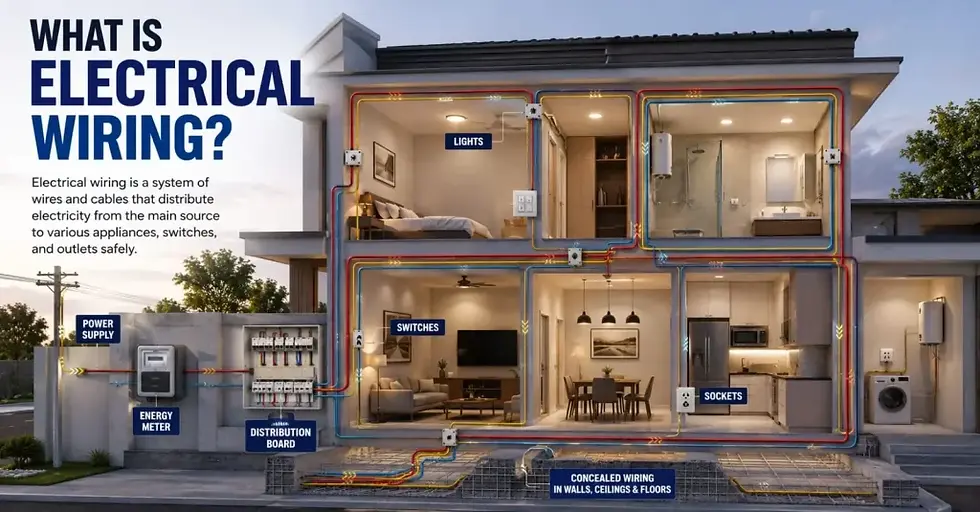
In many U.S. homes, electrical power is supplied through a 120/240-volt, single-phase service. Electricity enters the building through service conductors and passes through the meter and main electrical panel. The panel distributes power through individual branch circuits to lighting, receptacles, appliances, and other equipment.
A typical residential electrical system includes several main components:
Service entrance conductors: Carry electrical power from the utility supply to the home's service equipment.
Main electrical panel: Distributes electricity to individual circuits and contains overcurrent protection devices.
Feeders: Supply power from the service equipment to another panel or distribution point.
Branch circuits: Deliver electricity from the panel to receptacles, lighting outlets, appliances, and other loads.
Grounding and bonding conductors: Provide an effective path for fault current and help maintain electrical safety.
The type of wiring used depends on the function and location of the circuit.
For example, a standard lighting circuit installed inside a dry wall cavity may use NM-B cable. A circuit supplying an outdoor landscape light may require UF-B cable or appropriately rated individual conductors installed in a suitable raceway. A residential feeder may use SER cable or individual conductors in conduit, depending on the installation design.
Choosing the right wiring method requires more than knowing the voltage or electrical load. The installation environment, applicable electrical code, conductor size, insulation rating, and equipment connection requirements must also be considered.

2. What Is the Difference Between Electrical Wire and Electrical Cable?
The terms wire and cable are frequently used interchangeably in everyday conversations, but they describe different product constructions.
Electrical wire generally refers to a single electrical conductor, which may be solid or stranded. The conductor is usually surrounded by an insulating material that prevents unintended electrical contact.
Electrical cable is an assembly containing two or more insulated conductors, or conductors arranged within a protective construction. Depending on its design, a cable may also include an equipment grounding conductor, filler materials, shielding, armor, or an outer jacket.
For example:
THHN wire is typically supplied as an individual insulated conductor.
NM-B cable contains multiple insulated conductors and a bare equipment grounding conductor under an overall nonmetallic jacket.
UF-B cable has a protective construction designed for underground feeder and branch-circuit applications.
MC cable contains insulated conductors within a metallic protective covering.
The distinction is important because some wiring methods require individual conductors to be installed inside a raceway, while others use factory-assembled cables that can be installed according to their specific listing and code requirements.
A product's construction and markings determine its permitted applications. The appearance of a wire or cable alone is not enough to establish whether it is suitable for a particular installation.

3. Common Types of Household Electrical Wire and Cable
Residential electrical systems use several different types of building wire and cable. The following are among the most common products used in U.S. homes.
NM-B Cable (Nonmetallic-Sheathed Cable)
NM-B cable is one of the most widely used wiring products in residential construction in the United States. It is commonly referred to as Romex, although Romex is a brand name rather than the generic technical designation for all nonmetallic-sheathed cable.
NM-B cable typically consists of two or three insulated copper conductors and a bare equipment grounding conductor, all enclosed within an overall nonmetallic jacket.
The insulated conductors usually serve as the ungrounded (hot) and grounded (neutral) circuit conductors. A third insulated conductor may be included in certain configurations, such as circuits requiring an additional switched or ungrounded conductor.
Typical applications include:
General lighting circuits
Wall receptacle circuits
Bedroom and living room wiring
Kitchen appliance branch circuits, where permitted
Residential switches and outlets
Other indoor branch circuits
NM-B cable is intended primarily for normally dry indoor locations. It is not suitable for direct burial or general outdoor and wet-location installations.
Although the individual conductors in NM-B cable may have 90°C-rated insulation, the cable's allowable ampacity is limited by the applicable NEC requirements for NM cable. In particular, its ampacity cannot simply be selected using the 90°C conductor column.
This distinction matters when calculating conductor capacity, applying adjustment factors, or selecting overcurrent protection.
UF-B Cable (Underground Feeder and Branch-Circuit Cable)
UF-B cable is designed for applications where wiring may be exposed to moisture or installed underground.
Unlike NM-B cable, which is intended for dry locations, UF-B has a construction with an overall moisture-resistant jacket. Its insulated conductors are enclosed within the cable assembly, providing protection suitable for permitted underground and outdoor applications.
Depending on the product construction and markings, UF-B cable may be suitable for direct burial without a separate raceway.
Typical applications include:
Outdoor lighting circuits
Landscape lighting power supplies
Detached garage or workshop circuits
Outdoor equipment and pump circuits
Other permitted underground feeder and branch-circuit installations
UF-B cable is commonly available with copper conductors in different conductor counts and AWG sizes.
However, direct-burial suitability does not mean that every installation can be completed at the same burial depth. Required burial depth depends on the wiring method, voltage, protective measures, and applicable NEC provisions.
If UF-B cable is exposed to direct sunlight above ground, verify that the specific product carries the required sunlight-resistant identification.
UF-B can also be installed in permitted raceway applications. The raceway, fittings, cable protection, and installation conditions must all comply with applicable requirements.
THHN Wire
THHN is a commonly used type of building wire installed in electrical conduit systems.
The designation THHN describes the wire's insulation characteristics:
T: Thermoplastic insulation
H: Heat resistant
HN: Nylon jacket
THHN wire generally consists of a copper or aluminum conductor surrounded by thermoplastic insulation and a nylon outer covering, depending on the product.
It is available in different conductor sizes, colors, and solid or stranded constructions.
Typical applications include:
Residential feeder wiring
Branch circuits installed in conduit
Garage and workshop electrical systems
Electrical panel connections
Residential additions and renovation projects
Other permitted raceway installations
THHN is primarily associated with dry-location use. However, many building wires sold in the market carry multiple designations, such as THHN/THWN-2.
When a product is marked THHN/THWN-2, it has additional ratings that permit its use in wet locations under the applicable conditions.
Do not assume that a wire marked only THHN is suitable for installation in a wet raceway.
THHN wire is generally installed in a properly sized conduit or another permitted wiring method. Individual THHN conductors should not be treated as a substitute for a complete nonmetallic-sheathed residential cable.
THWN and THWN-2 Wire
THWN and THWN-2 are thermoplastic building-wire designations that indicate resistance to heat and moisture.
THWN wire is designed for wet-location applications, but its temperature rating depends on the specific designation and product marking.
THWN-2 is rated for use in wet or dry locations at a maximum conductor temperature of 90°C, subject to applicable conditions and installation requirements.
Typical applications include:
Conductors inside electrical conduit
Residential feeder systems
Branch circuits in raceways
Garage and workshop installations
Outdoor conduit systems
Other wiring applications permitted by the product listing
Many contractors use THHN/THWN-2 wire because it provides both designations in one product. This makes it suitable for a wider range of raceway applications than a product marked only THHN.
An important consideration is that the conductor's insulation temperature rating does not automatically determine the ampacity of the finished circuit. Terminal ratings, conductor size, installation conditions, and applicable NEC ampacity rules must also be considered.
XHHW-2 Wire
XHHW-2 is another common type of insulated building wire used in electrical distribution systems.
Its insulation is generally based on cross-linked polyethylene (XLPE), which provides heat and moisture resistance.
The designation can be understood as follows:
X: Cross-linked polymer insulation
HH: High heat resistance
W: Moisture resistant
-2: Rated for wet and dry locations at a maximum conductor temperature of 90°C
XHHW-2 wire is often selected for electrical feeders and distribution circuits that require a durable insulation system.
Typical applications include:
Residential service and feeder systems
Subpanel connections
Conductors installed in conduit
Electrical distribution systems
Larger residential buildings
Other permitted power distribution applications
Compared with some thermoplastic insulation systems, XLPE-based insulation offers different mechanical and thermal characteristics. The actual performance depends on the specific product design and manufacturer specifications.
One important point: XHHW-2 is not automatically a direct-burial designation. If underground installation is required, verify whether the conductor or cable assembly also carries an appropriate USE-2 or other applicable underground rating.
MC Cable (Metal-Clad Cable)
MC cable is a factory-assembled electrical cable protected by a metallic armor.
It typically contains insulated circuit conductors and an equipment grounding conductor within an interlocked metallic covering. Specific constructions vary depending on the product and intended application.
The metallic armor provides mechanical protection compared with ordinary nonmetallic cable.
Typical applications include:
Residential electrical renovations
Exposed wiring in permitted locations
Branch circuits in garages and workshops
Electrical equipment connections
Certain concealed wiring installations
Other applications permitted by the cable's listing
MC cable is used in both commercial and certain residential electrical installations.
However, not all MC cable products have identical environmental ratings. Some versions are suitable for dry locations, while specific jacketed products may be listed for additional environments.
The installer must verify the product's permitted uses, grounding construction, fittings, and installation requirements.
AC Cable (Armored Cable)
AC cable, also known as armored cable, has a flexible metallic armor that protects the insulated conductors inside.
It is sometimes informally called BX cable, although the actual product classification and listing should always be verified.
Traditional Type AC cable has an internal bonding strip in contact with the armor. This construction is part of its grounding design.
Although AC cable and MC cable may appear similar from the outside, they are not interchangeable.
They differ in construction, grounding methods, permitted uses, connectors, and installation requirements.
Typical applications include:
Certain residential branch-circuit installations
Lighting circuits
Permitted exposed or concealed wiring applications
Renovation projects requiring metallic cable protection
The exact installation suitability must be determined from the cable type, listing, fittings, and applicable NEC requirements.
SER Cable (Service Entrance Cable)
SER stands for Service Entrance, Style R.
It is commonly used for service entrance and feeder applications in residential and other permitted installations.
A typical SER cable contains multiple insulated conductors and a bare conductor within an overall protective jacket. The construction is generally round, with the conductors arranged within a binder and outer jacket.
Typical applications include:
Electrical service connections
Feeder circuits between distribution equipment
Residential subpanel feeders
Power distribution connections
Other applications permitted for Type SE cable
SER cable is available with different conductor materials and sizes, including copper and aluminum versions.
A critical distinction concerns the bare conductor. When SER cable is used as a feeder or branch-circuit cable, the bare conductor serves as the equipment grounding conductor, not as the neutral conductor. Service entrance applications have different rules.
SER cable is not a direct-burial cable. It must not be installed underground merely because it has an overall jacket.
SEU Cable (Service Entrance, Style U)
SEU cable is another type of service entrance cable used in certain residential electrical systems.
Unlike the round construction commonly associated with SER cable, SEU cable typically has a flat or oval profile.
A typical SEU cable consists of two insulated conductors and a concentric neutral/grounding conductor under an overall jacket.
Typical applications include:
Certain residential service entrance connections
Permitted connections between service equipment and metering equipment
Other service entrance installations allowed by the applicable code
SER and SEU cables serve related purposes, but their conductor arrangements are different.
The correct cable type must be selected according to the service configuration, equipment requirements, and applicable electrical code. Neither should be assumed suitable for underground installation.
USE-2 Wire
USE-2 stands for Underground Service Entrance, Type 2.
It is designed for applications involving underground service entrance conductors where the specific conductor is properly listed and marked for that use.
Typical applications include:
Underground service entrance conductors
Underground power distribution
Certain feeder and service applications
Other installations specifically permitted by its ratings
Some conductors carry multiple ratings, such as RHH/RHW-2/USE-2. These combined markings can permit different installation methods depending on the exact product.
However, a conductor marked USE-2 alone should not automatically be assumed suitable for installation inside a building. Verify whether an additional rating, such as RHH or RHW-2, is required for the intended portion of the installation.
4. Household Electrical Wire and Cable Comparison Chart
The following chart summarizes the most common residential wiring types and their general applications.
Wire or Cable Type | Construction | Typical Applications | Main Installation Consideration |
NM-B | Insulated conductors with nonmetallic jacket and grounding conductor | Indoor residential branch circuits | Dry locations |
UF-B | Moisture-resistant cable construction | Outdoor circuits and underground wiring | Suitable product marking and burial requirements |
THHN | Individual thermoplastic-insulated conductor with nylon covering | Conduit and raceway wiring | THHN designation alone is for dry locations |
THWN-2 | Thermoplastic-insulated conductor with wet-location rating | Wet and dry conduit installations | Check temperature and terminal limitations |
XHHW-2 | Cross-linked polymer insulation | Feeders and power distribution | Direct burial requires an applicable additional rating |
MC | Insulated conductors inside metallic armor | Permitted residential and commercial wiring | Product-specific grounding and environmental ratings |
AC | Insulated conductors inside armored construction | Specific permitted branch-circuit applications | Uses a different grounding construction from MC |
SER | Multiple insulated conductors and protective outer jacket | Service and feeder applications | Not for underground installation |
SEU | Two insulated conductors and concentric neutral/grounding conductor | Certain service entrance applications | Not interchangeable with SER |
USE-2 | Underground service entrance conductor | Underground service and distribution applications | Indoor use requires the appropriate additional rating |
This comparison is intended as a general guide. Always review the cable manufacturer's documentation and the applicable electrical code before selecting a product.
5. Which Electrical Wire Is Used in Different Areas of a House?
The correct electrical wire depends on the location, circuit function, connected equipment, and installation method.
A cable suitable for a dry living room wall cavity may not be appropriate for an outdoor installation or a wet basement environment.
The following examples explain common residential applications.
Living Rooms and Bedrooms
NM-B cable is commonly used for general lighting, switches, and receptacle circuits in normally dry living areas.
Typical residential circuits may use 14 AWG or 12 AWG copper conductors, depending on the circuit rating and design.
Where conduit wiring is required or selected, individual THHN/THWN-2 conductors may be used in a permitted raceway system.
Kitchens
Kitchens contain several electrical loads, including refrigerators, dishwashers, microwaves, countertop appliances, garbage disposals, and electric ranges.
Different appliances may require separate branch circuits or specific conductor sizes based on their electrical ratings and the applicable code.
NM-B cable is common in permitted concealed residential wiring. THHN/THWN-2 conductors may also be used in approved conduit systems.
Kitchen wiring must account for circuit loading, required GFCI and AFCI protection, and any dedicated-circuit requirements in the locally adopted electrical code.
Bathrooms
Bathrooms combine electrical equipment with water exposure, making electrical protection particularly important.
Lighting, exhaust fans, receptacles, and other equipment must be installed using wiring methods suitable for their location.
NM-B may be used in permitted dry concealed portions of a residential wiring system, but it should not be treated as a wet-location cable.
Conduit installations using conductors with the appropriate wet-location rating may be required in certain areas.
Bathroom receptacle circuits are also subject to specific GFCI protection requirements under applicable electrical codes.
Garages and Workshops
Garages and workshops often contain power tools, compressors, battery chargers, lighting, and other equipment.
NM-B may be permitted for concealed wiring in suitable dry locations. MC cable or individual conductors in conduit may be selected where the installation requires additional mechanical protection or a different wiring method.
For detached garages, underground feeder installations, or outdoor connections, UF-B cable or another permitted underground wiring method may be appropriate.
The selected cable must account for moisture, physical damage, temperature, and the electrical loads connected to the circuit.
Outdoor Lighting and Landscape Circuits
Outdoor lighting and landscape systems require wiring designed for the environmental conditions.
UF-B cable is commonly used for permitted outdoor feeder and branch-circuit applications, including underground wiring.
Individual conductors may also be installed in a properly designed raceway system when they carry the required wet-location rating.
Outdoor cable selection should consider:
Moisture exposure
Soil conditions
Direct burial requirements
Sunlight and UV exposure
Physical protection
Required burial depth
Connection and enclosure ratings
A cable that is suitable for indoor dry locations should never be assumed suitable for outdoor use.
HVAC Systems
Residential HVAC equipment can require substantial electrical power, depending on the equipment type and capacity.
Air conditioners, heat pumps, furnaces, and other equipment may use different supply voltages and circuit configurations.
The appropriate conductor size depends on the equipment nameplate, minimum circuit ampacity, maximum overcurrent protection, terminal ratings, and installation conditions.
THHN/THWN-2 conductors in conduit and appropriately rated residential cables may be used where permitted.
The equipment manufacturer's installation instructions and the applicable electrical code determine the correct wiring method.
Electric Dryers and Ranges
Electric dryers and ranges commonly require 240-volt circuits.
These circuits may use three-conductor or four-conductor configurations, depending on the equipment, installation, and applicable requirements.
The conductor size and cable type must match the appliance's electrical specifications.
A cable should not be selected simply because it is commonly used for another appliance of similar appearance or power consumption.
6. Understanding Electrical Wire Sizes: What Does AWG Mean?
AWG stands for American Wire Gauge. It is the standard system used to identify conductor sizes in many North American electrical applications.
AWG is an important consideration when selecting electrical wire because conductor size affects electrical resistance, allowable current, voltage drop, and heat generation.
One important rule is:
The smaller the AWG number, the larger the conductor diameter.
For example:
12 AWG wire is smaller than 10 AWG wire.
10 AWG wire is smaller than 8 AWG wire.
As conductor size increases, electrical resistance generally decreases for the same conductor material and length.
This can reduce voltage drop and resistive heating under comparable operating conditions.
Common Residential AWG Sizes
Wire Size | Relative Conductor Size | Common Residential Applications |
14 AWG | Small | Certain 15-amp lighting and general branch circuits |
12 AWG | Medium | Certain 20-amp receptacle and appliance circuits |
10 AWG | Larger | Certain 30-amp equipment circuits |
8 AWG | Larger | Selected higher-load residential applications |
6 AWG | Large | Certain feeder and higher-current equipment applications |
4 AWG | Very large | Selected service and feeder applications |
2 AWG | Very large | Larger electrical distribution applications |
1/0 AWG | Extra large | Larger service and feeder applications |
These are examples of common conductor sizes and applications, not a complete wire-sizing chart.
The actual conductor size must be calculated based on the connected load, overcurrent protection, conductor material, installation conditions, terminal temperature ratings, voltage drop, and applicable code requirements.
For example, the familiar 14 AWG, 15-amp and 12 AWG, 20-amp pairings are common for copper branch circuits, but they should not be interpreted as a universal sizing rule for every installation.
Why Does Wire Size Matter?
Choosing an undersized conductor can cause several problems:
Excessive conductor temperature
Increased electrical resistance
Higher voltage drop
Insulation deterioration
Increased fire risk
Poor equipment performance
An oversized conductor may increase material and installation costs without providing a practical benefit.
The objective is to select a conductor that safely meets the electrical and installation requirements of the circuit.
7. Copper Wire vs. Aluminum Wire: Which Is Better?
Copper and aluminum are the two main conductor materials used in residential power distribution.
Both are suitable for electrical applications when the wire or cable is properly manufactured, listed, sized, and installed.
However, they have different electrical and mechanical characteristics.
Copper Electrical Wire
Copper has high electrical conductivity and is widely used in residential branch circuits.
Its main advantages include:
Higher conductivity than aluminum by volume
Good electrical and mechanical performance
Generally smaller conductor size for comparable ampacity
Broad availability in residential cable and building-wire products
Established compatibility with many electrical devices and terminals
Copper is commonly used in NM-B cable, UF-B cable, THHN/THWN-2 wire, and many other residential electrical products.
Its main disadvantages are higher material cost and greater weight compared with aluminum conductors of equivalent length and electrical function.
Aluminum Electrical Wire
Aluminum is a lighter and generally less expensive conductor material.
It is commonly used in certain service entrance cables and larger feeder applications.
Its advantages include:
Lower weight
Lower material cost in many applications
Good performance when correctly sized and installed
Suitability for certain large-conductor power distribution applications
However, aluminum has lower electrical conductivity than copper by volume. A larger conductor size is therefore generally required to provide comparable electrical performance.
Aluminum connections also require appropriate terminals and connection methods. The selected electrical equipment must be listed or identified for the conductor material, and installation torque requirements must be followed.
Copper vs. Aluminum Comparison
Characteristic | Copper | Aluminum |
Electrical conductivity | Higher | Lower |
Weight | Heavier | Lighter |
Conductor size for comparable ampacity | Generally smaller | Generally larger |
Material cost | Generally higher | Generally lower |
Common residential applications | Branch circuits, feeders, building wire | Service entrance and larger feeders |
Connection requirements | Must follow terminal specifications | Requires appropriately rated terminals and connections |
Neither material is automatically better for every residential application. The correct choice depends on electrical design, installation conditions, equipment compatibility, and project cost.
8. Solid Wire vs. Stranded Wire
Electrical conductors are available in solid and stranded constructions.
Both can be used in residential electrical systems when the specific conductor type is approved for the intended application.
Solid Electrical Wire
Solid wire consists of one continuous metal conductor.
Its main characteristics include:
Simple conductor construction
Relatively rigid structure
Easy handling in certain small-conductor applications
Common use in residential nonmetallic-sheathed cables
Solid copper wire is frequently found in smaller NM-B cable sizes.
It is often used in fixed residential branch-circuit wiring where the cable remains stationary after installation.
Stranded Electrical Wire
Stranded wire consists of multiple smaller metal strands twisted or grouped together to form one conductor.
Its main characteristics include:
Greater flexibility
Easier handling in certain conduit installations
Suitability for applications requiring more flexible conductors
Availability in different stranding classes and conductor constructions
Stranded wire is common in THHN/THWN-2 building wire, larger feeder conductors, and many specialized cable products.
Solid vs. Stranded Wire Comparison
Characteristic | Solid Wire | Stranded Wire |
Construction | One conductor | Multiple smaller strands |
Flexibility | Lower | Higher |
Handling | Simple in many small fixed installations | Easier in many flexible or raceway applications |
Common use | Residential cables and fixed wiring | Building wire, feeders, and equipment connections |
Electrical performance | Depends on conductor material and size | Depends on conductor material, size, and construction |
Stranded wire is not automatically capable of carrying more current than solid wire of the same nominal AWG size. Ampacity must be determined using the applicable conductor and installation requirements.
9. Electrical Wire Color Codes in U.S. Residential Wiring
Wire colors help electricians identify the function of conductors within an electrical system.
In typical U.S. residential wiring, common color conventions include:
Wire Color | Typical Function |
Black | Ungrounded (hot) conductor |
Red | Additional ungrounded (hot) conductor |
White | Grounded (neutral) conductor |
Gray | Grounded (neutral) conductor |
Green | Equipment grounding conductor |
Bare copper | Equipment grounding conductor |
Hot Wire
A hot wire is an ungrounded conductor that supplies electrical energy to a circuit.
Black and red are common hot-wire colors in residential installations.
Other colors may also be used for ungrounded conductors, depending on the system and applicable requirements.
Neutral Wire
The neutral conductor is the grounded circuit conductor.
In a typical 120-volt branch circuit, it provides the normal return path for current.
White and gray are commonly used to identify neutral conductors.
A neutral conductor should not be confused with an equipment grounding conductor. They serve different purposes.
Ground Wire
The equipment grounding conductor provides a path for fault current to help protective devices operate under fault conditions.
It is commonly green, green with yellow stripes, or bare copper.
Unlike the neutral conductor, the equipment grounding conductor is not intended to carry normal operating current.
Important Note About Wire Colors
Wire colors are useful identification tools, but they should never be treated as the only method of determining a conductor's function.
Older installations, special circuits, and permitted conductor reidentification methods may differ from common color conventions.
Electricians should verify circuit function using appropriate testing procedures before working on existing wiring.
10. Understanding Electrical Wire Insulation Types and Markings
Electrical insulation protects conductors from unintended electrical contact and environmental exposure.
Different insulation materials and designations are used depending on the intended application.
Common building-wire designations include:
Designation | General Meaning |
THHN | Thermoplastic, heat-resistant insulation with nylon jacket |
THWN | Thermoplastic, heat- and moisture-resistant insulation with nylon jacket |
THWN-2 | Thermoplastic insulation rated for 90°C in wet and dry locations |
XHHW | Cross-linked polymer insulation with heat and moisture resistance |
XHHW-2 | Cross-linked polymer insulation rated for 90°C in wet and dry locations |
RHW | Rubber or thermoset insulation with heat and moisture resistance |
USE-2 | Underground service entrance conductor designation |
These designations provide information about the conductor's insulation type and intended use.
However, not every product carrying a similar designation has identical construction or performance characteristics.
A complete product specification should identify its applicable voltage rating, conductor material, conductor size, temperature rating, and permitted installation conditions.
What Does 600V Mean on Electrical Wire?
Many common residential building wires and cables carry a 600-volt rating.
This indicates the product's rated voltage classification, not the amount of current it can carry.
Voltage rating and ampacity are different characteristics.
The ampacity of a conductor depends on factors such as:
Conductor material
Conductor size
Insulation temperature rating
Number of current-carrying conductors
Ambient temperature
Installation method
Terminal temperature limitations
A 600V wire is not automatically suitable for every 600V installation. The wiring method, product listing, and applicable code requirements must also be satisfied.
11. How to Choose the Right Electrical Wire for a Household Project
Selecting electrical wire requires a systematic evaluation of the application.
The correct product should satisfy the electrical load requirements and the environmental conditions of the installation.
Identify the Electrical Load
Start by identifying the equipment or circuit that will be supplied.
Important information includes:
Rated voltage
Load current
Equipment nameplate specifications
Minimum circuit ampacity, where applicable
Maximum overcurrent protection, where specified
Continuous or noncontinuous operation
Starting current for relevant motors and equipment
Do not select a conductor based only on the appliance's wattage or the size of an existing breaker.
Determine the Required Conductor Size
The conductor size must be selected according to the applicable ampacity requirements.
The calculation may involve:
Copper or aluminum conductor material
AWG size
Insulation temperature rating
Ambient temperature correction
Adjustment for the number of current-carrying conductors
Terminal temperature limitations
Voltage drop considerations
Applicable overcurrent protection requirements
A conductor with a 90°C insulation rating cannot automatically be used at the full 90°C ampacity when the equipment terminals impose a lower temperature limitation.
Select the Correct Cable Type
After determining the electrical requirements, identify the appropriate wiring method.
For example:
NM-B may be suitable for permitted indoor dry-location residential branch circuits.
UF-B may be appropriate for permitted outdoor or underground feeder and branch-circuit applications.
THHN/THWN-2 may be appropriate for individual conductors installed in raceways.
XHHW-2 may be selected for certain feeder and distribution applications.
MC or AC cable may be suitable where their specific listings and installation requirements permit their use.
SER or SEU may be appropriate for certain service entrance and feeder applications.
The cable type must match the environment and installation method.
Check Environmental Conditions
The installation environment can affect cable performance and suitability.
Consider whether the wiring will be exposed to:
Moisture or water
Direct sunlight
High ambient temperatures
Oil or chemicals
Physical impact
Abrasion
Vibration
Underground soil conditions
Corrosive environments
A cable intended for an indoor dry location should not be installed in a wet environment unless the specific wiring method and product are approved for that condition.
Verify the Product Markings
Before purchasing or installing a wire or cable, review its surface markings and technical documentation.
Important information includes:
Manufacturer name
Product type
Conductor material
AWG size
Number of conductors
Voltage rating
Temperature rating
Wet- or dry-location suitability
Sunlight resistance
Direct-burial rating, where applicable
Applicable UL or other certification markings
The manufacturer's technical datasheet should confirm the product's permitted applications.
12. Electrical Wire Ampacity: What Determines How Much Current a Wire Can Carry?
Ampacity is the maximum current a conductor can carry continuously under specified conditions without exceeding its applicable temperature limit.
It is one of the most important factors in residential wire selection.
However, ampacity is not determined by conductor size alone.
Two wires with the same AWG size can have different allowable ampacities depending on their insulation rating, conductor material, installation method, ambient temperature, and other conditions.
Conductor Material
Copper and aluminum have different electrical properties.
For the same nominal conductor size, copper generally has lower electrical resistance than aluminum.
As a result, their allowable ampacities are not always identical.
Insulation Temperature Rating
Electrical wire may carry designations such as 60°C, 75°C, and 90°C.
These ratings indicate the maximum conductor temperature associated with the insulation's applicable use.
However, the temperature rating of the insulation does not necessarily determine the final allowable ampacity.
Terminal limitations and wiring-method requirements can impose lower limits.
Installation Conditions
A conductor installed in free air may have different heat-dissipation characteristics from one installed inside a conduit containing several other conductors.
Important factors include:
Ambient temperature
Number of current-carrying conductors
Raceway fill and installation conditions
Thermal insulation surrounding wiring
Grouping and bundling
Terminal ratings
For example, NM-B cable contains conductors with 90°C-rated insulation, but its allowable ampacity is limited to the applicable 60°C conductor ampacity under NEC requirements.
This is why it is important to consult the correct ampacity tables and apply the appropriate adjustment and correction rules rather than relying on a general online wire-size chart.
13. Electrical Conduit vs. Electrical Cable: When Is Each Used?
Electrical conduit and electrical cable are two different parts of a wiring system.
A cable is an assembly containing conductors. A conduit is a raceway used to route and protect electrical conductors.
Not all electrical wiring systems require conduit, and not all cables are designed to be installed inside the same type of raceway.
Common Electrical Conduit Types
EMT (Electrical Metallic Tubing)
EMT is a thin-wall metallic raceway used in many residential, commercial, and industrial installations.
It provides a protected pathway for individual conductors and is commonly used in garages, workshops, utility areas, and exposed installations.
PVC Electrical Conduit
PVC conduit is a nonmetallic raceway often used in underground and outdoor electrical installations.
Its suitability depends on the specific conduit type, fittings, installation conditions, and applicable code requirements.
Rigid Metal Conduit (RMC)
RMC is a heavy-duty threaded metallic raceway designed to provide substantial mechanical protection.
It is used in installations where a stronger wiring enclosure is required.
Why Are Electrical Wires Installed in Conduit?
Conduit systems can provide several advantages:
Mechanical protection
Organized conductor routing
Easier replacement or addition of conductors in certain installations
Protection against environmental exposure when the complete system is correctly designed
A defined wiring pathway
However, installing a conductor inside conduit does not automatically make the conductor suitable for wet locations.
For example, THHN-only wire is not transformed into a wet-location conductor simply because it is installed inside PVC conduit.
Wet-location ratings of conductors and the suitability of the entire raceway system must be verified.
14. GFCI and AFCI Protection in Residential Electrical Systems
Choosing the correct wire and cable is only one part of residential electrical safety.
Electrical protection devices are also important.
Two common protection technologies used in modern residential systems are GFCI and AFCI.
GFCI Protection
GFCI stands for Ground-Fault Circuit Interrupter.
A GFCI device monitors the electrical current flowing through a circuit and detects certain imbalances that may indicate current leakage.
It is designed to reduce the risk of electric shock.
GFCI protection is required in various residential locations under applicable electrical codes, particularly where electrical equipment may be exposed to moisture or where people may be in contact with grounded surfaces.
Examples of locations commonly subject to GFCI requirements include bathrooms, kitchens, garages, outdoor areas, and other specified spaces.
AFCI Protection
AFCI stands for Arc-Fault Circuit Interrupter.
An AFCI device is designed to detect certain hazardous electrical arcing conditions that could cause fires.
AFCI protection is required for various residential branch circuits, depending on the applicable NEC edition and local adoption.
GFCI and AFCI devices serve different safety functions. One does not automatically replace the other.
The required protection should be determined according to the locally adopted electrical code and the specific circuit installation.
15. Common Mistakes When Selecting Household Electrical Wiring
Choosing the wrong wire or cable type can lead to installation problems, equipment failure, and electrical hazards.
Several mistakes occur repeatedly in residential wiring projects.
Using Indoor Cable Outdoors
NM-B cable is intended for normally dry locations.
Using it for general outdoor or direct-burial installations is not an appropriate substitute for an outdoor-rated cable or wiring method.
Assuming All THHN Wire Is Suitable for Wet Locations
THHN and THWN-2 are different designations.
A conductor marked THHN/THWN-2 carries additional wet-location ratings, but a THHN-only conductor should not be assumed to have the same suitability.
Always inspect the actual product marking.
Choosing Wire Size Based Only on AWG
Wire size must be selected according to ampacity requirements and installation conditions.
Selecting a conductor based only on its AWG number or a generic online chart can overlook important factors such as ambient temperature, conductor material, and terminal ratings.
Confusing Neutral and Ground Conductors
Neutral and grounding conductors have different functions.
The neutral carries normal return current in many circuits, while the equipment grounding conductor provides a fault-current path.
They must be installed and connected according to the applicable grounding and bonding requirements.
Assuming SER and SEU Are the Same
SER and SEU have different conductor arrangements and physical constructions.
They should not be substituted for one another without verifying the circuit design and code requirements.
Using a Cable Without Checking Its Listing
A cable's appearance or conductor size does not prove that it is suitable for a particular installation.
The product must carry the appropriate identification and ratings for the intended wiring method.
Treating Extension Cords as Permanent Wiring
Ordinary flexible cords and extension cords are generally intended for temporary connections and specific equipment applications.
They should not be used as a general substitute for permanent building wiring unless a specific application is expressly permitted by the applicable code.
16. Household Electrical Wiring and Solar Electrical Wiring: Are They the Same?
Household electrical wiring and solar photovoltaic wiring both carry electrical power, but they are designed for different operating conditions and installation requirements.
Standard residential building wires are designed for the applications identified by their product listings and applicable building-wiring standards.
Solar photovoltaic systems can introduce additional requirements, including:
DC voltage ratings
Outdoor UV exposure
Temperature fluctuations
Long-term environmental exposure
Wet-location suitability
Specific PV conductor requirements
Connector and cable compatibility
Applicable photovoltaic installation standards
For example, NM-B cable is designed primarily for indoor residential branch-circuit wiring. It should not be substituted for a dedicated photovoltaic cable simply because the conductor size appears suitable.
PV systems require conductors specifically identified and approved for the intended photovoltaic application.
The exact wire type, voltage rating, environmental rating, and installation method should be checked against the system design and applicable electrical code.
For photovoltaic cable applications, see the FRCABLE solar cable product range and solar cable datasheets.
17. What Should Buyers and Contractors Check When Purchasing Electrical Wire and Cable?
For contractors, distributors, wholesalers, and electrical supply companies, purchasing wire and cable involves more than comparing conductor sizes and prices.
The product must meet the technical and regulatory requirements of the intended installation.
A useful purchasing checklist includes the following items.
Product identification
Confirm the exact wire or cable type, including NM-B, UF-B, THHN/THWN-2, XHHW-2, MC, SER, or another required designation.
Conductor material
Verify whether the product uses copper or aluminum conductors.
Conductor size
Confirm the required AWG size, conductor count, and grounding conductor configuration.
Insulation and jacket
Review the insulation material, overall jacket construction, temperature rating, and voltage rating.
Environmental suitability
Verify suitability for dry locations, wet locations, sunlight exposure, underground installation, and other project conditions.
Applicable standards and certification
Check the standards and certification markings required by the project and local regulations. For U.S. building wire and cable, the relevant UL product category and applicable standard should be verified rather than relying on a general statement that a product is certified.
Manufacturer documentation
Request the product datasheet, construction details, technical specifications, and relevant certification documentation.
Packaging and traceability
For commercial supply, confirm reel length, packaging method, batch identification, labeling, and product traceability.
Supply capability
For larger projects, evaluate manufacturing consistency, quality-control procedures, delivery schedules, and the supplier's ability to provide repeatable specifications.
A clear technical specification helps buyers compare products accurately and reduces the risk of purchasing a cable that does not match the intended installation.
18. Frequently Asked Questions About Household Electrical Wiring
What Type of Electrical Wire Is Most Commonly Used in Homes?
NM-B cable is one of the most common types of electrical cable used in U.S. residential construction. It is widely used for indoor branch circuits supplying lighting, receptacles, switches, and other household loads in permitted dry locations.
What Is the Difference Between NM-B and UF-B Cable?
NM-B cable is designed primarily for indoor dry-location wiring, while UF-B cable is designed for permitted underground and outdoor feeder and branch-circuit applications.
UF-B has an overall construction suitable for moisture exposure and may be approved for direct burial, depending on its product marking and installation conditions.
Is Romex the Same as NM-B Cable?
Romex is a registered brand name commonly associated with nonmetallic-sheathed building cable. NM-B is the generic cable designation used to describe the relevant wiring type.
In everyday conversations, people often use Romex to refer to NM-B cable, but the product's actual marking should always be checked.
What Is the Difference Between THHN and THWN-2 Wire?
THHN is designated for dry-location use, while THWN-2 carries a wet-location rating at a maximum conductor temperature of 90°C.
Many building wires are marked THHN/THWN-2, meaning they have both designations and the corresponding approved uses.
Can THHN Wire Be Used Outdoors?
A conductor marked only THHN should not be assumed suitable for outdoor wet-location installation.
Many THHN products also carry THWN-2 ratings, which can permit wet-location use under applicable conditions.
Always check the actual product markings and manufacturer's documentation.
Can NM-B Cable Be Used Outside?
NM-B cable is intended for normally dry locations and is not a general-purpose outdoor or direct-burial cable.
For permitted outdoor and underground applications, UF-B cable or another appropriately rated wiring method may be required.
What Is the Difference Between SER and SEU Cable?
SER cable typically has a round construction with multiple insulated conductors and a bare conductor under an overall jacket.
SEU cable generally has a flat or oval construction with two insulated conductors and a concentric neutral/grounding conductor.
Their applications and conductor arrangements differ, so the correct product must be selected according to the electrical system design.
Is Copper Wire Better Than Aluminum Wire?
Copper has higher electrical conductivity by volume and is commonly used in residential branch circuits.
Aluminum is lighter and often less expensive, making it useful in certain service and feeder applications.
Both materials can be suitable when correctly sized and installed with appropriately rated equipment and connections.
What Size Wire Is Typically Used for a 20-Amp Circuit?
12 AWG copper is commonly used for 20-amp residential branch circuits.
However, final conductor selection must also consider the cable type, installation conditions, voltage drop, terminal ratings, and applicable code requirements.
Does a Larger AWG Number Mean a Thicker Wire?
No. The AWG numbering system works in the opposite direction.
A smaller AWG number represents a larger conductor diameter. For example, 10 AWG wire is larger than 12 AWG wire.
What Is the Difference Between a Neutral Wire and a Ground Wire?
A neutral conductor is a grounded circuit conductor that carries normal return current in many electrical circuits.
An equipment grounding conductor provides a path for fault current and helps protective devices operate under fault conditions.
They perform different functions and must be connected according to applicable grounding and bonding requirements.
What Is the Difference Between MC Cable and AC Cable?
Both MC and AC cables use metallic protective coverings, but their internal construction and grounding methods differ.
Type AC cable uses an internal bonding strip as part of its grounding construction. Type MC cable has different grounding requirements and commonly incorporates a dedicated equipment grounding conductor.
They are separate wiring methods with different permitted uses and installation rules.
Is 600V Wire Suitable for Every Household Circuit?
No. A 600V rating indicates the voltage classification of the wire or cable, not its allowable current or universal suitability.
The product must also meet the requirements for conductor size, insulation, temperature, installation environment, and wiring method.
19. Conclusion: Choosing the Right Wire and Cable for Residential Electrical Systems
Household electrical wiring includes a wide range of wire and cable types, each designed for specific applications.
NM-B cable is commonly used for indoor residential branch circuits, while UF-B cable is designed for permitted outdoor and underground wiring. THHN/THWN-2 and XHHW-2 are widely used as individual building-wire conductors in raceway systems. MC and AC cables provide metallic protection for specific wiring applications, while SER and SEU cables are used in certain service entrance and feeder installations.
Selecting the right product requires a clear understanding of its construction, conductor material, AWG size, insulation designation, voltage rating, temperature rating, and permitted installation environment.
The most important principle is to match the wire or cable to the actual electrical application rather than choosing a product based on appearance, price, or conductor size alone.
For contractors, distributors, and electrical product buyers, reviewing technical datasheets, verifying product listings, and following the applicable NEC requirements are essential steps in building safe and reliable electrical systems.
The right electrical wire is not simply the one that carries the required current. It is the one whose complete construction, ratings, and installation method are suitable for the application.
Technical References


Trong lúc đọc các bài trao đổi trên diễn đàn, mình tình cờ thấy qs88 được đề cập trong một vài cuộc thảo luận nên quyết định truy cập để tìm hiểu thêm. Mình chủ yếu muốn xem cách trang này thiết kế giao diện và tổ chức các phần nội dung. Trang không thiết kế quá cầu kỳ, menu được sắp xếp khá trực quan, các phần thông tin có ranh giới rõ nên dễ phân biệt. Mục giấy phép pháp lý cũng được trình bày khá nổi bật, giúp người xem biết chỗ cần tìm khi muốn kiểm tra. Lướt sơ bộ thấy tổng thể tương đối thoáng, không có quá nhiều chi tiết làm phân tán sự chú…
dn88 tình cờ được mình biết đến khi đang đọc một bài viết về quản lý tài liệu và xem phần nguồn tham khảo ở cuối trang. Thấy tên này nằm trong danh sách nên mình mở thử cho biết, chủ yếu tò mò xem cách trình bày có khác những công cụ mình từng thấy không. Mình chỉ lướt qua vài trang, không đi sâu vào từng tính năng. Điều dễ nhận thấy là bố cục khá sạch, tiêu đề và nội dung được phân biệt rõ, chuyển qua các khu vực cũng tương đối thuận. Xem nhanh trên máy tính lẫn điện thoại đều không tạo cảm giác quá rối.v