
What Size Copper Wire Do You Need for a 200 Amp Service?

Choosing the correct copper wire size for a 200 amp service is not as simple as matching a 200-amp breaker with a single wire-size chart. For a typical 120/240V single-phase dwelling service, the NEC permits 2/0 AWG copper service conductors when the dwelling-service provisions apply and the required conditions are met. For other applications where the dwelling allowance does not apply, a larger conductor may be required.
That distinction is important because 2/0 copper is not universally a 200-amp conductor. Standard ampacity tables and dwelling-service provisions use different rules, and installation conditions can require further adjustment.
This guide explains how to approach 200-amp copper conductor sizing, the difference between service conductors and feeder conductors, when 2/0 or 3/0 copper is appropriate, how grounding conductors are sized, and why long runs require a separate voltage-drop review.
The current edition of NFPA 70, the National Electrical Code, is the 2026 NEC, although the edition enforced for a specific project depends on the authority having jurisdiction and local adoption.
What Is the Copper Wire Size for a 200 Amp Service?
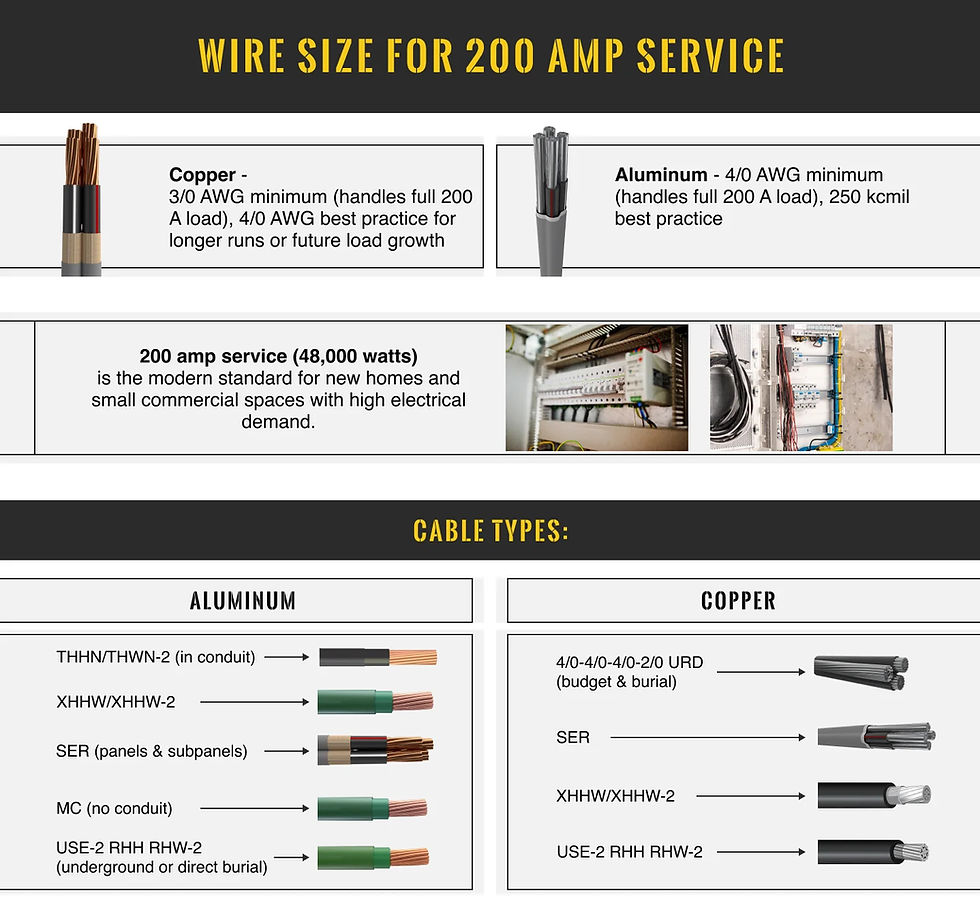
For a typical single-phase 120/240V dwelling service, the commonly applicable answer is 2/0 AWG copper under NEC Table 310.12(A). The same table identifies 4/0 AWG aluminum or copper-clad aluminum for a 200A dwelling service.
The important qualification is that this table is specifically for single-phase dwelling services and feeders covered by the dwelling provisions. It is not a universal rule for every 200A electrical installation.
For example, the standard ampacity table gives 2/0 copper an ampacity of 175A at 75°C and 195A at 90°C, while 3/0 copper is rated 200A at 75°C and 225A at 90°C under the referenced ampacity table.
The dwelling provision exists because the NEC allows eligible dwelling service and whole-dwelling feeder conductors to be sized at not less than 83% of the service or feeder rating. For a 200A rating, that represents 166A, which 2/0 copper exceeds under the applicable ampacity conditions.
200 amp service wire size at a glance
Application | Copper | Aluminum / Copper-Clad Aluminum | Key consideration |
Typical 120/240V one-family dwelling service | 2/0 AWG | 4/0 AWG | NEC 310.12 dwelling provision |
Whole-dwelling main feeder covered by 310.12 | 2/0 AWG | 4/0 AWG | Must meet dwelling-service conditions |
General 200A service where dwelling allowance does not apply | Typically 3/0 AWG | Typically 250 kcmil | Check applicable ampacity table |
200A feeder serving only part of a building | Typically 3/0 AWG | Typically 250 kcmil | Do not automatically apply 310.12 |
200A feeder equipment grounding conductor | 6 AWG Cu baseline | 4 AWG Al baseline | Table 250.122; different from GEC |
The table is a sizing starting point, not a substitute for the complete conductor calculation.
Why 2/0 Copper Can Be Used for a 200 Amp Residential Service
One of the most common sources of confusion is the difference between service rating and conductor ampacity.
A 200A service does not necessarily mean that every conductor supplying a dwelling must have a tabulated 200A ampacity. NEC 310.12 provides a specific allowance for qualifying single-phase dwelling services and whole-dwelling feeders.
The 83% dwelling rule
For eligible services and feeders rated from 100A through 400A, the conductors may have an ampacity of at least 83% of the service or feeder rating.
For a 200A service:
200A × 83% = 166A
The conductor therefore needs to meet the applicable minimum ampacity of 166A. Under the 75°C ampacity values, 2/0 copper is rated 175A, which clears that threshold.
That is why a typical residential 200A service can use 2/0 copper, even though someone looking only at the standard ampacity table might expect 3/0 copper.
When the 83% rule does not apply
This is where many wire-sizing articles become misleading.
The dwelling provision is intended for qualifying dwelling applications. It should not automatically be applied to a commercial service, an industrial installation, or a feeder that supplies only part of a dwelling.
For example, a feeder running from a main distribution panel to a detached workshop does not automatically become a 310.12 feeder simply because the building is residential. The specific scope and load served have to be evaluated.
When the dwelling allowance is unavailable, 3/0 copper is the typical 200A conductor size when using the 75°C column of the standard ampacity table, subject to the applicable conditions and correction factors.

200 Amp Service Wire Size vs. 200 Amp Feeder Wire Size
The words service and feeder are sometimes used interchangeably in consumer searches, but they describe different parts of an electrical distribution system.
A service conductor supplies electrical power from the utility/service point into the premises' service equipment. A feeder generally distributes power from service equipment or another source to downstream equipment.
That distinction matters because a 200A rating alone does not determine the conductor size.
Service entrance conductors
A residential service entrance installation may qualify for the dwelling conductor provisions. For a typical 120/240V single-family dwelling, that is why 2/0 copper is so frequently encountered.
Main feeders
A feeder supplying the entire load associated with a qualifying dwelling may also fall under the dwelling feeder provisions. A feeder supplying only a portion of the dwelling load is a different situation and should not simply inherit the 2/0 answer.
Commercial and industrial applications
A commercial 200A service generally needs to be evaluated using the standard conductor ampacity requirements rather than assuming the residential 310.12 allowance.
Under the referenced ampacity table, 3/0 copper has a 75°C ampacity of 200A.
This is one reason the answer to “what size copper wire for 200 amp service?” should always identify the application before giving a final conductor size.
What Size Copper Wire for a 200 Amp Service Entrance?
For a typical qualifying dwelling application, 2/0 AWG copper is the standard starting point for the ungrounded service conductors under Table 310.12.
However, conductor size is only one part of service-entrance cable selection.
Before specifying the cable, verify:
Service voltage and phase configuration
Calculated service load
Dwelling or non-dwelling application
Conductor material
Conductor insulation and listing
Terminal temperature rating
Number of current-carrying conductors
Ambient temperature
Raceway or cable installation method
Underground or above-ground installation
Required correction and adjustment factors
Voltage-drop requirements
Local electrical code amendments
The NEC ampacity tables are not stand-alone sizing instructions. Ampacity can be affected by installation conditions, while equipment terminals and conductor insulation also determine which temperature column can be used.
For equipment connections above 100A, conductor selection should be coordinated with the applicable terminal temperature requirements and equipment markings. The 75°C rating is commonly relevant to this size range, but the equipment and installation must be verified rather than assumed.
Copper vs. Aluminum for a 200 Amp Service
Copper and aluminum are both widely used conductor materials, but the choice affects conductor size, weight, cost, termination requirements, and installation characteristics.
For a qualifying 200A dwelling service, NEC Table 310.12(A) lists 2/0 copper and 4/0 aluminum or copper-clad aluminum.
Factor | Copper | Aluminum |
Typical 200A dwelling size | 2/0 AWG | 4/0 AWG |
Electrical conductivity | Higher | Lower |
Conductor size for same application | Smaller | Larger |
Weight | Heavier for a comparable cable system | Generally lighter |
Material cost | Typically higher | Typically lower |
Termination | Must use equipment listed for copper | Must use equipment listed for aluminum |
Common use | Service, feeder and specialty applications | Service entrances and larger distribution systems |
A procurement decision should not be based solely on conductor price.
A smaller copper conductor can sometimes simplify physical installation because it occupies less space than a larger aluminum alternative. Aluminum can offer significant advantages where conductor weight and material cost are major considerations.
For either material, the termination system, conductor compatibility, installation method, and listed application must be verified.
What Size Ground Wire for a 200 Amp Service?
This question needs clarification because electrical systems contain more than one type of grounding or bonding conductor.
The grounding electrode conductor (GEC) and equipment grounding conductor (EGC) are not the same thing, and they are sized using different rules.
Grounding electrode conductor
The grounding electrode conductor connects the service grounding system to the grounding electrode system.
Under Table 250.66, a 2/0 or 3/0 copper ungrounded service conductor falls into the row corresponding to a 4 AWG copper grounding electrode conductor, subject to the specific exceptions and electrode connection rules in 250.66(A) through (C).
This does not mean every 200A service has a universal 4 AWG copper grounding conductor. The electrode type matters.
For example, specific provisions can limit the maximum required grounding electrode conductor size when the conductor connects only to certain electrode types. Driven rods, concrete-encased electrodes, and ground rings have separate provisions.
Equipment grounding conductor
An equipment grounding conductor is a different component.
For a 200A overcurrent device, NEC Table 250.122 provides a baseline of 6 AWG copper or 4 AWG aluminum for a wire-type equipment grounding conductor. This table is based on the rating of the overcurrent protective device rather than the service-conductor size.
There is also an important proportional-upsizing rule. When ungrounded conductors are increased in size for reasons such as voltage drop, the equipment grounding conductor may also need to be increased proportionally.
The practical lesson is simple: do not use “ground wire size for 200 amp service” as though it refers to one universal conductor.
What Size Wire for a 200 Amp Service at Long Distances?
Distance is one of the most important factors that can change a wire-selection decision.
A conductor that satisfies the minimum ampacity requirement may still produce undesirable voltage drop on a long run.
This is particularly important when the service equipment, meter location, panel, or downstream distribution equipment is hundreds of feet apart.
Why distance matters
The longer the conductor, the greater its electrical impedance. Voltage drop becomes more significant as:
Conductor length increases.
Current increases.
Conductor cross-sectional area decreases.
Electrical resistance increases with conductor temperature.
Circuit configuration and conductor characteristics change.
This means searches such as “what size wire for 200 amp service 300 feet away” cannot be answered responsibly with one universal AWG number.
The correct approach is to establish the ampacity-compliant minimum first and then perform a voltage-drop review based on the actual load, system voltage, conductor material, conductor length, and installation configuration.
A practical workflow for long 200A runs
Calculate the service or feeder load.
Determine whether NEC 310.12 applies.
Select the minimum conductor based on the applicable ampacity rules.
Check conductor temperature and adjustment/correction factors.
Calculate voltage drop for the actual one-way run length.
Upsize the conductors when necessary.
Recheck the equipment grounding conductor and related requirements where conductor upsizing affects them.
Confirm the final design with the applicable local code and authority having jurisdiction.
This workflow is much safer than choosing a wire solely from a distance-based Internet chart.

Common Mistakes When Selecting 200 Amp Copper Wire
Even experienced buyers can run into problems when the application is reduced to a simple “200 amp = X AWG” rule.
Mistake 1: Automatically choosing 3/0 copper
3/0 copper is a logical result when the standard ampacity table is used for a 200A conductor at 75°C. But that does not mean every residential 200A service requires 3/0.
A qualifying dwelling service can use the specific 310.12 provision and 2/0 copper.
Mistake 2: Automatically choosing 2/0 copper
The opposite mistake is equally common.
2/0 copper should not automatically be specified for every 200A installation. Commercial, industrial, partial-dwelling feeders, or installations requiring correction and adjustment factors may require a different size.
Mistake 3: Confusing a service with a subpanel feeder
A 200A main service and a 200A feeder to a downstream panel are not automatically subject to identical conductor-sizing rules.
Mistake 4: Ignoring voltage drop
Meeting minimum ampacity does not automatically mean the conductor is the best choice for a long-distance run.
Mistake 5: Treating grounding conductors as the same wire
GEC, EGC, grounded conductor, and bonding conductors have distinct functions and sizing requirements.
Mistake 6: Ignoring local adoption
The NEC is a model code, and jurisdictions adopt editions and amendments on their own schedules. The current NFPA edition is 2026, but a project must follow the code edition actually enforced by its authority having jurisdiction.
How to Select 200 Amp Copper Service Cable for a Project
For contractors, distributors, engineers, and procurement teams, the better approach is to define the complete cable specification rather than ordering only by amp rating.
A professional cable request should include:
Service rating: 200A
System: 120/240V single-phase, three-phase, or another configuration
Conductor material: copper or aluminum
Conductor size: AWG or kcmil
Insulation type: according to the application
Temperature rating: based on the equipment and installation
Cable construction: individual conductors, service cable, or another permitted construction
Installation method: raceway, cable, underground, etc.
Run length: one-way distance
Environmental conditions: wet, dry, direct burial, sunlight, temperature, and other exposure
Applicable code: NEC edition and local amendments
Marking/listing requirements
Quantity and packaging requirements
This specification prevents a common procurement problem: receiving a cable that has the correct conductor area but the wrong construction or listing for the intended installation.
For project-specific sourcing, FRCABLE can work from the complete application specification rather than just the phrase “200 amp copper wire.” That makes it easier to evaluate the appropriate conductor construction, size, and project requirements.
FAQ: 200 Amp Copper Wire Size
What size copper wire do I need for a 200 amp service?
For a typical qualifying 120/240V single-phase dwelling service, 2/0 AWG copper is the standard size listed in NEC Table 310.12(A). This provision is specific to qualifying dwelling applications and should not automatically be applied to commercial or other installations.
Is 2/0 copper enough for 200 amps?
It can be for a qualifying dwelling service because NEC 310.12 permits the applicable conductors to be sized at 83% of the service rating. A 200A service produces a 166A minimum under that calculation, and 2/0 copper exceeds that value under the applicable ampacity conditions.
Is 3/0 copper required for a 200 amp service?
Not always. 3/0 copper has a 200A ampacity at 75°C in the standard ampacity table, but qualifying dwelling services can use the separate 310.12 dwelling provision. Non-dwelling applications may require the standard ampacity approach.
What size copper wire for a 200 amp residential service?
For a typical single-phase dwelling service covered by NEC 310.12, the table specifies 2/0 AWG copper. The exact installation still needs to satisfy all applicable conductor, terminal, adjustment, correction, and local-code requirements.
What size copper ground wire for a 200 amp service?
There is no single answer because “ground wire” can refer to different conductors. A 2/0 or 3/0 copper service conductor corresponds to a 4 AWG copper grounding electrode conductor under the basic Table 250.66 sizing rule, while a 200A feeder equipment grounding conductor starts at 6 AWG copper under Table 250.122. Different exceptions and installation conditions can change the result.
What size wire from the meter to a 200 amp panel?
If the meter-to-panel conductors are service conductors for a qualifying dwelling installation, 2/0 copper may be permitted. However, the exact wiring method, service configuration, conductor type, terminal ratings, installation conditions, and local requirements must be checked before selecting the final cable.
What size wire for a 200 amp service 300 feet away?
There is no universal AWG answer based only on the distance. The minimum conductor must first satisfy the applicable ampacity rules, followed by a voltage-drop evaluation using the actual system voltage, load, conductor material, conductor length, and installation conditions.
Is copper better than aluminum for a 200 amp service?
Neither material is automatically better for every project. Copper provides higher conductivity and can achieve the application with a smaller conductor, while aluminum can reduce conductor weight and material cost. The final choice should consider cable size, installation space, termination equipment, project economics, and code requirements.
Conclusion
The correct copper wire size for a 200 amp service depends on more than the 200A rating printed on the service equipment.
For a typical qualifying 120/240V single-phase dwelling service, 2/0 AWG copper is the standard NEC Table 310.12(A) answer. Where the dwelling provision does not apply, 3/0 copper is a common result when the standard 75°C ampacity table is used for a 200A conductor.
The key is to identify the application first, then evaluate ampacity, conductor temperature, installation conditions, voltage drop, grounding and bonding, and local code adoption.
For electrical contractors and cable buyers, the best specification is not simply “200 amp copper wire.” A complete cable specification gives the manufacturer enough information to select a compliant and practical conductor for the actual installation.
Resources
Need a 200 Amp Copper Cable Specification?
When sourcing service or feeder cable, provide FRCABLE with the system voltage, service rating, conductor material, required conductor size, cable type, installation method, run length, and project destination. A complete technical specification helps avoid incorrect cable selection and unnecessary rework.


Comments