
How to Buy Solar Cable from China to South Africa: Sizes, Standards, Certification and Import Guide
- Vicky

- 1 day ago
- 12 min read

South Africa's solar boom wasn't really planned around solar. It was built around load shedding — years of scheduled outages that pushed households, businesses, and farms toward hybrid systems fast, often on compressed timelines. That urgency shows up in how cable gets bought: installers and EPCs increasingly source PV cable straight from Chinese manufacturers rather than waiting on local distributor stock, because the range and pricing are better suited to the pace the market is moving at.
That's a reasonable approach, and it works. But it puts the burden of proof on the buyer. South African cable manufacturers have been vocal, publicly and repeatedly, about substandard imported cable already showing up in local solar installations. Whether a specific import is a problem or a perfectly good product depends entirely on documentation the buyer has to go and check — not on where it was made.
This guide is about how to buy solar cable from China to South Africa properly: how to specify the right cable, what "certified" should actually mean, how South Africa's import rules apply to a product category that sits in a slightly unusual regulatory position, and how to work with a Chinese supplier without getting caught out.
Quick Answer
Question | Short answer |
Can I import solar cable directly from a Chinese manufacturer? | Yes — it's already standard practice for SA installers and EPCs |
Is DC solar cable subject to a mandatory NRCS import certificate? | Not currently, unlike inverters (VC 9006) — confirm current status, since this is changing |
What standard should the cable be certified to? | SANS IEC 62930 and/or EN 50618, tested by an accredited third party |
What voltage rating is typical for SA systems? | 1.5kV DC, usable to around 1.8kV DC, per local industry guidance |
Is cheap imported cable actually a real risk here? | Yes — SA cable manufacturers have publicly flagged imported cable failing thermal and UV tests |
Does copper theft affect cable choice? | Mainly for exposed, buried, or unattended runs — worth a deliberate decision, covered below |
Why Buy Solar Cable from China to South Africa? Start With Proof, Not Price

Unlike some import markets, South Africa has a domestic cable manufacturing industry with real capacity and a real incentive to push back on cheap imports. South Ocean Electric Wire has publicly warned that standard AC-rated cable is increasingly being substituted for proper DC-rated PV cable in local solar installs, with failures — arcing, overheating, efficiency loss — sometimes only surfacing years after commissioning, once inferior PVC-type insulation has degraded under sun and heat. That's not a generic "imports are risky" talking point; it's a specific, named failure mode from people who test cable for a living.
None of this means Chinese-manufactured cable is inherently a problem. Most of the world's certified PV cable, including cable used by major domestic and international installers, is made in China. The distinction that actually matters is between a manufacturer who tests to IEC 62930 / EN 50618 and can produce a certificate you can verify, and one who prints "solar cable" on a reel of general-purpose wire and hopes nobody checks. Buying direct from China removes a layer of markup and gives you access to a wider range of specifications than most local distributors stock — but it also means nobody is pre-checking the product for you.
Specifying the Cable
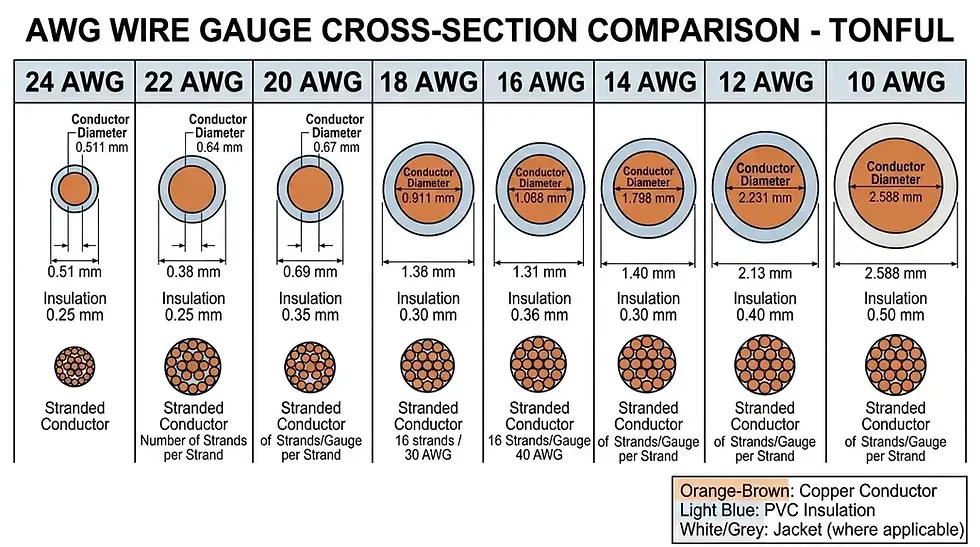
Cross-section: size it, don't guess it
Cross-section should come from the actual string current and cable run length, not from whatever a previous project used. As a general illustration of the underlying calculation — not project-ready guidance — a simplified single-core DC voltage drop works out to:
Voltage drop (V) ≈ (2 × Length in metres × Current in amps × 0.0175) ÷ Cross-section in mm²
A 30-metre run carrying 10A through 6mm² cable gives roughly (2 × 30 × 10 × 0.0175) ÷ 6 ≈ 1.75V of drop.
Whether that's acceptable depends on the system's operating voltage and the installer's tolerance for loss — this is a standard electrical formula, not a manufacturer figure, and a qualified designer should confirm actual sizing for any real project. Longer ground-mount runs common in the Northern Cape and Free State need larger cross-sections even where current is modest, purely to hold voltage drop within range.
Conductor material is usually bare fine-strand copper; tinned copper adds corrosion resistance worth asking for on coastal KwaZulu-Natal or Western Cape installations, though not every cross-section is necessarily stocked in tinned copper as standard.
Voltage, temperature and UV — check the actual certificate, not the label

South African industry guidance (again from South Ocean Electric Wire) points to 1.5kV DC-rated cable, usable up to roughly 1.8kV DC, as the relevant benchmark under SANS IEC 62930. As string voltages climb on larger C&I and utility systems, confirm the cable's rated voltage against your actual design voltage rather than trusting a generic "solar cable" label — a rating mismatch is a safety-margin problem, not just paperwork.
Certified PV cable is tested for a wide ambient operating range and a maximum conductor temperature that comfortably covers South African rooftop and ground-mount conditions, including the high daytime temperatures typical of the Northern Cape. The UV and ozone resistance built into a properly formulated cross-linked jacket compound is exactly what the substandard imports referenced above tend to lack — this is where a real certificate earns its cost.
Halogen-free construction for enclosed runs
Where cable runs through ceilings, roof spaces, or plant rooms close to other wiring — the norm for residential hybrid backup systems — a halogen-free, low-smoke jacket construction is worth specifying, since it's a fire-safety consideration distinct from the cable's outdoor weathering performance.
Cable Selection Across South Africa's Solar Use Cases
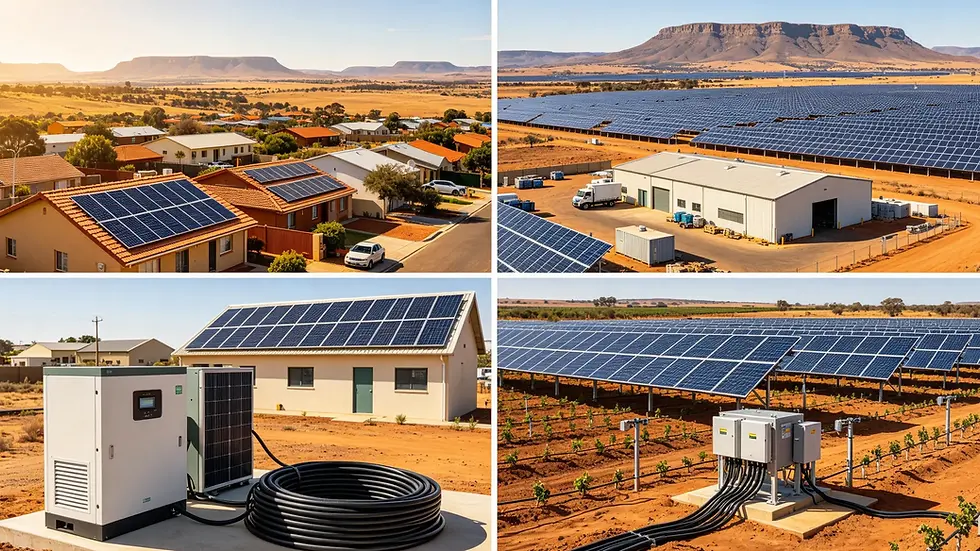
Residential and small commercial backup (hybrid) systems. This is the segment load shedding created almost overnight: solar, battery, and often an existing generator, wired to keep essential circuits alive through outages. Runs are usually short but pass close to other household or building wiring, which is why halogen-free construction and correct separation from AC circuits matter more here than raw thermal margin.
C&I rooftop systems. Installations in Johannesburg, Cape Town, and Durban typically have moderate run lengths with sustained direct UV exposure between panels and combiner boxes. Voltage drop over the specific run is usually the more relevant sizing question than thermal margin, since certified cable already has headroom for rooftop heat; larger commercial buildings should also check whether the project's fire specification calls for a defined fire-reaction class.
Utility-scale and large ground-mount in high-irradiance regions. Northern Cape and Free State projects involve long DC runs between array and inverter under sustained high ambient and ground-surface temperatures — cross-section sizing for voltage drop, plus dust and abrasion resistance on exposed runs, are the priorities.
Rural, agricultural and off-grid systems. Ground-mounted arrays with limited maintenance access need UV and thermal resistance for the long term, and, on farms or bush-adjacent sites, rodent-resistant construction is worth confirming directly with the supplier rather than assumed.
Theft Risk: A Design Consideration Specific to This Market

South Africa's cable theft problem is large enough that it shapes engineering decisions, not just security ones. Eskom alone has reported losing billions of rand annually to copper cable theft, and the problem extends to solar installations directly — coordinated theft of panels, inverters, and cabling from residential, farm, and commercial sites has become common enough that physical hardening (tamper-resistant fixings, secured enclosures, marked equipment) is now standard advice for installers.
For most rooftop PV string cable, this is a secondary concern — the wire is comparatively low-value scrap and usually not the primary target compared to inverters, batteries, and panels themselves. It becomes a more direct design question for exposed or buried runs on farms, ground-mount arrays in unattended locations, and any cable routed where it's accessible without entering a building. Cable manufacturers have been developing theft-resistant conductor options — tinned copper-clad aluminium alloy constructions with lower scrap value — for high-theft grid applications, though industry commentary has also flagged that South Africa's cable standards (SANS 1507) don't yet formally accommodate these alternative conductor materials, which limits how readily they're specified. For a typical PV installation, the more practical response is standard: secure cable trays and conduit for exposed runs, physical hardening of accessible sections on rural or unattended sites, and not routing cable in a way that leaves long unattended lengths exposed at ground level.
Standards, Certification and Verifying What You're Buying

South Africa has adopted IEC 62930 directly as a national standard, referenced in local industry material as SANS IEC 62930; EN 50618 is the earlier European standard covering similar scope. These, not a country-specific construction standard, are what to look for on a Chinese supplier's datasheet and certificate.
Checking a certificate is worth doing properly rather than accepting an image at face value. TÜV Rheinland certificates are verifiable by certificate number through Certipedia.com; ISO management-system certificates issued in China are typically checkable through the China National Certification and Accreditation Administration at cnca.gov.cn. Ask for the certificate number, the issuing body, and — critically — whether the certified scope actually covers the specific cross-section and construction you're ordering, since a specialized variant (fire-rated, submersion-tested) is sometimes certified across a narrower size range than the manufacturer's standard product line.
If a project's fire specification calls for a defined fire-reaction classification such as B2ca-s1a,d0,a1 under the EU Construction Products Regulation, confirm with the project's fire engineer how — or whether — that specific European framework is referenced in the applicable South African building requirements, rather than assuming it transfers automatically. This guide can't state confidently how broadly that scheme applies locally; it's a genuine confirm-before-you-rely-on-it item, not a formality.
South Africa's Import Rules: A Genuinely Different Shape
Some import markets run a single mandatory scheme that any cable shipment must clear before customs release. South Africa's structure is different, and worth understanding precisely rather than assuming either a hard gate or no oversight.
The National Regulator for Compulsory Specifications (NRCS) requires a Letter of Authority (LOA) — issued to the manufacturer or a registered South African importer — for products under an active compulsory specification, including certain AC power cable categories (VC 8075, VC 8077) and inverters (VC 9006), backed by a formal customs-control arrangement with SARS. DC solar cable itself, along with most passive balance-of-system components, currently sits outside a dedicated compulsory specification, though it's still expected to meet applicable IEC/SANS technical standards. In practice, that means compliance for solar cable specifically currently rests more on buyer diligence and voluntary certification than on a single mandatory customs gate — which is exactly why the certificate-verification steps above matter as much as they do.
This is also a moving target. In 2026, South Africa's Department of Trade, Industry and Competition introduced a Pre-Export Verification of Conformity (PVoC) programme for imported products outside existing NRCS specifications — naming solar panels and generators among the covered examples — requiring a Certificate of Conformity issued through a South African Bureau of Standards (SABS) arrangement with a Chinese conformity partner. Whether this extends to solar cable specifically isn't something this guide can confirm; check directly with SABS, NRCS, or a customs clearing agent at the time of ordering, since scope details of a newly introduced programme are precisely the kind of thing that shifts.
Grid-tied embedded generation rules (commonly referenced through NRS 097) are a separate, system-level compliance topic handled at the inverter and connection-agreement level, not the cable-specification level — off-grid systems are generally exempt, but confirm applicability with the project's electrical engineer if relevant.
Sourcing and Vetting a Chinese Supplier
Buying direct instead of through a local distributor usually means a lower unit price, a wider range of cross-sections and constructions, and a longer lead time, with certification verification landing squarely on the buyer instead of being pre-checked. That trade-off is worth accepting for larger or project-specific orders; for a small or urgent order, a local distributor with stock on hand and compliance already checked is often the more sensible choice.
When evaluating a supplier, go past the quoted price per metre. Ask what standard and cross-section the certificate actually covers, and get the certificate number to verify independently. Ask whether they're the manufacturer or a trading company reselling someone else's certified product — factory photographs, a matching registered company name on the certificate, and willingness to accept a third-party pre-shipment inspection are reasonable ways to check. Ask about export experience to South Africa or the broader Southern African region specifically, minimum order quantity, typical lead time, and whether a sample is available before committing to a full production run.
A useful request-for-quotation should specify: product type (e.g. H1Z2Z2-K single-core PV cable), conductor (bare or tinned copper), cross-section, required voltage rating, required standard (IEC 62930 / EN 50618), construction (standard, halogen-free, anti-rodent), colour, quantity, destination port, Incoterm, and required certificates (product certificate, test report, ISO 9001). Sending that level of detail to two or three suppliers, rather than "quote your best price for solar cable," is what makes their quotations actually comparable.
From Quote to Delivery

A first order is easiest to get right by working through it deliberately rather than chasing the cheapest number first: confirm the exact project specification, send the RFQ above to a shortlist of suppliers, verify certificate numbers directly rather than trusting the image sent, request and inspect a sample, compare quotations on the full set of factors above rather than price alone, agree a production timeline and, for larger orders, a pre-shipment inspection, confirm shipping documents and Incoterm, and confirm current NRCS/SABS/PVoC documentation requirements with a clearing agent before the shipment leaves China. Keep every certificate, test report, and batch record on file — not just for this order, but for the life of the installation, since a warranty, insurance, or compliance question years later is much easier to answer with paperwork already in hand.
Mistakes Worth Avoiding
The most common error is sizing cable from habit rather than calculation — reusing a previous project's cross-section instead of working from actual current and run length, which quietly increases voltage drop and reduces system output. A close second is treating a manufacturer's certification as blanket coverage for every product they make, when a specialized construction is often certified across a narrower size range than the standard line — always check the certificate's stated scope against the exact item being ordered.
On the compliance side, the mistake to watch for is assuming DC solar cable follows the same mandatory-certificate path as inverters, when currently it doesn't — leading either to unnecessary delay chasing a certificate that isn't required, or, worse, to skipping diligence altogether on the assumption that "no mandatory certificate" means "no risk." Confirm current status directly rather than assuming either direction. And on the supplier side, taking a certificate image at face value without checking the number, or without confirming you're dealing with the actual manufacturer rather than a reseller, is the single easiest way to end up with cable that doesn't match what was shown during sourcing.
What Actually Drives Landed Cost
There's no single "solar cable price for South Africa" worth quoting, since it moves with conductor material, cross-section, construction, certification overhead, packaging, order volume, and shipping terms — but it's worth understanding the pieces. The base cable price is driven mainly by copper content and construction type; genuine certification and testing add real cost, not padding. Incoterms determine who carries freight and insurance risk from the Chinese port onward — FOB leaves that to the buyer (usually cheaper with an established freight forwarder), CIF has the seller include it in the price (usually simpler for a first-time importer). Add the rand-dollar exchange rate, since it can move a landed-cost estimate meaningfully between quotation and payment, and destination-port charges and any clearing-agent fees confirmed with your agent.
The lowest per-metre quote isn't automatically the lowest total cost. Cable without verifiable certification, or unsuited to its installation environment, can generate replacement, delay, or dispute costs — with an insurer, a client, or an inspector — that dwarf the initial saving.
Frequently Asked Questions
Q1: Is Chinese-manufactured solar cable actually safe for South African conditions?
A: It depends entirely on the specific product's tested ratings, not on country of manufacture. Reputable Chinese manufacturers produce cable certified to IEC 62930 and EN 50618 with thermal and UV performance that comfortably covers South African conditions — the risk documented by local industry has been about substandard imports lacking real certification, not Chinese manufacturing as a category.
Q2: Does DC solar cable need an NRCS Letter of Authority?
A: Not currently — unlike inverters (VC 9006) or certain AC cable types, DC solar cable isn't under a specific NRCS compulsory specification today, though it should still meet applicable IEC/SANS standards. This is an evolving area given the new PVoC programme, so confirm current status with NRCS, SABS, or a clearing agent before assuming either way.
Q3: What voltage rating should I specify?
A: Match it to your system's actual DC string voltage. South African industry guidance points to 1.5kV DC-rated cable, usable to around 1.8kV DC, as the SANS IEC 62930 benchmark — if your design exceeds a specific cable's rating, raise it with the supplier directly.
Q4: How do I actually verify a supplier's certificate?
A: Get the certificate number and issuing body, then check it yourself — TÜV Rheinland certificates via Certipedia.com, Chinese ISO certificates via cnca.gov.cn. A claim of "certified" without a checkable number isn't verification.
Q5: Does copper theft mean I should avoid copper solar cable?
A: Not generally — for most rooftop string cable, theft risk is a secondary concern compared to inverters and panels. It's worth a deliberate decision mainly for exposed or unattended ground-mount and rural runs, where physical securing of the cable route matters more than swapping conductor material, given that theft-resistant alternative conductors aren't yet fully accommodated in South African cable standards.
Q6: FOB or CIF — which should I choose for a first order?
A: CIF is usually simpler for a first-time importer, since the supplier arranges freight and insurance to the destination port. FOB can offer better total value once you have an established freight forwarder relationship.
Q7: Should I get a sample before placing a full order?
A: Yes, particularly with a new supplier or before a first delivery against a specific project's requirements — it's the cheapest point at which to catch a specification mismatch.
Q8: What documents should I keep on file after the shipment arrives?
A: The product certificate with its verifiable number, the underlying test report, the manufacturer's ISO 9001 certificate, batch-specific quality inspection records, and the packing list — retained for the life of the project, not just the import process.
Conclusion
South Africa's solar cable market runs on a paradox worth holding onto: the demand is driven by urgency — outages that don't wait for a slow procurement process — but the buying decision that actually protects a project rewards patience, specifically the patience to check a certificate number rather than trust a datasheet. Direct sourcing from a genuine, verifiably certified Chinese manufacturer is a sound way to buy solar cable for a South African project. The failure mode local industry keeps warning about isn't imported cable in general — it's unverified cable, imported or not, sold on the assumption that nobody will check.


Comments