
16 AWG Wire in mm²: Diameter, Ampacity and Where This Gauge Actually Belongs
- Vicky

- 1 day ago
- 7 min read
Introduction
16 AWG generates a different kind of question than the larger building-wire gauges. Instead of “what breaker do I need,” the question is usually “can I use this for a lamp cord,” “is this safe for my extension cord,” or “what's the metric size for this control cable I'm sourcing overseas.” That's because 16 AWG rarely appears as a fixed branch-circuit conductor — it lives in cords, control panels, low-voltage systems, and light-duty wiring instead.
This guide covers what 16 AWG measures in mm², its physical dimensions, its ampacity in the contexts where it is actually used, how it compares with 14 AWG and 18 AWG, and the applications — and mistakes — that matter most for this particular gauge.
What Is 16 AWG Wire? Definition and Physical Specifications
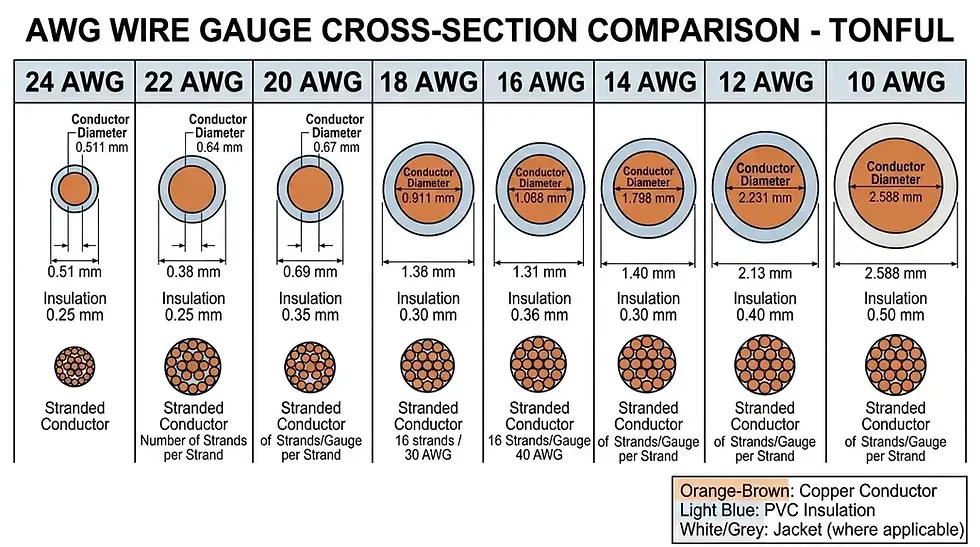
16 AWG follows the same American Wire Gauge standard (ASTM B258) as every other size on the chart, with the same inverse logic: a higher number means a thinner conductor. 16 AWG sits between 14 AWG (thicker, used for fixed branch circuits) and 18 AWG (thinner, used for very light-duty signal and control wiring).
Unlike 14 AWG and larger sizes, 16 AWG is generally not covered by the NEC's building-wire ampacity table (Table 310.16), which starts at 14 AWG. Instead, 16 AWG ampacity is governed by the flexible-cord table (NEC Table 400.5) and fixture-wire rules (NEC Article 402), which is an important distinction when specifying this gauge.
Physical Dimensions of 16 AWG Wire
• Conductor diameter: approximately 1.29 mm (solid conductor)
• Cross-sectional area: approximately 1.31 mm²
• DC resistance at 20°C: approximately 13.2 Ω/km (copper)
• Approximate weight (copper): 11.6 kg/km
Because 16 AWG is used almost exclusively in flexible applications — cords, control cables, appliance leads — the stranded form is far more common than solid. Fine-strand construction keeps the cable flexible enough for repeated flexing in cords and moving equipment.
16 AWG in mm²: The Metric Conversion
The direct answer: 16 AWG = 1.31 mm² (exact calculated value). On the IEC metric scale, the closest standard sizes are 1.0 mm² and 1.5 mm².
Following the same rule used across the AWG-to-metric conversion — always round up to the nearest standard size at or above the AWG equivalent — the correct IEC substitute for 16 AWG is 1.5 mm², not 1.0 mm². Specifying 1.0 mm² undersizes the conductor by more than 20%, which matters more at this small gauge than it might seem, since resistance rises quickly as cross-section shrinks.
AWG to mm² Conversion Chart with Amp Ratings
The chart below places 16 AWG next to its immediate neighbors. Because 16 AWG and 18 AWG are governed by cord and fixture-wire tables rather than the building-wire table, their ampacity figures are shown as general references and vary by product construction and insulation.
AWG Size | Exact Area (mm²) | Nearest IEC mm² | Diameter (mm) | Resistance (Ω/km) | Typical Ampacity |
18 AWG | 0.82 mm² | 1.0 mm² | 1.02 mm | 21.0 | ≈ 7–10 A (cord use) |
16 AWG | 1.31 mm² | 1.5 mm² | 1.29 mm | 13.2 | ≈ 10–13 A (cord use) |
14 AWG | 2.08 mm² | 2.5 mm² | 1.63 mm | 8.45 | 15 A (branch circuit) |
12 AWG | 3.31 mm² | 4 mm² | 2.05 mm | 5.21 | 20 A (branch circuit) |
16 AWG Ampacity: How Much Current Can It Carry?

Because 16 AWG falls outside the standard building-wire ampacity table, its rating depends heavily on what type of product it is — lamp cord, appliance cord, fixture wire, or a multi-conductor control cable — and on the insulation and number of current-carrying conductors involved:
• Light-duty cord (SPT-1/SPT-2 style, 2 conductors): often referenced around 10 amps
• Heavier-duty flexible cord with higher-temperature insulation: up to roughly 13 amps
• Multi-conductor control or instrumentation cable: ampacity is generally set by the lowest-rated conductor in the bundle and derated further as conductor count increases
The most important rule with 16 AWG is not a number — it is a boundary. This gauge should not be treated as a substitute for 14 AWG in a fixed, in-wall branch circuit. NEC building-wire rules do not recognize 16 AWG for that purpose, and doing so removes an important safety margin the code is built around.
16 AWG Wire Diameter and Why It Matters

• Ferrule and crimp-terminal sizing: control-panel wiring at 16 AWG needs correctly sized ferrules; a terminal designed for 14 AWG will not grip 16 AWG securely
• Flexibility for cords and moving equipment: the smaller bundle diameter and fine stranding make 16 AWG far more flexible than 14 AWG, which matters for cords, robotics, and vibration-prone connections
• Cable and conduit fill in control cabinets: many small 16 AWG conductors packed into a cabinet raise fill and heat-dissipation considerations even though each conductor carries modest current
• Connector compatibility: small-format connectors (JST, Molex, terminal blocks rated for 0.75–1.5 mm²) are frequently matched to 16 AWG rather than the larger building-wire connector classes
16 AWG vs 14 AWG vs 18 AWG: Choosing the Right Wire Size

Choose 16 AWG over 18 AWG when a cord or control run needs a bit more current headroom or a longer run length where voltage drop starts to matter — landscape lighting and longer thermostat runs are typical examples. Choose 14 AWG instead of 16 AWG whenever the application is a fixed branch circuit; 16 AWG is not a legitimate substitute there, regardless of the load being light.
Parameter | 18 AWG (1.0 mm²) | 16 AWG (1.5 mm²) | 14 AWG (2.5 mm²) |
Typical ampacity | ≈ 7–10 A (cord) | ≈ 10–13 A (cord) | 15 A (branch circuit) |
DC Resistance | 21.0 Ω/km | 13.2 Ω/km | 8.45 Ω/km |
Flexibility | Highest | High | Moderate |
Fixed branch-circuit use | Not permitted | Not permitted | Permitted (15 A max) |
Typical role | Signal/control, thin cords | Cords, control cable, LED wiring | Lighting circuits, general wiring |
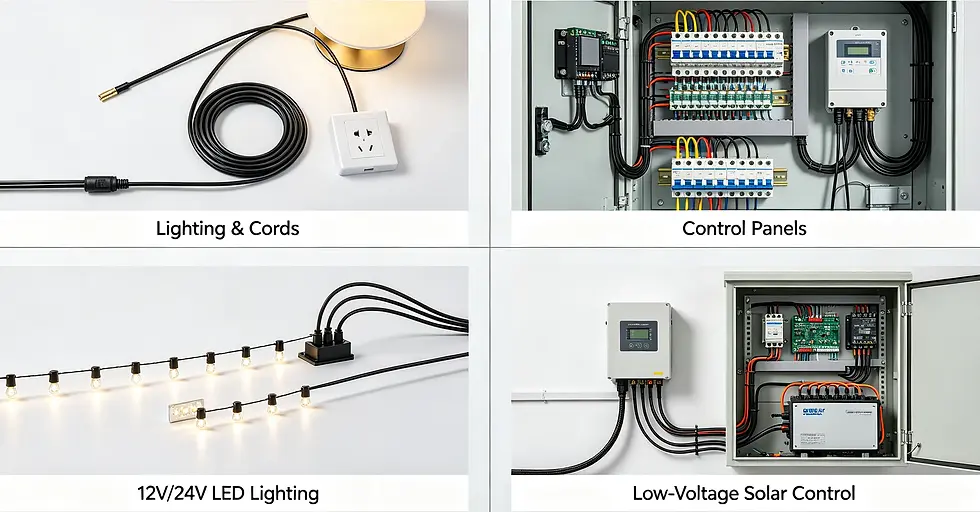
Applications for 16 AWG Wire: Where Is It Used?
Cords and Portable Equipment
• Extension cords and lamp cords for light-duty household use
• Small appliance power cords
• Portable tool and equipment leads within their rated current limits
Control, Signal, and Low-Voltage Systems
• Thermostat and HVAC low-voltage control wiring, especially on longer runs where 18 AWG would suffer excessive voltage drop
• Doorbell and Class 2 low-voltage control circuits
• Instrumentation and sensor cabling inside control panels and enclosures
Lighting and 12V/24V DC Systems
• LED strip and landscape lighting wiring, particularly for medium-length runs
• Automotive and marine 12V accessory wiring for moderate loads
• Speaker wire for typical home-audio run lengths
Solar and Battery Auxiliary Wiring
• Communication and RS-485/sensor wiring between inverters, charge controllers, and monitoring equipment
• Fan, damper, and small relay control loops inside combiner and inverter enclosures
Common Mistakes When Using 16 AWG Wire
• Using 16 AWG as a substitute for 14 AWG in fixed, in-wall branch-circuit wiring
• Overloading an extension cord beyond its printed ampacity rating because “16 AWG felt fine for a smaller cord”
• Ignoring voltage drop on longer 12V/24V DC runs — low-voltage systems are far more sensitive to resistance than 120V circuits
• Specifying 1.0 mm² IEC cable as a direct substitute for 16 AWG instead of the correct 1.5 mm²
• Mismatching ferrule or connector size, leading to loose crimps and intermittent connections in control panels
• Assuming a higher-temperature-rated cord automatically means a proportionally higher ampacity without checking the manufacturer's rating
Is 16 AWG Equal to 1.5 mm²? Understanding IEC vs AWG
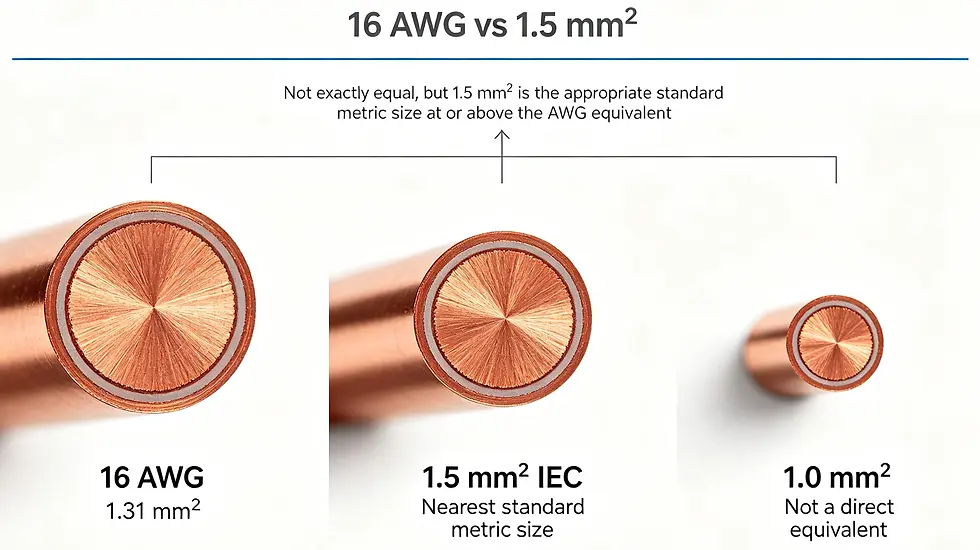
Not precisely — 16 AWG measures 1.31 mm², while true IEC 1.5 mm² cable is slightly larger. But 1.5 mm² remains the correct substitute because it is the nearest standard IEC size at or above the AWG equivalent, it comfortably meets or exceeds 16 AWG's current capacity across typical cord and control applications, and it matches the connector and terminal classes designed around that cross-section. Using 1.0 mm² instead would undersize the conductor by more than 20% — a meaningful gap at this scale.
Frequently Asked Questions
Q: What is 16 AWG wire in mm²?
A: 16 AWG measures approximately 1.31 mm² in cross-sectional area. The correct IEC metric equivalent to specify is 1.5 mm².
Q: How many amps can 16 AWG wire carry?
A: It depends on the product type — typical light-duty cord applications sit around 10 amps, with heavier-duty cord constructions reaching roughly 13 amps. 16 AWG is not assigned a rating in the NEC building-wire table.
Q: Can 16 AWG be used for a branch circuit in a wall?
A: No. 16 AWG is governed by cord and fixture-wire rules, not the building-wire ampacity table, and it is not a recognized substitute for 14 AWG in fixed branch-circuit wiring.
Q: What is the diameter of 16 AWG wire?
A: A solid 16 AWG conductor measures approximately 1.29 mm in diameter. Stranded versions have a similar copper cross-section with a slightly larger overall bundle diameter.
Q: Is 16 AWG the same as 1.5 mm² cable?
A: Not exactly — 16 AWG is 1.31 mm² and IEC 1.5 mm² is slightly larger — but 1.5 mm² is the correct and safe metric substitute for sourcing purposes.
Q: What's the difference between 16 AWG and 14 AWG?
A: 14 AWG has a larger cross-section (2.08 mm² vs. 1.31 mm²), lower resistance, and is recognized for fixed 15-amp branch circuits, while 16 AWG is intended for cords, control wiring, and other flexible, lower-current applications.
Q: Is 16 AWG good for LED strip or 12V wiring?
A: Yes, for moderate loads and typical run lengths. For longer runs or higher-current LED or 12V DC systems, voltage drop should be calculated, and a larger gauge may be needed to keep the drop within acceptable limits.
Conclusion
16 AWG wire converts to approximately 1.31 mm², with 1.5 mm² as the correct IEC equivalent for international sourcing. Its role is defined less by a single amp rating and more by the type of product it appears in — cords, control cabling, low-voltage lighting, and instrumentation wiring — where its flexibility and compact size are the main advantages.
The clearest rule to remember is what 16 AWG is not: it is not a substitute for 14 AWG in fixed branch-circuit wiring. Respecting that boundary, and matching the gauge to the cord, control, or low-voltage application it was designed for, keeps both safety and performance where they need to be.
Source 16 AWG Control Cable and 1.5 mm² Wire from FRCABLE
FRCABLE manufactures flexible copper conductors in both AWG and metric sizes for control, instrumentation, and low-voltage applications, including:
• 1.5 mm² flexible control and instrumentation cable — the metric equivalent of 16 AWG
• 16 AWG stranded cord and control wire for North American installations
• Fine-strand copper construction for flexibility in cords, panels, and moving equipment
• PVC, XLPO, and other insulation options for indoor, outdoor, and solar/battery enclosure environments
Our technical team can help verify cross-section equivalence, connector compatibility, and certification requirements for your specific control, cord, or low-voltage cabling project.


Comments