
4 AWG Copper Wire Guide (NEC US): Ampacity, Voltage Drop, Insulation & Installation

Updated: Apr 23
If you’re searching for 4 awg copper wire, you’re usually trying to solve one (or more) of these problems: What current can it safely carry? Will it cause an unacceptable voltage drop over distance? Which insulation type is allowed for your installation? And—often overlooked—how do you terminate it correctly with the right lugs and crimp process?
This guide focuses on practical, NEC-aligned selection steps used in the United States, including 4 AWG copper wire ampacity, 4 AWG voltage drop considerations, insulation choices (THHN / THWN-2 / XHHW-2), and installation/termination best practices.
Safety & code notice: This is educational information. Always follow the latest NEC adopted by your jurisdiction, product markings, device listings, and local amendments. For high-stakes work, use a licensed electrician.
What is 4 AWG copper wire?
4 AWG copper wire refers to a conductor that is:
Copper (material),
4 AWG (American Wire Gauge size),
Installed with a specific insulation type and temperature rating (for ampacity and termination compatibility).
In practical US projects, 4 AWG copper conductors are commonly used for:
feeders and larger branch circuits,
equipment wiring where conductor size and temperature/termination matter,
some DC/solar-related wiring (depending on insulation, environment, and system design).
Key point: In real NEC work, you don’t decide “4 AWG = X amps” by size alone. You decide it by ampacity conditions.

NEC-based selection: don’t guess—match conditions
When you choose 4 awg copper wire, the NEC approach is essentially:
Start with conductor construction & insulation rating
Confirm temperature rating and installation location (dry/wet)
Check installation details that affect ampacity (NEC adjustment factors)
Verify overcurrent protection and terminal ratings
Then check performance goals like voltage drop
This order prevents one of the most common issues: selecting a wire size that looks “big enough,” but ends up failing due to conditions, terminations, or thermal limits.

4 AWG copper wire ampacity
4 AWG copper wire ampacity is determined primarily by the conductor’s insulation type and temperature rating, then adjusted by installation conditions (for example, ambient temperature and number of conductors).
Step-by-step: how engineers/electricians typically handle ampacity
Pick the insulation type (for example, THHN, THWN-2, XHHW-2) and identify the conductor’s temperature rating.
Look up ampacity for 4 AWG copper in the relevant NEC conductors table (commonly referenced as NEC Table 310.16 for ampacity by insulation/temperature).
Apply NEC adjustment factors for real installation conditions (not just the bare table).
If the load is continuous, apply the NEC continuous-load design approach (commonly using the “125% rule” concept for sizing conductors/overcurrent devices).
Common mistakes to avoid
Assuming a fixed ampacity without confirming the insulation temp rating.
Ignoring installation conditions that require adjustment (conduit fill, ambient temperature, conductor grouping, etc.).
Forgetting that termination points can impose their own limits (often dictated by the device/terminal listing temperature rating).
4 AWG voltage drop: when it matters and how to calculate
A 4 AWG voltage drop problem usually shows up when:
the run is long,
the system is low voltage or sensitive to voltage,
motors, inverters, or electronic equipment require stable voltage to perform correctly,
you’re targeting a specific design performance percentage.
Why voltage drop isn’t only about wire size
Even though a larger conductor (like 4 AWG) reduces impedance, voltage drop depends on:
current (I),
conductor resistance (R),
length (L),
and circuit type (single-phase vs three-phase).
For the resistance value, many NEC-based methods pull conductor resistance from NEC informational sources (commonly referenced tables), or from manufacturer data consistent with the assumed temperature.
Example
If current or length increases, voltage drop increases roughly proportionally. That’s why for long runs, you may keep 4 AWG for ampacity but still need to check whether performance goals are met.
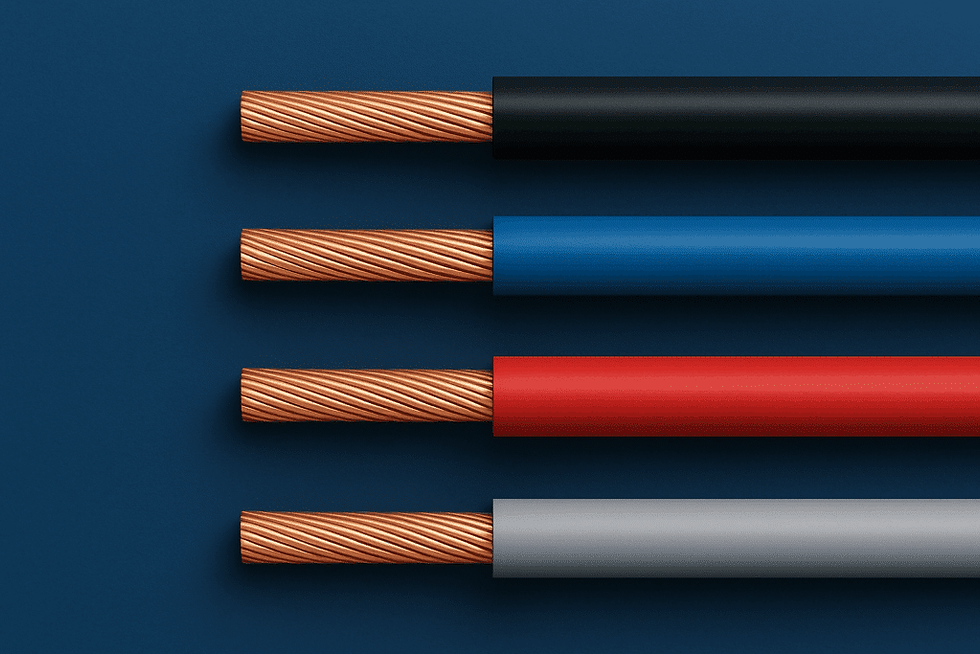
Choosing insulation for 4 AWG: THHN vs THWN-2 vs XHHW-2
If you search 4 AWG THHN wire or THHN vs THWN-2 vs XHHW-2, you’re usually trying to solve: “Can I use this in wet locations or where moisture is expected?”
How to think about insulation choice
Confirm whether your installation is treated as dry or wet, and what the NEC rules require for that location/type.
Check the cable jacket/printing for the insulation type designation and temperature rating.
Make sure the insulation type is allowed with your installation method (conduit/cable tray/etc.) and compatible with terminations.
Rule of thumb
THWN-2 / XHHW-2 are commonly used when wet-rated capability is required.
THHN is often associated with dry locations (but always verify markings and allowances).
Final decision should be based on product listing and NEC allowances, not marketing.
Breaker sizing and overcurrent protection: wire size alone is not enough
One of the most important sections for SEO and user intent is: people often ask, “What breaker size for 4 AWG copper?”
The most correct answer is: choose overcurrent protection based on the conductor ampacity, insulation/temperature conditions, and NEC overcurrent protection rules—not by guessing from wire size alone.
Also remember:
terminals (lugs, breakers, device wiring points) may have temperature ratings,
continuous loads require correct sizing methodology,
derating conditions can change what the “effective” ampacity is.

Common uses for 4 AWG copper wire in the US
Branch circuits & feeders
When the design calls for higher current capability and acceptable voltage drop, 4 AWG copper wire can be part of feeder or branch conductor sizing.
Equipment wiring
For equipment circuits, termination quality and matching lug type/size become critical. Even if the wire is correct, a poor termination can create heat and failure.
Solar/DC-related wiring
Some projects use 4 AWG copper for DC wiring (for example, depending on
insulation and system design). For DC circuits, connector quality, polarity discipline, and insulation suitability matter even more.

Grounding and bonding: when 4 AWG copper grounding wire comes into play
You may encounter 4 AWG copper grounding wire questions in equipment grounding and bonding contexts.
However, grounding/bonding conductor sizing and application are rule-based:
confirm the system type and requirements,
verify whether 4 AWG is allowed for the specific grounding/bonding function,
ensure terminations meet corrosion/connection requirements.
Terminations & crimp lugs: the part that fails most often
If you want 4 AWG copper wire to perform reliably, the termination must be correct:
the lug must match the conductor size (4 AWG range),
the lug must be compatible with copper,
and your crimp method/die selection must be correct.
High-impact termination checklist
Use the correct crimp die matched to the lug manufacturer/spec.
Ensure the conductor is fully seated correctly (no conductor strands left partially outside).
Follow the lug manufacturer’s torque instructions.
If required for the environment, use appropriate sealing methods (for example, insulating boots or moisture protection solutions—based on the connection listing and environment).
Installation checklist for 4 AWG copper wire
Before you close the junction box, verify:
Cable protection: avoid abrasion and physical damage to insulation.
Bend radius: don’t exceed allowable bend radius for the cable type.
Strip length: strip only what the termination requires (too much copper can cause shorts).
Torque & fit: tighten with the correct tool; don’t “guess tight.”
Identification: label circuits and maintain consistent polarity/scheme where applicable.
No reuse of damaged insulation: if the jacket is compromised, address it before energizing.
Buying tips: how to buy the right 4 AWG copper wire
When you shop for 4 awg copper wire, verify:
copper conductor (not copper-clad unless explicitly intended),
correct insulation type (THHN / THWN-2 / XHHW-2),
correct temperature rating for your system/terminals,
suitability for wet/dry locations as required,
packaging length and certificate/listing markings.
FAQ: 4 AWG copper wire (NEC US focused)
1) How many amps can 4 AWG copper wire carry?
The ampacity of 4 AWG copper wire depends on insulation type, temperature rating, and installation conditions. According to National Electrical Code (NEC) Table 310.16, typical values are:
60°C rating: ~85A
75°C rating: ~95A
90°C rating: ~115A
Actual allowable current may be lower after applying adjustment factors for ambient temperature, conduit fill, and bundling. Always ensure compatibility with terminal ratings and overcurrent protection devices.
2) How far can 4 AWG copper wire run?
There is no fixed maximum distance. Proper wire length is determined by:
Ampacity (safety requirement)
Voltage drop (performance requirement)
A common engineering guideline is to keep voltage drop within:
≤3% for branch circuits
≤5% total system
For longer distances, larger conductors may be required even if ampacity is sufficient.
3) Is THHN or THWN-2 better for wet locations?
For wet or damp environments, THWN-2 is generally the appropriate choice because it is rated for wet locations.
THHN: Primarily for dry locations (may be dual-rated in some cases)
THWN-2: Rated for both wet and dry environments, with higher temperature tolerance
Always verify the cable markings and ensure compliance with NEC requirements for the specific installation method.
4) Can I use 4 AWG copper wire for grounding?
Yes, but only if it meets the requirements defined by the NEC for grounding or bonding conductors. The correct size depends on:
Type of grounding (equipment grounding vs grounding electrode conductor)
System voltage and fault current
Associated overcurrent protection device
4 AWG copper is commonly used in grounding applications, but sizing must follow code tables and project-specific requirements.
5) What are signs of a bad crimp or termination?
Common indicators of improper termination include:
Loose or unstable connection
Visible conductor damage (cut strands or deformation)
Incomplete insertion into lug or connector
Overheating, discoloration, or insulation melting
Intermittent electrical faults
Proper installation requires correct tools, specified crimping force, and verification procedures such as pull testing or visual inspection.
Conclusion
A correct 4 AWG copper wire design is never “wire size only.” The winning approach is:
choose the right insulation/temperature rating,
determine ampacity using NEC-based conditions,
verify voltage drop for the performance target,
size overcurrent protection correctly, and
terminate with the right lugs and proven crimp practice.


Comments