
Staubli MC4 Male vs. Female Connectors: Differences, Compatibility, and How to Choose

If you have ever terminated a solar cable or wired up a photovoltaic (PV) array, you have almost certainly encountered an MC4 connector. Invented by Multi-Contact (now Stäubli Electrical Connectors) in 2004, the MC4 is the undisputed global benchmark for solar panel connections [1].
Yet, despite being an everyday component on job sites, MC4 connectors remain one of the most misunderstood parts in solar installations. Installers frequently ask:
“Why does my male MC4 connector contain a female metal socket?”
“Which connector goes on the positive (+) cable of the solar panel?”
“Are cheaper 'MC4-compatible' third-party brands safe to mate with original Stäubli parts?”
In this comprehensive guide, we unpack the MC4 "gender paradox," clarify DC polarity standards, address the legal and fire risks of cross-mating, and walk you through exact selection criteria for your next PV project.

1. The MC4 "Gender Paradox": Housing vs. Metal Terminal
The number-one source of confusion on job sites is the mismatch between the plastic housing and the internal metal contact.
In electrical engineering, "male" usually refers to a solid pin, while "female" refers to a hollow receptacle. In Stäubli MC4 connectors, the naming convention is based on the outer plastic housing—not the internal metal pin [1].
Breaking Down the Components
Component Feature | Male Connector (Plug) | Female Connector (Socket) |
Official Stäubli Model | PV-KST4 (Kupplungsstecker) | PV-KBT4 (Kupplungsbuchse) |
Outer Plastic Housing | Slim shell with two latching prongs/clips | Thicker sleeve with internal O-ring seal |
Internal Metal Terminal | Hollow socket contact (Female terminal) | Solid pin contact (Male terminal) |
Visual Recognition | Inserts into the female housing | Receives the male housing |
💡 Quick Memory Trick: Look at the plastic latching clips. If it has two flexible snap-in clips on the outside, it is a Male Plug (PV-KST4). If it is a smooth cylindrical receiver, it is a Female Socket (PV-KBT4).
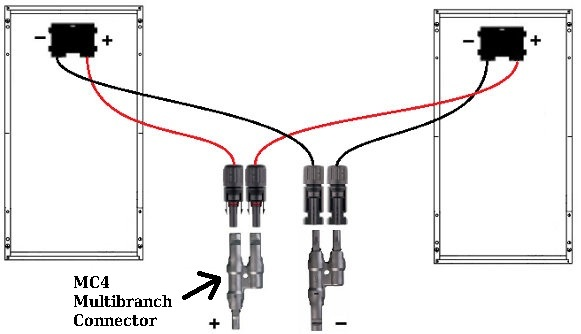
2. Solar Panel Polarity: Which Connector Goes Where?
When unboxing standard solar panels, you will notice factory-installed leads. Many beginners are shocked to find that the positive lead does not have a "male" metal pin connector housing.
Here is the universal industry standard convention:
[Solar Panel]
  ├── Positive Output (+) Lead  ───> Factory-terminated with FEMALE Housing (PV-KBT4)
  └── Negative Output (-) Lead  ───> Factory-terminated with MALE Housing (PV-KST4)
Why Did the Industry Standardize It This Way?
Safety against electrical shock. The positive lead carries direct current (DC) from the PV cells. By housing the positive live connection deep inside a recessed female plastic housing (PV-KBT4), it prevents the installer's fingers or tools from accidentally touching live conductors (IP2X touch protection).
Extension Cable Rule
When you build an extension or home-run cable from the solar array to your charge controller or inverter:
To connect to the panel’s Positive (+) Female lead, your extension wire requires a Male Connector (PV-KST4).
To connect to the panel’s Negative (-) Male lead, your extension wire requires a Female Connector (PV-KBT4).

3. What Makes Original Stäubli MC4 Connectors Unique?
With millions of counterfeit and generic connectors flooding the market, why do tier-one developers and EPCs insist on genuine Stäubli parts?
Patented MULTILAM Technology: Inside the female terminal contact sits a specialized gold- or silver-plated spring strip (MULTILAM). This creates multiple parallel contact points, keeping electrical resistance exceptionally low (≤0.25mΩ≤0.25mΩ) and preventing hotspots.
True IP68 Environmental Sealing: Stäubli’s high-grade elastomer seals resist ozone, extreme UV radiation, and hydrolysis, certified to withstand water submersion.
Locking Mechanism Compliance: Modern electrical codes (like NEC 690.33 and UL 6703) require that DC disconnects cannot be pulled apart by hand while energized. Genuine MC4s require a specialized unlock tool (PV-MS), preventing accidental disconnection and lethal DC arc flash [1].
4. The "MC4 Compatible" Trap: The Reality of Cross-Mating
A common cost-cutting practice is cross-mating—pairing an authentic Stäubli connector on a solar panel with a generic "MC4-compatible" connector on the inverter string cable.
Why "MC4 Compatible" Does Not Exist
"MC4" is a registered trademark of Stäubli Electrical Connectors, not an open standard. There is no universal public dimensional blueprint for an MC4 clone.
Even a 0.1 mm variance in the metal pin thickness, stamping curvature, or plastic thermal expansion coefficients can trigger catastrophic failure:
High Contact Resistance: Micro-gaps create electrical bottlenecks.
Thermal Runaway & Arcing: As high DC current flows, the terminal heats up, degrades the plastic, and eventually ignites a sustained DC arc fault—the primary cause of solar roof fires.
Voided Warranties and Code Violations:
NEC 690.33(C) states: “Where mating connectors are not of the same manufacturer and model, they shall be listed and identified for intermatability…” (Virtually no manufacturer has cross-listed their parts).
IEC 60364-7-712 expressly prohibits intermating connectors from different manufacturers.
In the event of a fire, insurance adjusters routinely deny claims if cross-mated connectors are found at the point of ignition.
Can You Mate MC4 with Stäubli MC4-Evo 2?
Yes. Stäubli has rigorously tested and officially certified cross-compatibility between standard MC4 and MC4-Evo 2 lines within their own ecosystem. However, mixing Stäubli with non-Stäubli brands remains strictly prohibited.
5. Selection Guide: How to Choose the Right Stäubli MC4 Connector
Selecting the right connector involves four key technical parameters:
Step 1: Check System Voltage (1000V vs. 1500V)
   │
Step 2: Match Cable Conductor Cross-Section (4 mm² vs. 6 mm² vs. 10 mm²)
   │
Step 3: Verify Cable Outer Diameter (Gland Seal Range)
   │
Step 4: Select Stamping Type (Open-crimp vs. Solid turned)
1. Rated Voltage: MC4 vs. MC4-Evo 2
Standard MC4 (PV-KST4 / PV-KBT4): Rated up to 1000V DC (IEC/UL), current up to 39A. Ideal for residential rooftops and small commercial arrays.
MC4-Evo 2 (PV-KST4-EVO 2 / PV-KBT4-EVO 2): Rated up to 1500V DC, current up to 45A–69A depending on cable size. The global standard for large utility-scale systems and modern commercial strings.
2. Cable Conductor Cross-Section (Gauge)
Stäubli contacts are engineered for specific wire diameters. Choosing the wrong size leads to poor mechanical pull-out strength:
2.5mm2 / 14 AWG (Light-duty auxiliary circuits)
4.0–6.0mm2 / 12–10 AWG (Most standard residential and commercial PV strings)
10mm2 / 8 AWG (Long home-run cables requiring minimal voltage drop)
3. Outer Cable Diameter (OD) & Cable Gland
The rubber compression bushing on the back of the MC4 connector creates the IP68 seal. You must match the gland to your solar cable’s outer jacket thickness:
Gland Range 1 (Small): For cable OD
5.5–7.4mm5.5–7.4mm
Gland Range 2 (Large): For cable OD
7.0–8.8mm7.0–8.8mm

6. Proper Installation & Crimping Best Practices
Even authentic Stäubli connectors will fail if installed improperly. Follow these golden rules on site:
Use Dedicated MC4 Crimping Tools: Never use standard wire strippers, pliers, or generic automotive crimpers. Use a calibrated ratchet crimping tool designed with an open-barrel die (e.g., Stäubli PV-CZM or certified equivalents).
Listen for the "Click": When mating the male and female housings, push them together firmly until you hear a distinctive mechanical snap. Inspect the latching tabs to confirm full engagement.
Use the PV-MS Assembly Spanner: Tighten the back gland nut to the manufacturer’s specified torque until the ratchet slips or the nut bottoms out against the housing ridge.
NEVER Disconnect Under Load: Solar strings generate hundreds of volts of live direct current. Disconnecting an MC4 connector while current is flowing will create a continuous electrical arc capable of burning your hands, destroying the connector, and igniting nearby materials. Always shut off the DC isolator or string inverter first.
Frequently Asked Questions (FAQ)
Q1: Is the positive terminal on a solar panel a male or female MC4?
The factory positive (+) lead of a solar module features a female housing (PV-KBT4) which contains a solid male metal pin.
Q2: How can I tell if an MC4 connector is genuine Stäubli?
Authentic Stäubli connectors have the Stäubli or Multi-Contact logo stamped directly into the plastic housing. Look inside the female terminal: you should clearly see the intricate, spring-loaded MULTILAM metal band lining the socket.
Q3: Can I cut off factory MC4 connectors to wire panels directly to a terminal block?
Cutting off factory MC4 connectors usually voids the solar panel manufacturer's warranty. It is far better practice to build a short jumper cable with an authentic MC4 connector on one end and bare wire / bootlace ferrule on the other.
Summary: Building Safe and Reliable Solar Connections
Understanding the difference between Stäubli MC4 male (PV-KST4) and female (PV-KBT4) connectors is not just a matter of semantics—it directly affects installation safety, panel polarity, and system uptime.
To avoid costly warranty disputes, electrical arc faults, and inspection failures:
Identify connectors by their locking tabs (male) vs. receptacle sleeves (female).
Remember that the panel’s positive (+) wire has a female housing.
Never cross-mate genuine Stäubli connectors with unauthorized third-party clones.
Always select your connector model based on cable cross-section (
4/6mm24/6mm2) and gland outer diameter.
Need genuine Stäubli MC4 connectors, crimping tools, or UL-certified PV cable assemblies for your next solar build? Explore our technical catalog or get in touch with our engineering team for bulk specifications.


Comments