
How Many 8 AWG Wires Fit in 3/4-Inch Conduit?

How many 8 AWG wires can fit in 3/4-inch conduit?
The answer depends on the conduit type and the insulation dimensions of the conductors.
For typical 8 AWG THHN/THWN-2 conductors, a 3/4-inch EMT conduit can accommodate up to six conductors under standard conduit-fill calculations. A 3/4-inch PVC Schedule 40 conduit can accommodate five, while PVC Schedule 80 can accommodate four.
These figures are based on standard conduit-fill tables for conductors of the same size and type. They should not be applied automatically to every 8 AWG wire, because different insulation systems have different outside diameters and different conduit types have different internal dimensions.
It is also important to distinguish conduit fill from electrical ampacity. The number of wires that physically fit inside a conduit does not determine how much current those wires can safely carry. When multiple conductors carry current, additional ampacity calculations may be required.
This guide explains how many 8 AWG wires fit in 3/4-inch conduit, compares EMT and PVC conduit, explains the 40% conduit-fill rule, and covers the key considerations for selecting and installing electrical conductors.
How Many 8 AWG Wires Can Fit in 3/4-Inch Conduit?
The maximum number of 8 AWG conductors depends on the conduit material, schedule, internal diameter, and wire insulation type.
For typical THHN/THWN-2 conductors, the following table provides a useful reference.
3/4-inch conduit type | Maximum 8 AWG THHN/THWN-2 conductors |
EMT (Electrical Metallic Tubing) | 6 |
PVC Schedule 40 | 5 |
PVC Schedule 80 | 4 |
These values correspond to commonly published conduit-fill tables based on NEC conduit-fill requirements. Verify the applicable table and code edition before using them for an actual installation.
Why Does the Conduit Type Matter?
Although EMT and PVC conduit may share the same nominal trade size, their internal dimensions are not identical.
EMT is a metallic raceway with its own specified wall thickness and internal area. PVC conduit is available in different schedules, and thicker walls reduce the available interior space.
PVC Schedule 80 generally has a thicker wall than Schedule 40, leaving less room for conductors of the same size.
As a result, the maximum number of 8 AWG conductors can differ even when all three conduits are labeled 3/4 inch.
The nominal conduit size is therefore not sufficient to determine conductor capacity. The specific raceway type and its permitted fill area must be used.
What Is the 40% Conduit Fill Rule?
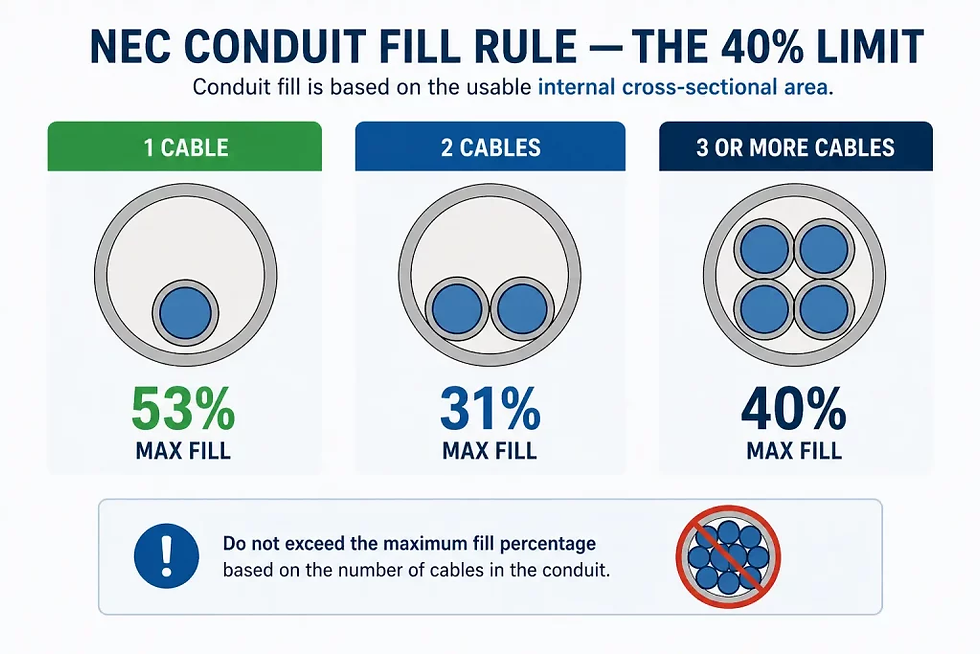
Conduit fill refers to the portion of a raceway's internal cross-sectional area occupied by the conductors installed inside it.
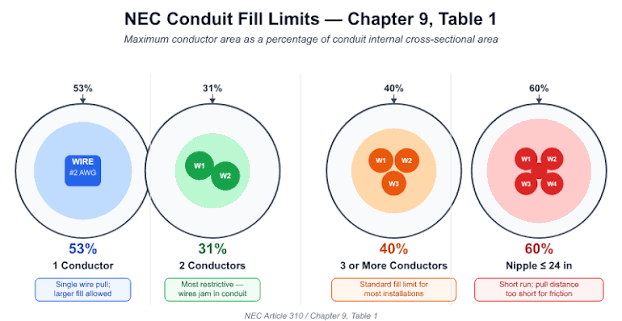
Under the general NEC Chapter 9, Table 1 rules, the maximum fill for three or more conductors is normally 40% of the conduit’s internal cross-sectional area.
Different limits apply when only one or two conductors are installed:
Number of conductors | General maximum conduit fill |
One | 53% |
Two | 31% |
Three or more | 40% |
These percentages are general NEC conduit-fill limits, subject to the applicable exceptions and installation provisions.
The fill percentage is based on the total area occupied by the conductors, including their insulation, rather than the bare copper or aluminum conductor area alone.
This distinction is important because insulation contributes substantially to the overall outside diameter of an electrical wire.
For example, two 8 AWG conductors may have the same nominal conductor size but different insulation systems. If one conductor has a larger outside diameter, it occupies more conduit space and may reduce the number of conductors that can be installed.
The 40% rule helps maintain appropriate space within the raceway for conductor installation and heat management. It is not a substitute for ampacity calculations or other applicable electrical requirements.
How to Calculate Conduit Fill for 8 AWG Wire
Conduit fill calculations compare the total cross-sectional area of the conductors with the allowable fill area of the selected raceway.
The general process is straightforward.
First, identify the conduit type and trade size. For example, a 3/4-inch EMT conduit has different internal dimensions from 3/4-inch PVC Schedule 40.
Second, determine the cross-sectional area of the actual insulated conductor. Use the applicable NEC Chapter 9, Table 5 value or the relevant manufacturer's conductor dimensions.
Third, multiply the conductor area by the number of conductors to determine the total occupied area.
Finally, compare the total conductor area with the permitted fill area for the selected conduit.
For example, commonly referenced NEC-based tables list an approximate conductor area of 0.0366 square inches for 8 AWG THHN conductors. The 40% fill area of 3/4-inch EMT is approximately 0.213 square inches.
Six conductors occupy:
6 × 0.0366 = 0.2196 square inches.
This exceeds the nominal 0.213-square-inch 40% fill area. Therefore, when checking a conduit-fill chart, it is important to use the applicable NEC table rules and rounding provisions rather than simply dividing two rounded numbers.
The maximum conductor count for an actual installation should be verified against the applicable NEC Annex C table or a correctly implemented conduit-fill calculation using the relevant conductor and raceway dimensions.
For mixed conductor sizes or insulation types, calculate the combined area of every conductor rather than relying on a chart that assumes all conductors are identical.
Does Wire Insulation Affect How Many 8 AWG Wires Fit?
Yes. The outside diameter of an insulated conductor directly affects how much conduit space it occupies.
8 AWG identifies the nominal conductor size, not the complete outside diameter of the finished insulated wire.
Different wire types can have different insulation materials, wall thicknesses, and outside dimensions. For example, THHN/THWN-2 and XHHW-2 conductors of the same AWG size may occupy different amounts of space.
This means that the maximum number of conductors listed for 8 AWG THHN wire should not automatically be used for every other 8 AWG conductor type.
When checking conduit fill, confirm:
The conductor's nominal AWG size
The insulation type and outside diameter
The number of conductors in the raceway
The conduit type and trade size
The applicable allowable fill percentage
For projects involving specialized cables or conductors with unusual insulation dimensions, use manufacturer specifications and the appropriate code calculation.
Does Conduit Fill Affect the Ampacity of 8 AWG Wire?
Conduit fill and ampacity are two separate considerations, but both can affect conductor selection.
Conduit fill determines whether the conductors occupy an allowable amount of space inside the raceway.
Ampacity determines the current a conductor can carry under specified conditions without exceeding its applicable temperature limits.
A conduit may have sufficient space for a particular number of conductors, but the installation may still require ampacity adjustments if too many conductors carry current at the same time.
Under applicable NEC provisions, adjustment factors can apply when more than three current-carrying conductors are installed together in a raceway or cable.
For example, a common adjustment factor for four to six current-carrying conductors is 80% under the relevant conditions. The actual calculation must account for the conductor type, ambient temperature, applicable code provisions, and any other required corrections.
Importantly, not every conductor installed in a conduit is necessarily a current-carrying conductor for ampacity-adjustment purposes. Equipment grounding conductors are generally treated differently, subject to the applicable rules.
The installer must therefore evaluate both conduit fill and allowable ampacity before determining whether the complete installation is suitable.
Can You Put Six 8 AWG Wires in 3/4-Inch Conduit?
The answer depends on the exact conduit and conductor specifications.
Six 8 AWG THHN/THWN-2 conductors are commonly listed for 3/4-inch EMT in published NEC-based conduit-fill tables. However, the same number should not automatically be assumed to fit in 3/4-inch PVC Schedule 40 or Schedule 80.
The wire type must also match the assumptions of the table. Conductors with larger insulation dimensions may occupy more space.
Before installing six 8 AWG conductors, verify the raceway type, applicable conduit-fill table, conductor insulation, and actual installation requirements.
Also check whether the number of current-carrying conductors requires an ampacity adjustment. The fact that six conductors fit does not automatically mean that all six can carry their full unadjusted ampacity simultaneously.
For long runs or installations involving several bends, the practical difficulty of pulling conductors should also be considered.
How Many 8 AWG Wires Can Fit in 1/2-Inch or 1-Inch Conduit?
Comparing conduit sizes helps when planning a new installation or deciding whether a larger raceway is necessary.
For typical 8 AWG THHN/THWN-2 conductors, commonly referenced NEC-based tables provide the following approximate capacities.
Conduit type | 1/2-inch conduit | 3/4-inch conduit | 1-inch conduit |
EMT | 3 | 6 | 9 |
PVC Schedule 40 | 3 | 5 | 9 |
PVC Schedule 80 | 2 | 4 | 7 |
These figures are reference counts for the specified conductor type and raceway sizes. Always verify the applicable table and code edition before using the figures for installation.
A larger conduit generally provides more interior area and makes conductor installation easier. However, conduit sizing should also account for future expansion, conductor pulling conditions, bend configuration, and project requirements.
If a planned installation is close to the maximum fill limit, choosing a larger raceway may be more practical than designing around the absolute maximum conductor count.
What Else Should You Consider When Installing 8 AWG Wire?
Conduit fill is only one part of a complete electrical installation.
Conductor Pulling and Bend Radius
The maximum permitted conductor count does not guarantee that the conductors will be easy to pull through the raceway.
Long runs, multiple bends, tight bends, and larger conductor bundles can increase pulling difficulty and the risk of insulation damage.
Use appropriate pulling methods and comply with conductor and raceway manufacturers' requirements. The actual installation must also satisfy applicable rules for raceway bends and pull points.
Conductor Temperature Rating
8 AWG conductors are available with different insulation systems and temperature ratings.
The selected conductor must be suitable for the intended environment and compatible with the connected equipment. Its allowable ampacity must be evaluated separately from the conduit-fill calculation.
A higher insulation temperature rating does not automatically permit a higher final circuit ampacity if terminal ratings or other applicable requirements impose lower limits.
Equipment Grounding Conductors
An equipment grounding conductor may occupy conduit space and must be included in conduit-fill calculations where required.
However, it is generally treated differently from current-carrying conductors when applying ampacity adjustment factors, subject to the applicable code provisions.
This distinction matters when a conduit contains a combination of circuit conductors and grounding conductors.
Future Expansion
A conduit that is filled to its maximum permitted capacity may leave little practical flexibility for adding conductors later.
If future expansion is likely, a larger raceway may simplify subsequent modifications and reduce the need to replace an existing conduit run.
The final design must still comply with applicable conduit-fill and electrical requirements.
Frequently Asked Questions About 8 AWG Conduit Fill
How many 8 AWG THHN wires fit in 3/4-inch EMT?
Commonly referenced NEC-based conduit-fill tables list six 8 AWG THHN/THWN-2 conductors for 3/4-inch EMT. Verify the applicable code table and conductor specifications before installation.
How many 8 AWG wires fit in 3/4-inch PVC Schedule 40?
For typical 8 AWG THHN/THWN-2 conductors, the commonly published reference count is five. Other insulation types may occupy more or less space, so verify the actual conductor dimensions.
How many 8 AWG wires fit in 3/4-inch PVC Schedule 80?
A commonly referenced NEC-based conduit-fill count is four 8 AWG THHN/THWN-2 conductors. PVC Schedule 80 has thicker walls than Schedule 40, reducing the available interior area.
Does conduit fill include the ground wire?
Yes. Equipment grounding conductors generally occupy conduit space and must be included when calculating conductor fill. Their treatment for ampacity adjustment is different from that of current-carrying conductors under applicable code provisions.
Can I use a conduit-fill chart for different wire insulation types?
Not without checking the assumptions. Conductor insulation affects outside diameter and occupied area. A chart for THHN/THWN-2 should not automatically be used for XHHW-2 or another conductor type with different dimensions.
Does filling a conduit to 40% mean the wires are electrically safe?
No. The 40% limit addresses conduit fill for three or more conductors under the general NEC rules. The installation must also comply with ampacity, temperature, overcurrent protection, grounding, and other applicable requirements.
Should I use a larger conduit if I need to install more 8 AWG wires?
A larger conduit may be appropriate if the required conductor count exceeds the allowable fill of the planned raceway. The design should also account for conductor pulling, bend configuration, future expansion, and applicable electrical requirements.
Choose the Right Cable and Raceway for Your Project
Selecting conductors and raceways requires more than matching a wire gauge to a conduit size. Conduit material, internal diameter, insulation dimensions, fill percentage, conductor ampacity, and installation conditions all affect the final design.
For electrical and photovoltaic applications, it is equally important to verify that the conductor is suitable for the intended use, operating environment, voltage rating, and applicable product standards.
FRCABLE supplies solar cable solutions for photovoltaic applications. If your project involves PV wiring or other specialized cable requirements, contact the FRCABLE team to discuss conductor specifications, insulation requirements, and the applicable standards for your target market.
Choose cable and installation specifications based on the complete project requirements—not conduit size alone.


Comments