
Types of Solar Cables: A Complete Guide for PV Systems

Solar photovoltaic systems use several different types of cables to transfer electricity safely and efficiently between modules, strings, combiner boxes, inverters, batteries and the electrical grid.
However, the term solar cable does not refer to one single cable type.
Solar cables can be classified according to their application, certification standard, conductor material, voltage rating, construction and installation environment. Common examples include H1Z2Z2-K solar cable, IEC 62930 photovoltaic cable, UL 4703 PV Wire, PV1-F cable, aluminum solar cable and specialized cables designed for demanding PV environments.
For solar developers, EPC contractors, distributors and system integrators, understanding these differences is important because a cable suitable for one project or market may not necessarily meet the requirements of another.
This guide explains the major types of solar cables, where they are commonly used and what to consider when selecting cable for a photovoltaic system.
What Is a Solar Cable?
A solar cable is an electrical cable designed for use in photovoltaic power systems.
Unlike many conventional building wires, PV cables are frequently installed outdoors where they may be exposed to sunlight, temperature changes, moisture, ozone and other environmental conditions over long periods.
Depending on the applicable standard and cable design, photovoltaic cables may use flexible stranded conductors together with cross-linked insulation and sheath materials to provide the electrical, mechanical, thermal and environmental performance required for solar installations.
For example, IEC 62930 applies to single-core cross-linked insulated and sheathed cables used on the DC side of photovoltaic systems with rated DC voltage up to 1.5 kV.
Typical solar DC cable connections include:
Solar module to solar module
Solar module to string wiring
String to combiner box
Combiner box to inverter
PV array to inverter
Other DC connections within photovoltaic systems
The correct cable depends on the system voltage, current, installation method, applicable electrical codes and certification requirements.

What Are the Main Types of Solar Cables?
Solar cables can be divided into several categories.
The following table provides a useful overview.
Solar Cable Type | Common Standard or Designation | Typical Application | Common Market |
H1Z2Z2-K Solar Cable | EN 50618 | PV module and DC string wiring | Europe / International |
IEC Solar Cable | IEC 62930 | DC photovoltaic systems | International |
PV Wire | UL 4703 | PV array interconnection | United States / North America |
USE-2 Wire | Applicable UL/NEC requirements | Certain PV wiring applications | United States |
PV1-F Solar Cable | 2 PfG 1169 | Existing or specified PV projects | Various markets |
Aluminum Solar Cable | Product-specific TÜV/UL requirements | Utility-scale PV installations | Global |
Twin-Core Solar Cable | IEC/product-specific designs | Two-conductor PV connections | Various markets |
AC Solar Cable | Applicable power cable standards | Inverter to transformer/grid | Global |
Specialized PV Cable | CPR, water-resistant and other designs | Special installation environments | Project-specific |
There is therefore no single “best solar cable.” The appropriate type depends on where and how the cable will be installed.
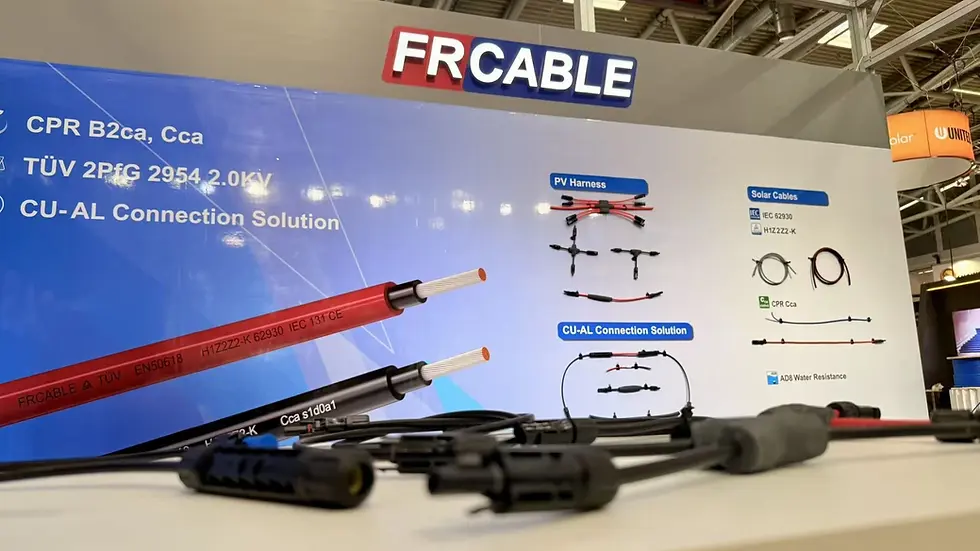
1. H1Z2Z2-K Solar Cable
H1Z2Z2-K is one of the most widely recognized cable designations for modern photovoltaic systems, particularly in European and international projects.
It is associated with EN 50618, which specifies requirements for electric cables intended for photovoltaic systems. H1Z2Z2-K cables are designed for PV installations and are suitable for permanent outdoor and indoor applications under the conditions defined by the standard.
A typical H1Z2Z2-K solar cable construction includes:
Flexible stranded conductor
Commonly tinned copper
Cross-linked insulation
Cross-linked outer sheath
Single-core construction
H1Z2Z2-K cable is commonly used between:
Solar Panel → String → Combiner Box → Inverter
Why Is H1Z2Z2-K Common in Solar Installations?
PV cables must operate in environments very different from ordinary indoor electrical wiring.
Depending on the certified cable construction, H1Z2Z2-K products can provide resistance to environmental stresses such as UV radiation, ozone and weather exposure.
FRCABLE, for example, manufactures H1Z2Z2-K products designed to EN 50618 requirements with stranded tinned-copper conductors and cross-linked insulation and sheath materials. Some FRCABLE constructions combine EN 50618 and UL 4703 requirements in one cable design.
For projects targeting Europe or specifications referencing EN 50618, H1Z2Z2-K will therefore often be one of the first cable types considered.
2. IEC 62930 Solar Cable
IEC 62930 is another important photovoltaic cable standard.
IEC 62930:2017 covers cables intended for use on the DC side of photovoltaic systems, with rated DC voltage up to and including 1.5 kV between conductors and between conductor and earth.
These are single-core power cables using cross-linked insulation and a cross-linked sheath.
IEC 62930 is especially relevant for international projects where IEC standards are specified.
IEC 62930 vs EN 50618
The two are frequently encountered together in the international solar market, but they should not simply be treated as interchangeable names.
A project specification may explicitly require:
IEC 62930
EN 50618
Both standards
A specific third-party certification
For this reason, EPC contractors and cable buyers should check the exact project specification rather than selecting cable based only on conductor size or voltage.
FRCABLE offers solar cable constructions designed for both EN 50618 H1Z2Z2-K and IEC 62930, making them suitable for projects where both requirements are relevant.

3. UL 4703 PV Wire
For the North American solar market, PV Wire is another major cable category.
UL 4703 covers photovoltaic wire used for interconnection wiring in grounded and ungrounded photovoltaic power systems.
The current UL scope includes PV Wire with voltage ratings of 600 V, 1000 V and 2000 V, depending on the specific cable construction and certification. It also includes requirements relating to sunlight resistance and wet/dry temperature ratings.
Where Is UL 4703 PV Wire Used?
Typical applications include wiring within photovoltaic arrays and other DC-side connections permitted by the relevant electrical requirements.
Common PV Wire sizes include AWG conductor sizes such as:
14 AWG
12 AWG
10 AWG
8 AWG
6 AWG
Larger sizes for higher-current applications
The actual cable size must be determined from electrical design rather than selected from a general table alone.
Factors such as current, temperature, installation method, bundling, conductor material and voltage drop can all affect the final selection.
1500V and 2000V PV Wire
As utility-scale solar systems evolve, higher-voltage PV cable designs have become increasingly important.
UL 4703 includes PV Wire ratings up to 2000 V, giving system designers additional options where the overall PV system and associated equipment are designed and approved for those voltage levels.
FRCABLE currently manufactures dual-standard cable constructions with a TÜV-side rating of 1500 V DC and UL 4703 configurations rated to 2000 V DC.
4. USE-2 Wire
USE-2 is another cable designation commonly encountered when discussing solar installations in the United States.
It is sometimes confused with PV Wire because both may be found in photovoltaic applications.
However, PV Wire and USE-2 should not automatically be treated as the same product.
Their construction requirements, permitted applications and markings may differ.
When specifying cable for a North American PV project, designers should confirm:
Applicable NEC requirements
Cable listing
Voltage rating
Wet-location requirements
Sunlight resistance
Installation method
Equipment requirements
Instead of asking only whether a cable is “solar cable,” it is better to identify the exact listing and installation requirement.
This is particularly important for commercial and utility PV projects where compliance documentation may form part of the EPC approval process.
5. PV1-F Solar Cable
PV1-F is another designation that solar cable buyers may encounter, especially in older specifications or projects that explicitly reference it.
PV1-F is associated with the 2 PfG 1169 photovoltaic cable specification.
Although H1Z2Z2-K is widely used for current EN 50618-based specifications, PV1-F remains relevant because it still appears in project documents, distributor enquiries and replacement requirements.
PV1-F vs H1Z2Z2-K
Feature | PV1-F | H1Z2Z2-K |
Common Reference | 2 PfG 1169 | EN 50618 |
Application | Photovoltaic DC systems | Photovoltaic DC systems |
Current Relevance | Often seen in existing or specifically written project specifications | Widely used in modern European PV specifications |
Selection Approach | Confirm exact project requirement | Confirm EN 50618/certification requirement |
If a customer requests PV1-F, the safest approach is not to automatically substitute another solar cable.
Instead, the supplier should confirm the project's required standard, certification, voltage, conductor size and documentation before recommending an alternative.
6. Copper Solar Cable
Copper remains one of the most common conductor materials used in photovoltaic cables.
Many solar DC cables use flexible stranded tinned copper conductors.
Tinning the copper can help protect the conductor surface and is widely used in photovoltaic cable constructions intended for demanding outdoor environments.
Copper offers high electrical conductivity, which allows relatively compact conductor cross-sections for a given electrical requirement.
Common metric solar cable sizes include:
2.5 mm²
4 mm²
6 mm²
10 mm²
16 mm²
Larger cross-sections for specific applications
Among these, 4 mm² and 6 mm² solar cables are frequently encountered in module and string-level wiring.
However, conductor size should always be calculated according to the actual circuit.

7. Aluminum Solar Cable
Aluminum solar cable is becoming particularly relevant for large photovoltaic installations where long cable runs and large conductor quantities can make material cost and weight important design considerations.
Compared with copper, aluminum has lower electrical conductivity. Therefore, an aluminum conductor generally requires a larger cross-sectional area to achieve comparable electrical performance.
However, aluminum is also lighter and can offer economic advantages in certain large-scale installations.
Copper vs Aluminum Solar Cable
Feature | Copper Solar Cable | Aluminum Solar Cable |
Electrical Conductivity | Higher | Lower |
Required Cross-Section | Generally smaller | Generally larger |
Weight | Higher | Lower |
Material Cost | Generally higher | Often lower |
Common Application | Residential, commercial and utility PV | Particularly attractive for large PV plants |
Termination | Conventional compatible PV connections | Requires compatible terminals/connectors and correct installation practices |
The decision should therefore be based on total system design, not conductor price alone.
Connector compatibility, termination technology, conductor size, voltage drop, installation cost and project certification all need to be considered.
FRCABLE's current photovoltaic cable portfolio includes aluminum solar cable designed for 1500 V DC applications, including products referencing TÜV 2 PfG 2642 PV1500DC-AL.
8. Single-Core Solar Cable
Single-core cable is the most familiar construction on the DC side of many photovoltaic systems.
Each cable contains one conductor, allowing the positive and negative circuits to be routed separately.
Typical configurations include:
1 × 4 mm²
1 × 6 mm²
1 × 10 mm²
1 × 16 mm²
In AWG-based markets, corresponding project specifications may instead use sizes such as 12 AWG, 10 AWG, 8 AWG and 6 AWG.
Single-core PV cable offers flexibility when routing cables through module arrays, cable trays and other system components.
9. Twin-Core Solar Cable
Twin-core solar cable combines two conductors within one overall cable construction.
It can be useful in applications where positive and negative conductors need to follow the same route and the installation design allows a twin-core cable.
Advantages may include:
Simplified cable routing
Easier cable management
Reduced number of individual cable runs
Cleaner installation in suitable applications
However, twin-core construction is not automatically suitable for every PV system.
Thermal performance, cable routing, connectors, installation method and the applicable standard must all be evaluated.
FRCABLE's current product portfolio includes an IEC 62930 twin-core solar cable, providing an option for applications where this construction is required.
10. DC Solar Cable vs AC Solar Cable
One important distinction is between cables on the DC side and cables on the AC side of a photovoltaic installation.
DC Solar Cable
DC solar cable is used before the inverter.
A simplified current path is:
PV Module → String → Combiner Box → Inverter
This is where H1Z2Z2-K, IEC 62930 solar cable and UL 4703 PV Wire are commonly relevant.
AC Solar Cable
After the inverter converts DC electricity into AC electricity, different power cables may be used to connect:
Inverter → AC Distribution → Transformer → Grid
These cables are selected according to AC voltage, current, installation method, local electrical standards and project requirements.
Therefore, not every cable used in a solar power plant is technically a photovoltaic cable.
This distinction is particularly important when preparing a complete cable bill of materials for commercial or utility-scale solar plants.
11. Solar Cable Types by Voltage
Solar cables can also be categorized according to system voltage.
600V Solar Cable
600 V cable designs can still be encountered in certain PV applications and older system architectures.
1000V Solar Cable
1000 V DC systems have been widely used in photovoltaic installations and remain relevant in many applications.
1500V Solar Cable
1500 V DC has become particularly important for modern commercial and utility-scale photovoltaic installations.
IEC 62930 specifically covers photovoltaic cables rated up to and including 1.5 kV DC.
Higher system voltage can allow designers to connect more modules in series, depending on the module and inverter design, potentially reducing the number of parallel strings and associated balance-of-system components.
However, every component in the circuit must be suitable for the designed system voltage.
2000V PV Wire
UL 4703 includes photovoltaic wire rated up to 2000 V.
This does not mean that a 2000 V cable can simply be installed in any PV system.
Modules, connectors, protection devices, inverters and other equipment must also be suitable for the intended voltage, and the installation must comply with applicable codes and project requirements.
12. Solar Cable Types by Market and Certification
For international solar projects, the destination market can be just as important as electrical performance.
A cable may have excellent physical properties but still be unsuitable if it does not carry the certification required by the project.
A simplified market guide is shown below.
Market / Project Type | Cable Requirement Commonly Encountered |
Europe | EN 50618 / H1Z2Z2-K |
International IEC Projects | IEC 62930 |
United States | UL 4703 PV Wire |
Canada | Applicable Canadian PV cable certification |
Japan | Applicable JET/PSE/project requirements |
International EPC Projects | One or multiple international certifications |
Utility-Scale PV Plants | Copper or aluminum PV cable depending on system design |
This is why international buyers should provide the destination country and required certification when requesting a quotation.
The same conductor size can be manufactured under different cable constructions and certifications.
13. Special Types of Solar Cable
Some photovoltaic installations create environmental challenges beyond those encountered in a standard rooftop solar system.
Specialized cable designs may therefore be required.
Water-Resistant Solar Cable
Floating PV systems, wet environments and installations with increased water exposure may require enhanced water-resistance characteristics.
The exact requirement should be determined from the installation environment and project specification rather than assuming every PV cable provides the same level of water protection.
CPR-Rated Solar Cable
Projects in Europe may also specify fire-performance classifications under the Construction Products Regulation depending on how and where cable is installed.
Classes such as B2ca, Cca and Dca may appear in project specifications.
The required class should be confirmed from the building and project requirements.
Anti-Rodent Solar Cable
Ground-mounted solar farms can expose cables to wildlife.
Where rodent damage is considered a significant project risk, specially designed anti-rodent cable constructions may be considered.
Anti-Termite or Anti-Ant Solar Cable
In some regions, insects can also create long-term cable-protection concerns.
Special cable constructions can be developed for projects where this type of environmental resistance is required.
Solar Cable for Harsh Climates
Projects located in deserts, coastal areas, high-altitude environments or regions with extreme seasonal temperatures may require additional attention to:
UV exposure
Temperature range
Salt or chemical exposure
Water resistance
Mechanical protection
Cable routing
Installation method
The cable should be selected according to the actual environment rather than simply by conductor size.

How to Choose the Right Type of Solar Cable
With so many photovoltaic cable types available, a structured selection process helps reduce mistakes.
Step 1: Identify the Destination Market
First determine where the cable will be installed.
For example:
Europe
United States
Canada
Japan
Middle East
Southeast Asia
Australia
International IEC project
This helps identify the required certification and electrical standards.
Step 2: Confirm the DC System Voltage
Determine whether the project uses:
600 V
1000 V
1500 V
2000 V or another specified voltage
Do not select cable based solely on conductor size.
The voltage rating must be appropriate for the electrical system.
Step 3: Determine the Required Current
Cable ampacity must be sufficient for the circuit after considering applicable design factors.
Current capacity can be affected by:
Conductor size
Conductor material
Ambient temperature
Installation method
Number of grouped cables
Cable temperature rating
Applicable code requirements
Step 4: Calculate Voltage Drop
Long cable runs increase conductor resistance and voltage drop.
A larger conductor may therefore be required even when a smaller conductor can safely carry the circuit current.
This is especially relevant in large ground-mounted PV systems.
When comparing sizes such as 4 mm² vs 6 mm² solar cable or 10 AWG vs 12 AWG PV Wire, ampacity and voltage drop should be considered together.
Step 5: Choose Copper or Aluminum
Copper is commonly used in module and string wiring.
Aluminum may become attractive for longer and higher-capacity runs in utility-scale installations.
If aluminum is used, compatible connectors, terminals and installation procedures are essential.
Step 6: Evaluate the Installation Environment
Ask whether the cable will be installed:
On a rooftop
On a ground-mounted PV system
Underground or in conduit
In a floating solar project
In a desert environment
Near the coast
In an industrial environment
In an area with rodent risk
Environmental conditions can significantly affect cable requirements.
Step 7: Verify Certification and Documentation
Before purchasing solar cable, check the required:
Certification
Cable marking
Datasheet
Test report
Declaration documents
Manufacturer information
Conductor size
Voltage rating
Production specification
For large EPC projects, documentation verification should be completed before mass production and shipment.
Solar Cable Type Comparison
The following table provides a simple starting point for project selection.
If Your Project Requires... | Cable Type to Investigate |
European PV cable | H1Z2Z2-K / EN 50618 |
International IEC compliance | IEC 62930 |
US photovoltaic wiring | UL 4703 PV Wire |
Existing PV1-F specification | PV1-F |
Lower conductor weight in large projects | Aluminum solar cable |
Standard module/string wiring | Single-core solar cable |
Two conductors in one construction | Twin-core solar cable |
1500V DC PV system | Certified 1500V photovoltaic cable |
Up to 2000V North American PV application | Appropriate UL 4703 PV Wire |
Special environmental conditions | Application-specific solar cable |
This table is only a starting point. Final cable selection should always be verified against the electrical design, installation conditions and applicable standards.
What Solar Cable Sizes Are Common?
Understanding cable type is only part of the selection process.
The next question is normally:
What size solar cable do I need?
Common metric sizes include:
Cable Size | Typical PV Application |
2.5 mm² | Lower-current PV connections where design permits |
4 mm² | Common module and string wiring |
6 mm² | String wiring and longer cable runs |
10 mm² | Higher-current or longer-distance connections |
16 mm²+ | Larger DC circuits and project-specific applications |
For AWG systems, common PV Wire sizes may include 12 AWG, 10 AWG, 8 AWG and larger conductors.
There is no universal cable size for all solar panels.
The correct size should be determined using:
Current + Ampacity + Cable Length + Voltage Drop + Temperature + Installation Method
Using an ampacity table alone is not enough.
Why Solar Cable Certification Matters
Solar projects are designed for long operating periods, often under continuous outdoor exposure.
Cable failure can cause:
Power losses
Ground faults
Insulation failure
Connector problems
System downtime
Maintenance costs
Safety risks
Certification does not replace correct engineering, but it provides third-party evidence that a cable design has been evaluated against defined requirements.
FRCABLE's solar cable laboratory performs electrical, mechanical, thermal and environmental testing for photovoltaic cable products designed for standards including EN 50618, IEC 62930 and UL 4703.
For procurement teams, checking the certificate against the exact cable model is an important part of supplier qualification.
How FRCABLE Supports Different Solar Cable Requirements
Different PV markets require different cable constructions.
FRCABLE's current solar cable range includes products designed for:
EN 50618 H1Z2Z2-K
IEC 62930
UL 4703 PV Wire
Dual-certified PV cable
Aluminum solar cable
Twin-core solar cable
Different conductor sizes and voltage requirements
The product portfolio includes H1Z2Z2-K and IEC 62930 products, UL 4703 combinations, aluminum PV cable and IEC twin-core constructions.
For OEM and project enquiries, buyers should provide the required standard, conductor size, voltage rating, cable color, quantity, destination market and any project-specific testing requirements.
Frequently Asked Questions About Solar Cable Types
What are the different types of solar cables?
Common solar cable types include H1Z2Z2-K cable, IEC 62930 photovoltaic cable, UL 4703 PV Wire, PV1-F cable, copper PV cable, aluminum solar cable, single-core solar cable and twin-core solar cable. Solar plants also use separate AC cables after the inverter.
What type of cable is used for solar panels?
Single-core photovoltaic DC cable is commonly used to connect solar modules and strings. Depending on the project market, this may be H1Z2Z2-K, IEC 62930 cable or UL 4703 PV Wire.
What is H1Z2Z2-K solar cable?
H1Z2Z2-K is the cable designation specified by EN 50618 for photovoltaic cable. It is commonly used for DC connections in European and international PV installations.
What is IEC 62930 solar cable?
IEC 62930 covers single-core cross-linked insulated and sheathed photovoltaic cables intended for the DC side of PV systems with rated voltage up to 1.5 kV DC.
What is UL 4703 PV Wire?
UL 4703 is the UL standard covering photovoltaic wire used for interconnection wiring in photovoltaic power systems. Its scope includes PV Wire rated at 600 V, 1000 V and 2000 V.
What is the difference between PV Wire and USE-2?
PV Wire and USE-2 are different cable categories with different requirements and permitted applications. The correct product should be selected according to the applicable electrical code, system voltage, installation method and project specification.
Is PV1-F still used?
PV1-F still appears in some project specifications and customer enquiries and is associated with the 2 PfG 1169 photovoltaic cable specification. For new projects, buyers should confirm exactly which standard and certification the project requires.
Is copper or aluminum better for solar cable?
Neither conductor is universally better. Copper offers higher conductivity and allows smaller conductor cross-sections, while aluminum is lighter and can reduce conductor material cost in suitable large-scale applications. The decision should consider conductor size, termination, voltage drop, installation cost and project certification.
Is 4 mm² or 6 mm² cable better for solar panels?
It depends on circuit current, cable length, voltage drop, installation conditions and applicable electrical requirements. A 6 mm² conductor has lower electrical resistance than a 4 mm² conductor of the same material, but this does not mean every PV system requires 6 mm² cable.
Can solar cable be used for 1500V systems?
Yes, provided the specific cable is certified and rated for the intended 1500 V DC photovoltaic application. IEC 62930, for example, covers PV cable with rated DC voltage up to 1.5 kV.
Is there 2000V solar cable?
Yes. UL 4703 includes PV Wire with voltage ratings up to 2000 V. The entire PV system and associated components must also be suitable for the intended voltage.
What information should I provide when ordering solar cable?
For an accurate quotation, provide:
Required cable standard
Certification
Conductor material
Cable size
Voltage rating
Cable color
Required length
Packing requirements
Destination market
Installation environment
Project documentation requirements
Conclusion
There are many types of solar cables, and they should not be selected based on size or price alone.
H1Z2Z2-K and IEC 62930 cables are widely used for international photovoltaic DC systems, while UL 4703 PV Wire is particularly important for North American projects. PV1-F continues to appear in certain specifications, while aluminum cable, twin-core cable and specialized PV cable designs provide additional options for utility-scale and demanding installations.
For any photovoltaic project, the correct selection starts with five questions:
Which market? Which standard? Which voltage? Which conductor size? Which installation environment?
Once these requirements are clear, buyers can compare solar cable constructions more accurately and avoid selecting a cable that does not match the electrical or certification requirements of the project.
For solar EPC contractors, distributors and PV equipment manufacturers requiring EN 50618, IEC 62930, UL 4703 or customized photovoltaic cable solutions, FRCABLE can support project-specific cable selection, manufacturing and testing.


One of the most fun moments in hole io is when you suddenly become large enough to swallow an object that, just seconds earlier, seemed completely out of reach.