
Types of Aluminum Overhead Conductors: AAC, AAAC, ACSR, ACAR and ACSS Explained

Aluminum overhead conductors are widely used in electrical transmission and distribution because they provide a practical balance of electrical conductivity, weight, mechanical strength, thermal performance, and cost.
However, “aluminum conductor” does not describe a single product. Different conductor constructions are engineered for different combinations of ampacity, tensile strength, span length, sag, operating temperature, corrosion resistance, and installation requirements.
The main types include:
AAC — All Aluminum Conductor
AAAC — All Aluminum Alloy Conductor
ACSR — Aluminum Conductor, Steel Reinforced
ACAR — Aluminum Conductor, Aluminum Alloy Reinforced
ACSS — Aluminum Conductor, Steel Supported
Advanced overhead-conductor families can also include AACSR, ACCR, ACCC, and other high-temperature low-sag designs.
The important point is that there is no universally suitable aluminum overhead conductor. The appropriate construction depends on the requirements of the transmission or distribution line.
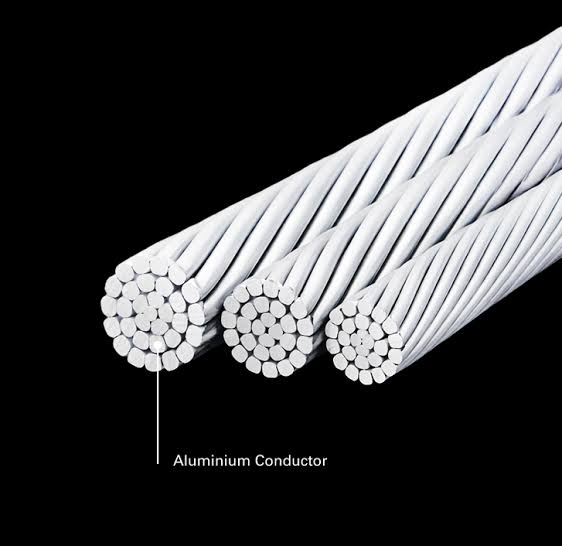
What Is an Aluminum Overhead Conductor?
An aluminum overhead conductor is a conductor designed to carry electrical current on an overhead power line. Unlike an insulated power cable, a traditional bare overhead conductor does not rely on a polymeric insulation layer around the conductor for primary electrical insulation.
Overhead conductor design therefore has to address two major functions:
Electrical function
The conductor must carry the required current with acceptable electrical losses.
Mechanical function
The conductor must withstand installation tension, environmental loading, vibration, and other mechanical stresses while maintaining the required clearances.
IEEE's technical material on overhead conductors identifies electrical resistance, mechanical strength, weight, environmental loading, and conductor configuration as important considerations in conductor design.
This is why different conductor families use different combinations of aluminum, aluminum alloy, steel, composite cores, and specialized strand geometries.
Why Is Aluminum Widely Used in Overhead Conductors?
Aluminum has lower electrical conductivity than copper for the same cross-sectional area, but its much lower density creates a favorable conductivity-to-weight relationship.
For large overhead networks, conductor weight is particularly important because it affects:
Tower and pole loading
Span length
Sag and tension
Installation requirements
Supporting hardware
Overall project economics
This makes aluminum particularly attractive for long overhead transmission and distribution systems.
The advantage is therefore not that aluminum is more conductive than copper. Instead, it is the combination of adequate conductivity with low density and relatively low material cost that makes aluminum attractive for overhead electrical infrastructure.
What Determines the Type of Aluminum Overhead Conductor?
Choosing an overhead conductor is an engineering decision rather than a material-only decision.
The major design variables include:
Electrical Conductivity
Conductor resistance affects power losses and voltage performance.
Ampacity
The conductor must carry the required current without exceeding the applicable thermal limits.
Mechanical Strength
Long spans and high environmental loads may require greater tensile strength.
Weight
Lower conductor weight can reduce mechanical loading on supporting structures.
Operating Temperature
Some conductor designs are intended for higher operating temperatures than conventional designs.
Sag Characteristics
Temperature changes cause conductor expansion and can increase sag. Managing this effect is particularly important on high-capacity transmission lines.
Environmental Conditions
Wind, ice, corrosion, vibration, and other site conditions can affect conductor selection.
Existing Transmission Infrastructure
For reconductoring projects, a conductor may need to achieve greater electrical capacity while remaining compatible with existing towers, hardware, and clearances.
These factors explain why the industry uses multiple aluminum conductor constructions rather than one universal design.
What Is AAC?
AAC stands for All Aluminum Conductor.
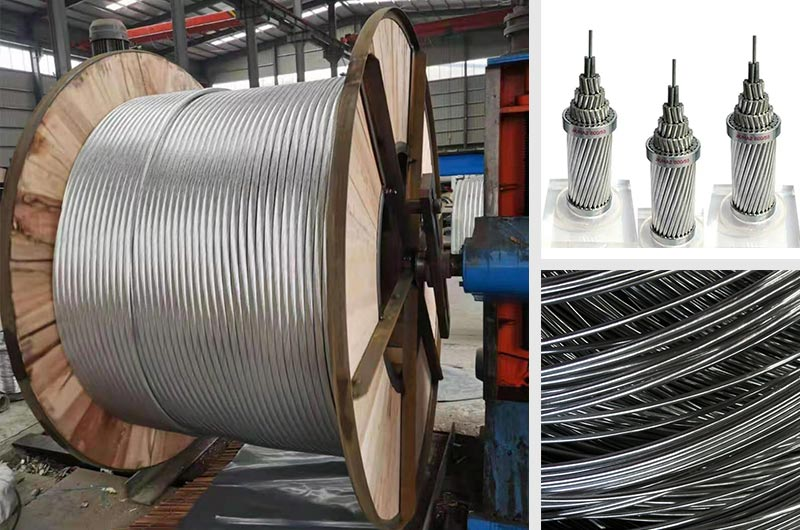
AAC is a stranded conductor made from aluminum wires without a separate steel reinforcing core. Southwire specifies its AAC construction using 1350-H19 aluminum wires concentrically stranded.
AAC classes AA and A are used primarily for overhead transmission and primary and secondary distribution where ampacity must be maintained, a lighter conductor than ACSR is desired, and conductor strength is not the primary design constraint.
AAC Construction
The basic structure is:
1350-H19 aluminum strands → electrical conduction
There is no central steel reinforcing core.
This produces a comparatively simple aluminum conductor design.
Advantages of AAC
AAC can provide:
Good electrical conductivity
Low conductor weight
Simple construction
Good corrosion characteristics associated with aluminum
A useful solution where high mechanical strength is not the dominant requirement
Limitations of AAC
The main limitation is mechanical strength.
Because there is no steel or alloy reinforcing core, AAC is not automatically the preferred choice for applications demanding very high tensile strength or long spans.
Southwire specifically describes AAC applications in terms of situations where conductor strength is not a critical factor.
What Is AAAC?
AAAC stands for All Aluminum Alloy Conductor.
Unlike AAC, which uses electrical-grade aluminum, AAAC uses a higher-strength aluminum alloy.
A common AAAC construction uses 6201-T81 aluminum alloy wires concentrically stranded. Southwire states that AAAC is designed to achieve a high strength-to-weight ratio and good sag characteristics.
AAAC Construction
The structure is:
6201-T81 aluminum alloy strands → conductivity + mechanical strength
Unlike ACSR, AAAC does not use a separate steel core.
Why Use Aluminum Alloy?
Alloying changes the balance between electrical conductivity and mechanical performance.
AAAC therefore provides a stronger conductor than a comparable all-aluminum design while maintaining an aluminum-based construction.
Southwire also identifies corrosion resistance as an advantage of its 6201-T81 AAAC construction relative to ACSR in the referenced product specification.
Where Is AAAC Used?
AAAC is used as a bare overhead conductor for primary and secondary distribution and in applications where strength-to-weight characteristics and corrosion performance are important.
The exact application depends on line design, required ampacity, span, mechanical loading, and utility specifications.
What Is ACSR?
ACSR stands for Aluminum Conductor, Steel Reinforced.
It is one of the most widely recognized overhead conductor constructions.
ACSR normally consists of aluminum strands surrounding a steel core. Southwire specifies its ACSR construction using 1350-H19 aluminum outer strands and coated steel core strands.
ACSR Construction
The design separates the electrical and mechanical functions:
Aluminum outer strands → primarily electrical conductivity
Steel core → mechanical reinforcement
This arrangement gives ACSR a useful combination of conductivity and tensile strength.
Why Does ACSR Use a Steel Core?
A bare aluminum conductor does not necessarily provide enough mechanical strength for every long-span overhead application.
The steel core provides tensile strength while the surrounding aluminum strands carry most of the electrical current.
Southwire notes that variable steel-core stranding can be used to achieve the desired strength without sacrificing ampacity.
This is a key engineering principle:
Electrical conductivity and mechanical strength do not have to come from the same material.
Where Is ACSR Used?
ACSR is used as a bare overhead transmission conductor and as a primary and secondary distribution conductor.
It can be especially useful where tensile strength and line span requirements are important.
What Is ACAR?
ACAR stands for Aluminum Conductor, Aluminum Alloy Reinforced.
ACAR is different from ACSR because it uses an aluminum alloy for reinforcement rather than steel.
Southwire describes ACAR as 1350-H19 aluminum wires concentrically stranded around a 6201-T81 aluminum-alloy core. In some constructions, the alloy strands can also be distributed among the aluminum layers.
ACAR Construction
The basic concept is:
1350-H19 aluminum → conductivity
6201-T81 aluminum alloy → mechanical reinforcement
This creates an all-aluminum-based conductor without a steel core.
Why Use ACAR Instead of ACSR?
The choice depends on the required balance of:
Ampacity
Strength
Weight
Conductivity
Corrosion characteristics
Line-design constraints
Southwire states that ACAR provides a good strength-to-weight ratio and is intended for applications where both ampacity and strength are important. Its product specification also states that, at equal weight, ACAR can provide higher strength and ampacity than ACSR for the referenced construction.
This makes ACAR a useful alternative where the designer wants an aluminum-alloy-reinforced conductor rather than a steel-reinforced construction.
What Is ACSS?
ACSS stands for Aluminum Conductor, Steel Supported.
ACSS is designed differently from conventional ACSR, particularly in the temper and mechanical role of the aluminum.
Southwire's ACSS comparison information specifies 1350-O temper aluminum outer strands, a coated steel core, and a continuous operating temperature of up to 250°C for the referenced ACSS construction. It also identifies self-damping as a characteristic.
ACSS Construction
The basic structure is:
1350-O aluminum strands → electrical conductivity
Steel core → mechanical support
The “O” temper indicates annealed or soft aluminum.
Southwire's technical documentation explains that because of the soft aluminum temper, the steel core carries most or all of the mechanical load.
Why Is ACSS Used?
ACSS is designed for applications where high-temperature operation and sag performance are important.
For example, when a conventional conductor is operated at elevated temperatures, thermal expansion can increase sag. ACSS is designed to maintain useful mechanical performance at higher operating temperatures.
This makes ACSS particularly relevant to:
Higher-current transmission
Reconductoring
Capacity upgrades
Applications with demanding thermal requirements
Southwire specifically describes ACSS as a bare overhead transmission and distribution conductor and provides ratings at elevated conductor temperatures.
AAC vs AAAC vs ACSR vs ACAR vs ACSS
The simplest way to understand the major conductor families is to compare their construction and design priorities.
Conductor | Full Name | Typical Conductor Materials | Main Design Characteristic |
AAC | All Aluminum Conductor | 1350 aluminum | Conductivity with low weight |
AAAC | All Aluminum Alloy Conductor | 6201-T81 aluminum alloy | Strength-to-weight performance |
ACSR | Aluminum Conductor, Steel Reinforced | 1350 aluminum + steel | High tensile strength |
ACAR | Aluminum Conductor, Aluminum Alloy Reinforced | 1350 aluminum + 6201 alloy | Balance of ampacity and strength |
ACSS | Aluminum Conductor, Steel Supported | 1350-O aluminum + steel | High-temperature and low-sag applications |
The exact electrical and mechanical properties vary with conductor size, stranding, core construction, alloy, temperature and product specification. Southwire's conductor comparison documentation lists these major conductor families and their material constructions.
What Is the Difference Between AAC and AAAC?
AAC and AAAC are both all-aluminum-based conductors, but they use different aluminum materials.
AAC:
1350-H19 aluminum
AAAC:
6201-T81 aluminum alloy
The principal difference is therefore not simply the number of strands. It is the material system itself.
Southwire describes AAC primarily for applications where conductor strength is not a critical factor, while AAAC uses high-strength aluminum alloy to improve strength-to-weight characteristics and sag performance.
What Is the Difference Between AAC and ACSR?
The major difference is mechanical reinforcement.
AAC contains aluminum strands only.
ACSR combines aluminum strands with a steel core.
This means ACSR is designed to provide substantially greater mechanical reinforcement for applications where span, tension, and structural loading are important.
AAC may be suitable where conductor strength is not the dominant constraint.
The correct choice therefore depends on line design rather than simply selecting the conductor with the highest nominal current rating.
What Is the Difference Between ACSR and AAAC?
Both are widely used aluminum-based overhead conductors, but their reinforcement systems differ.
ACSR:
Aluminum + steel core
AAAC:
Aluminum alloy only
ACSR uses steel for mechanical reinforcement.
AAAC uses a high-strength aluminum alloy to achieve its mechanical properties.
Southwire identifies 6201-T81 AAAC as providing a high strength-to-weight ratio and good sag characteristics, while ACSR relies on coated steel core strands for reinforcement.
What Is the Difference Between ACSR and ACAR?
This comparison is particularly useful for advanced cable buyers.
Both conductors combine a highly conductive aluminum component with a reinforcing component.
However:
ACSR = aluminum + steel
ACAR = aluminum + aluminum alloy
ACAR therefore avoids a steel reinforcing core and instead uses 6201-T81 aluminum alloy within the conductor structure.
Southwire describes ACAR as suitable where both ampacity and strength are important and identifies its strength-to-weight performance as a key feature.
What Is the Difference Between ACSR and ACSS?
The two constructions both use aluminum and steel, but their mechanical and thermal design philosophies differ.
ACSR
1350-H19 aluminum
Steel core
Conventional reinforced conductor design
Widely used for overhead transmission and distribution
ACSS
1350-O aluminum
Steel core
Aluminum is annealed
Steel carries most or all of the mechanical load
Designed for high-temperature operation and controlled sag
Southwire's technical information identifies ACSS with 250°C continuous operation for the referenced product family and highlights self-damping and high-temperature capability.
Why Does Conductor Sag Matter?
Sag is one of the most important mechanical considerations in overhead-line design.
As conductor temperature increases, the conductor can expand.
Higher operating temperature can therefore increase sag and reduce ground clearance.
The relationship between:
Temperature → expansion → tension → sag
must be considered when selecting a conductor for a transmission or distribution line.
For conventional conductors, increasing current can increase temperature and therefore affect sag.
This is one reason high-temperature and low-sag conductor technologies have become important in capacity-upgrade projects.
Southwire's ACSS technical data provides conductor ampacity values across multiple operating temperatures, illustrating how conductor performance is evaluated thermally rather than by a single current number.
What Are High-Temperature Low-Sag Conductors?
HTLS stands for High Temperature Low Sag.
HTLS conductors are designed to carry higher current at elevated conductor temperatures while controlling thermal sag.
Modern overhead conductor families can use:
Annealed aluminum
Aluminum alloys
Steel cores
Composite cores
Trapezoidal strands
Advanced corrosion-protection systems
Southwire's current overhead-conductor comparison materials list conventional designs alongside advanced technologies using aluminum, aluminum alloy, aluminum-zirconium, steel, and composite-core systems.
The fundamental purpose is to improve the relationship between:
Ampacity + operating temperature + sag + mechanical performance
This becomes especially important when utilities want to increase line capacity without rebuilding an entire transmission corridor.
What Is AAC/TW?
Not every variation is a completely different conductor family.
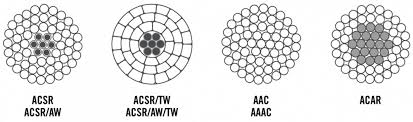
AAC/TW refers to All Aluminum Conductor using trapezoidal aluminum strands.
Southwire states that AAC/TW uses 1350-H19 trapezoidal aluminum wires and that the geometry can provide comparable ampacity in a smaller overall diameter or greater ampacity within a comparable overall diameter, depending on the design.
This illustrates an important principle:
Conductor geometry can be engineered as carefully as conductor material.
Trapezoidal-wire constructions can improve packing efficiency and change the relationship between:
Cross-sectional area
Overall diameter
Ampacity
Wind loading
Ice loading
Such designs are particularly useful when conductor dimensions and line hardware impose constraints.
Why Does Conductor Diameter Matter?
Conductor diameter affects more than appearance.
It can influence:
Electrical capacity
Wind loading
Ice loading
Corona performance
Mechanical design
Hardware compatibility
Right-of-way considerations
For example, Southwire's AAC/TW documentation specifically describes trapezoidal stranding as a way to achieve more favorable relationships between ampacity and conductor diameter.
In larger transmission systems, reducing diameter while preserving electrical performance can affect mechanical and environmental loading.
How Does Conductor Material Affect Electrical Performance?
Different aluminum materials have different combinations of conductivity and mechanical strength.
Southwire's comparison chart lists:
1350-H19: approximately 61.2% IACS conductivity
6201-T81: approximately 52.5% IACS conductivity
1350-O used in ACSS: approximately 63% IACS conductivity
These values are product-family reference values from Southwire's conductor comparison documentation; actual conductor performance depends on the complete construction and applicable specification.
This illustrates an important engineering trade-off:
Higher mechanical strength can come with reduced conductivity.
Therefore, conductor selection is a balance rather than an attempt to maximize one property in isolation.
How Does Conductor Weight Affect Transmission Design?
A lighter conductor can reduce mechanical loading on poles and towers.
This can be particularly important for:
Long spans
Existing transmission corridors
Difficult terrain
Reconductoring
High-wind areas
Structural limitations
The choice is not simply about conductor mass per kilometer.
Engineers also consider:
conductor strength + tension + sag + span + tower capability
A conductor with a higher strength-to-weight ratio can provide valuable design flexibility.
AAAC is specifically designed around this concept, while ACSR uses a dedicated steel core to provide mechanical strength.
How Do Environmental Conditions Affect Conductor Selection?
The same conductor is not necessarily appropriate for every geographic environment.
Important conditions include:
Wind
Wind loading produces mechanical stress and can affect conductor vibration.
Ice
Ice accumulation increases effective conductor weight and aerodynamic loading.
Corrosion
Salt, moisture, industrial pollution, and other environmental factors can affect conductor components and hardware.
Temperature
Ambient and conductor temperatures influence resistance, ampacity, and sag.
Vibration
Aeolian vibration and other mechanical phenomena can influence long-term conductor and hardware reliability.
These conditions explain why conductor selection cannot be reduced to ampacity alone.
Which Aluminum Overhead Conductor Should You Choose?
There is no universal “best” aluminum overhead conductor.
The appropriate type depends on the design objective.
AAC may be considered when:
Low weight is desirable
Mechanical strength is not the primary constraint
Standard aluminum conductivity is appropriate
AAAC may be considered when:
Higher strength-to-weight performance is important
Aluminum-alloy construction is preferred
Corrosion characteristics are important
ACSR may be considered when:
High tensile strength is required
Long-span applications are involved
Conventional steel-reinforced construction fits the line design
ACAR may be considered when:
Both ampacity and strength are important
An aluminum-alloy reinforced construction is suitable
Strength-to-weight performance is a priority
ACSS may be considered when:
High operating temperatures are expected
Increased ampacity is required
Low-sag performance is important
Reconductoring or capacity upgrades are being evaluated
These are application principles rather than universal procurement rules. Final selection should be based on the utility or project specification and detailed conductor calculations. Southwire maintains separate technical data and installation documentation for multiple overhead-conductor families, reflecting these differences in design and installation.
How Do You Compare Aluminum Overhead Conductors?
A professional comparison should evaluate at least the following parameters:
Parameter | Why It Matters |
DC resistance | Determines resistive losses |
Ampacity | Determines current-carrying capability |
Rated breaking strength | Determines mechanical capacity |
Conductor weight | Affects structural loading |
Overall diameter | Affects wind, ice and hardware considerations |
Operating temperature | Affects thermal capacity |
Sag characteristics | Affects clearance |
Strand material | Determines electrical and mechanical properties |
Core construction | Determines reinforcement method |
Corrosion protection | Affects long-term environmental performance |
Installation requirements | Influences field handling and stringing |
Southwire's technical resources include conductor property data, installation guides, thermal ratings, and sag-tension calculation resources, showing why these parameters need to be considered together.
Why Sag-Tension Calculations Matter
A conductor cannot be evaluated only by looking at its static size.
Transmission-line design requires the relationship between:
Conductor temperature
Tension
Sag
Span
Conductor weight
Environmental loading
Initial stringing conditions
Southwire provides dedicated installation guides for ACSR and ACSS and describes its Sag10 software as a tool for overhead-conductor sag-tension calculations.
For utility-scale projects, these calculations help determine whether a selected conductor can meet required clearances and mechanical limits.
What Standards Apply to Aluminum Overhead Conductors?
The applicable standard depends on the conductor type and target market.
For example, Southwire's current product specifications reference ASTM standards such as:
AAC
ASTM B230
ASTM B231
AAAC
ASTM B398
ASTM B399
ACSR
ASTM B230
ASTM B232
ASTM B498
ASTM B500
ACAR
ASTM B230
ASTM B398
ASTM B524
The specific standard should always be checked against the conductor type, project specification, destination market, and utility requirements.
Are Aluminum Overhead Conductors the Same as Aluminum Power Cables?
No.
This distinction is important for both engineers and buyers.
An overhead conductor such as ACSR is generally a bare conductor system intended for use on overhead lines.
An insulated aluminum power cable is a different product with a complete insulation and protective system.
For example:
Overhead conductor
→ Aluminum strands→ Optional steel/alloy/composite reinforcement→ Exposed conductor
Insulated power cable
→ Aluminum or copper conductor→ Conductor screen→ Insulation→ Metallic screen/sheath→ Protective outer layers
Southwire's product resources separately classify bare overhead conductors and insulated power cables, including separate installation guides for these systems.
Are Aluminum Conductors Used in Solar Cables?
Yes, aluminum can also be used as a conductor material in photovoltaic cable applications.
However, an aluminum PV cable should not be treated as equivalent to an overhead conductor such as ACSR or AAAC.
PV cable selection involves different requirements, including:
DC voltage rating
Current
Voltage drop
UV exposure
Temperature
Insulation system
Connector compatibility
Installation method
Applicable PV standards
For a solar cable manufacturer, the important connection between these topics is the broader engineering principle:
Conductor selection must balance electrical performance with mechanical, thermal, environmental, and economic requirements.
This is also why aluminum PV cables and copper PV cables need to be evaluated according to their actual cable construction rather than simply compared by conductor material.
Frequently Asked Questions
What are the main types of aluminum overhead conductors?
The major aluminum overhead conductor families include AAC, AAAC, ACSR, ACAR, and ACSS. They differ in conductor material, reinforcement method, electrical performance, mechanical strength, thermal capability, and intended applications.
What is AAC conductor?
AAC means All Aluminum Conductor. It is typically made from concentrically stranded 1350-H19 aluminum wires and is used for overhead transmission and distribution where conductor strength is not the dominant design constraint.
What is AAAC conductor?
AAAC means All Aluminum Alloy Conductor. A common construction uses 6201-T81 aluminum alloy strands designed to provide a high strength-to-weight ratio and good sag characteristics.
What is ACSR conductor?
ACSR means Aluminum Conductor, Steel Reinforced. It combines aluminum outer strands for electrical conductivity with a steel core for mechanical reinforcement.
Why does ACSR use a steel core?
The steel core provides mechanical reinforcement and tensile strength, while the surrounding aluminum strands provide most of the electrical conduction.
What is ACAR conductor?
ACAR means Aluminum Conductor, Aluminum Alloy Reinforced. It uses 1350-H19 aluminum with 6201-T81 aluminum-alloy reinforcement rather than a steel core.
What is ACSS conductor?
ACSS means Aluminum Conductor, Steel Supported. It uses annealed 1350-O aluminum with a steel core and is designed for applications involving high operating temperatures and controlled sag.
What is the difference between AAC and AAAC?
AAC uses conventional electrical-grade aluminum, while AAAC uses high-strength aluminum alloy. AAAC is designed to provide improved mechanical performance and strength-to-weight characteristics.
What is the difference between ACSR and ACAR?
ACSR uses steel reinforcement, while ACAR uses aluminum-alloy reinforcement. Both are designed to combine electrical conductivity with mechanical strength, but they use different reinforcing materials.
What is the difference between ACSR and ACSS?
Both use aluminum and steel, but ACSS uses annealed 1350-O aluminum and is designed for higher-temperature operation and controlled sag. Southwire's referenced ACSS construction is rated for continuous operation up to 250°C.
Which aluminum overhead conductor is best for long-span transmission?
There is no universal answer. Long-span conductor selection depends on required ampacity, tensile strength, sag, environmental loading, conductor temperature, tower capability, and project specifications.
What are HTLS conductors?
HTLS means High Temperature Low Sag. These conductors are designed to operate at elevated temperatures while controlling thermal sag, allowing higher current-carrying capability in applications where conventional conductors may be constrained by temperature and sag.
Conclusion
The main types of aluminum overhead conductors are not simply different names for the same product. Each construction represents a different engineering balance between conductivity, mechanical strength, weight, thermal performance, sag, corrosion resistance, and cost.
AAC uses aluminum alone and is suited to applications where conductor strength is not the dominant limitation.
AAAC uses high-strength aluminum alloy to improve mechanical performance while retaining an all-aluminum construction.
ACSR combines conductive aluminum with a steel reinforcing core and remains one of the most established solutions for overhead transmission and distribution.
ACAR replaces the steel reinforcement approach with aluminum-alloy reinforcement, providing another way to balance ampacity and mechanical strength.
ACSS uses annealed aluminum supported by a steel core and is particularly relevant to high-temperature and low-sag applications.
The right conductor should therefore be selected from the actual line requirements rather than from a generic “best conductor” list.
For professional projects, the selection should consider:
Ampacity + resistance + conductor weight + tensile strength + sag + operating temperature + environmental loading + installation requirements + applicable standards
That engineering approach provides a more reliable basis for choosing an aluminum overhead conductor than comparing conductor names alone.


Comments