
Does a Larger AWG Wire Have More Strands? Understanding Gauge & Stranding

Executive Summary: American Wire Gauge (AWG) numbers specify conductor diameter: smaller AWG = thicker wire. Larger wire cross-section (lower AWG) does not inherently require more strands; strand count is chosen for flexibility, not determined by AWG.
For example, 14 AWG copper has a cross-section ~2.08 mm², which may be built from 41 fine strands (AWG30 each) to reach that area. Strand count influences flexibility (more strands ⇒ more flexible) and slightly affects AC resistance (skin effect is minimal at 50/60 Hz for typical wire sizes), but the ampacity (current rating) is dictated by cross-sectional area and insulation, not the number of strands.
In PV (solar) cables, stranded copper (often tinned) with UV-resistant insulation is standard. When selecting a solar cable, choose AWG by required current and voltage drop (per NEC/IEC tables), and choose strand count based on installation (e.g. high-flexibility wires use many fine strands). The flowchart below outlines this decision process.
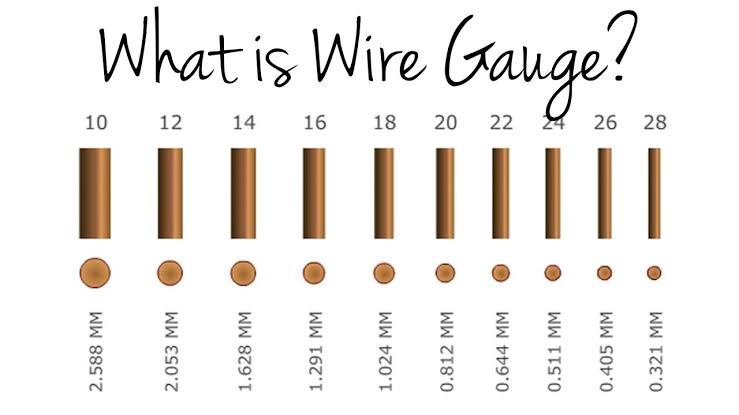
Understanding AWG (Wire Gauge)
The American Wire Gauge (AWG) system is a standardized way to denote wire size. In AWG, smaller gauge numbers mean larger wires: e.g. AWG 10 (diameter ~2.588 mm) is thicker than AWG 14 (diameter ~1.628 mm).
In fact, the relationship is logarithmic: every 6 AWG sizes down doubles the diameter, and every 3 AWG sizes down doubles the cross-sectional area. Table references list AWG versus diameter and resistance (see Table below).
For quick examples, AWG 10 copper has a diameter of about 0.1019″ (2.588 mm) and area ≈5.26 mm², while AWG 14 is ~0.0641″ (1.628 mm) and area ≈2.08 mm². The “max current” listed in [28] (e.g. 15 A for AWG 10) is a rule-of-thumb – actual ampacity can be higher (e.g. AWG 10 is often rated 30–40 A at 90 °C insulation) depending on code and insulation.
Table: AWG gauge vs wire size and example stranding (cross-sectional area = π*(d/2)²). Note: Example strands from PV cable specs; actual configurations vary by manufacturer.
AWG | Diameter (in / mm) | Area (mm²) | Example Stranding (count × AWG) | Strand Diam. (mm) |
8 | 0.1285 / 3.264 | 8.37 | 19 × AWG20 | 0.81 |
10 | 0.1019 / 2.588 | 5.26 | 19 × AWG22 | 0.64 |
0.0808 / 2.052 | 3.31 | 19 × AWG24 | 0.51 | |
14 | 0.0641 / 1.628 | 2.08 | 41 × AWG30 | 0.25 |
16 | 0.0508 / 1.290 | 1.31 | 7 × AWG26 | 0.41 |
Table: AWG size, conductor diameter, and area. Example stranded constructions illustrate how many fine wires can make up that AWG size. | ||||

Strand Count vs Conductor Area
The AWG rating of a cable refers to its total copper cross-sectional area – not the number of strands. A higher-AWG (thinner) wire always has less area than a lower-AWG wire. To make a stranded cable of a given AWG, manufacturers split the cross-section into multiple strands.
For instance, 14 AWG copper is ~2.08 mm². Alpha Wire’s datasheet shows 14 AWG built from 41 strands of AWG 30 (each ~0.254 mm diameter) to total that area.
Similarly, 10 AWG (≈5.26 mm²) might be built as many strands of smaller wires. The sum of all strand areas equals the AWG’s area (minus tiny gaps). Thus, a “larger AWG” (thicker cable) does not automatically come with more strands; the number of strands is a design choice for flexibility and cost, keeping the total area (and AWG) constant.
For example, both a solid 10 AWG and a 10 AWG made of 19 strands have roughly the same total copper area (~5.26 mm²). The strand diameter just adjusts so that 19×(strand area) ≈ 5.26 mm².
In practice, designers choose a stranding pattern to balance flexibility and manufacturing cost. Many PV cables use e.g. 7 or 19 strands for 12–10 AWG, or even finer (30+ strands) for smaller gauges, as needed.
Stranding Effects: Flexibility, Resistance, Skin Effect, Ampacity
The number (and thickness) of strands affects cable flexibility and (to a minor extent) its electrical behavior, but not its fundamental capacity. Key points:
Flexibility: More strands = more flexible. Very fine-stranded cables bend much easier. As one expert notes, “the finer the stranding the more flexible the cable is”. In high-vibration or moving applications (like PV module connectors or mobile equipment), cables with many fine strands are preferred. Coarse-stranded (few-thick-strand) cables are stiffer.
Electrical Resistance (DC): At DC (or low frequency), a stranded conductor has essentially the same resistance as a solid conductor of the same AWG (cross-sectional area). Any difference is tiny; stranded wires might have slightly higher resistance due to small air gaps, but this is usually negligible.
Skin Effect (AC): Skin effect causes AC current to concentrate at the wire surface, raising effective resistance at high frequency. However, at mains frequencies (50–60 Hz), skin depth in copper (~8–9 mm) is much larger than the radii of typical wires. For example, at 50 Hz the skin depth is ~9.2 mm – far bigger than an AWG 10 radius (≈1.3 mm). Thus, for typical AWG sizes used in PV systems, AC skin effect has negligible impact. Stranding also does not significantly mitigate skin effect at these frequencies unless using special litz wire. In short, skin effect is not a practical concern for 50/60 Hz solar wiring. (Only for very large conductors or RF would it matter.)
Ampacity (Current Rating): The current-carrying capacity (ampacity) of a cable is determined by its cross-sectional area and insulation temperature rating, not by strand count. A stranded AWG 10 and a solid AWG 10 of the same copper area will carry the same current (assuming the same insulation and installation conditions). For guidance, NEC/UL tables (or manufacturer specs) give ampacities: e.g. bare copper AWG 10 is often used up to 30–40 A in PV systems. For example, an Alpha 14 AWG PV wire (41×AWG30) is rated ~35 A @ 30 °C. Strand count alone does not increase ampacity.

Stranded vs Solid Conductors in PV Applications
Photovoltaic (PV) cables are almost always stranded copper (usually tinned) with cross-linked insulation. Solid conductors are impractical for solar arrays because the wiring must route across panels, through junctions and equipment, and often needs bending and vibration tolerance. Stranded (fine-wire) conductors provide needed flexibility and mechanical resilience. In fact, UL Subject 4703 (PV wire standard) is written around stranded copper (90 °C insulation, UV-resistant), and even identifies conductor types as stranded copper or copper-clad aluminum. In contrast, solid conductors (like typical house wiring) are rarely used on the DC side of PV systems. Even on the AC side, most solar cables are stranded for flexibility.
Key takeaways: For solar cables, expect stranded (fine-wire) construction. Many PV wire products use tinned copper strands (for corrosion resistance) and XLPE or similar insulations rated for 90–125 °C and 1000–2000 V.
Check that chosen cables meet UL 4703 (North America) or IEC 62930 / EN 50618 (International) standards for photovoltaic cables.
Choosing AWG and Strand Count for Solar Cables
When selecting a solar cable, consider both electrical and mechanical factors:
Current & Voltage Drop: Calculate the maximum DC current and allowable voltage drop for the run. Use NEC/IEC ampacity tables or manufacturer datasheets. For example, an inverter’s input current might dictate using at least AWG 10, whereas shorter lower-current runs might use AWG 12 or 14. Table values can guide you (e.g. AWG 10 has ~5.26 mm² cross-section). Also factor in higher ambient temperatures on rooftops, which may lower ampacity.
Application / Environment: Is the cable outdoors exposed to sun?
(PVC vs XLPE insulation, UV-rating). Will it be in conduit or sunlight? UL 4703/IEC 62930 specify weather-resistant insulations. For fixed, protected runs, coarse-strand cable is fine; for cables on moving parts or frequent bending, choose a highly-stranded (flex) construction.
Flexibility & Routing: If wiring tight bends, or subject to vibration (e.g. on trackers or connecting module junctions), choose a cable with many fine strands (e.g. 19/36 AWG per foot or more). If the run is straight and stationary, standard stranding (7–19 strands) is acceptable.
Connectors: Check terminal requirements. Some connectors (e.g. MC4) prefer certain minimum strand counts or conductor shapes. Often PV wires are specified as “class 5” or “class 6” flexible.
Standards: Ensure compliance with PV cable standards. UL 4703 (or IEC 62930) dictates acceptable materials, tests (cold impact, UV), and conductor types (tinned copper). For example, UL 4703 originally covered 18–8 AWG copper, but newer revisions allow larger sizes (up to 2000 kcmil). Most residential PV cables are 10–14 AWG.
Ampacity: Use the AWG/area for current capacity. As noted, 10 AWG copper (~5.26 mm²) can safely carry ~30–35 A in a PV application; 12 AWG (~3.31 mm²) around 20–25 A; 14 AWG (~2.08 mm²) ~15–20 A, etc., depending on conditions. Always follow local electrical codes for continuous DC circuits.
FAQ
Q: What does a larger AWG number mean for wire thickness?A: AWG (American Wire Gauge) is inversely related to size: a larger AWG number means a smaller (thinner) diameter. For example, AWG 14 (1.628 mm) is thinner than AWG 10 (2.588 mm). So “AWG 14” is a smaller wire than “AWG 10”.
Q: Does a larger AWG wire have more strands?A: No. AWG designates the total cross-sectional area of copper, not the number of strands. A larger-diameter (lower AWG) wire simply has more total copper area. It can be made from many thin strands or fewer thick strands – the AWG size (area) stays the same. For instance, 14 AWG copper (~2.08 mm²) can be made from 41 fine AWG30 strands, but 41 is not a required number by AWG. Conversely, one could make 14 AWG from 7 thicker strands of AWG15 or from 19 strands of AWG24 – different strandings yield the same area. The AWG number itself does not imply a specific strand count.
Q: How does strand count affect cable flexibility and use?A: More strands = finer wire = greater flexibility. A finely stranded cable bends more easily and resists fatigue better under vibration. It’s ideal where bending is needed (e.g. moving connectors or dynamic mounting). Coarse-stranded cable is stiffer but often less expensive. Electrical performance (resistance, ampacity) is virtually the same at low frequencies regardless of strand count, so choose strands based on mechanical needs.
Q: Does skin effect impact solar cable performance?A: Not practically. Skin effect (AC current crowding at the surface) increases resistance at high frequency, but at 50/60 Hz the skin depth in copper is on the order of 8–9 mm – much larger than the radius of typical wires. Even a very large wire (several AWG/0 size) is much smaller than that diameter. Thus, for PV cables carrying DC (or low-frequency AC), skin effect is negligible. More strands do not significantly mitigate skin effect at these frequencies. The resistance and ampacity of the cable will be essentially the same whether solid or stranded for 50/60 Hz or DC operation.
Q: What factors determine the ampacity of a solar cable?A: Ampacity depends on conductor cross-sectional area, insulation temperature rating, and installation conditions – not on strand count. For example, a 10 AWG copper conductor (~5.26 mm²) with 90 °C insulation might carry ~30–40 A in a PV application. When sizing cable, use AWG area (or mm²) to meet the required current with acceptable voltage drop. Also consider temperature (choose cables rated for 90–125 °C per IEC/UL) and derating (e.g. bundling). PV standards (UL 4703 / IEC 62930) require using stranded, tinned copper cables with proper insulation; they give guidance on allowable sizes (e.g. UL 4703 covers 18–8 AWG historically) and performance. In summary, pick AWG by the needed current and voltage drop (following code or datasheets), then choose strand count for flexibility (e.g. 19+ strands for high-flex cables).
Sources: AWG tables and definitions; PV cable manufacturer datasheets; UL 4703/IEC 62930 standards summaries; electrical engineering references on stranding and skin effect. These provide the basis for the above analysis.


Comments