
12 AWG Wire: What It's Actually Rated For — and the Loads Where 8 AWG Takes Over


Introduction
12 AWG is the wire most people reach for the moment a project outgrows 14 AWG — a shop extension cord, a 20A kitchen circuit, a window air conditioner, a bench tool. It has a reputation as the reliable “middle” gauge: not flimsy, not overkill. That reputation is mostly deserved, but it also causes a specific kind of mistake — people keep using 12 AWG for loads that quietly outgrew it, especially once cord length or continuous draw enters the picture.
This guide covers what 12 AWG is actually rated for, how that rating changes once you're talking about a long extension cord rather than a short in-wall run, a load-by-load breakdown of common household and workshop equipment, and — just as importantly — exactly where the honest answer becomes 8 AWG instead.
What Is 12 AWG Wire? Quick Specifications
Physical and Electrical Specifications
• Conductor diameter: approximately 2.05 mm
• Cross-sectional area: approximately 3.31 mm² (nearest IEC metric size: 4 mm²)
• DC resistance: approximately 5.21 Ω/km (1.588 Ω/kft) for copper at 20°C
Ampacity and Breaker Limits
• Standard copper ampacity: 20A at 60°C, 25A at 75°C, 30A at 90°C
• Maximum standard overcurrent protection: 20A breaker for general branch circuits (NEC 240.4(D))
Those numbers make 12 AWG the standard conductor for 20A branch circuits — kitchen counter receptacles, bathroom outlets, garage circuits, and general workshop wiring. Where 12 AWG starts to get interesting is everything downstream of the breaker: cords, tool leads, and longer runs, where the printed ampacity stops being the only number that matters.
12 AWG in Extension Cords: How Length Quietly Changes the Rating
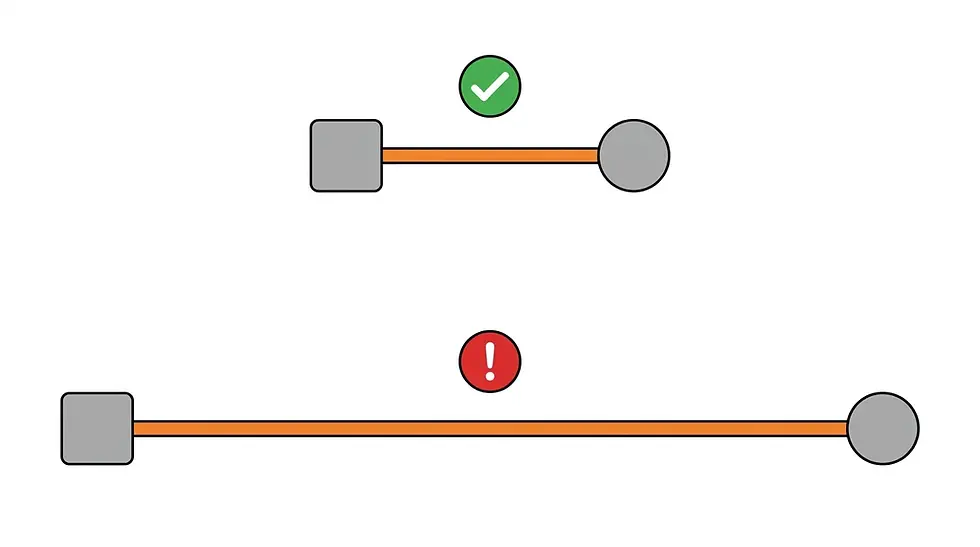
A 20A breaker on a 12 AWG circuit does not mean a 12 AWG extension cord plugged into that circuit is good for 20A at any length. Ampacity describes what the conductor can carry thermally; it says nothing about voltage drop, and voltage drop is what actually limits a long cord.
Maximum Cord Length by Current
Using a standard 5% voltage-drop budget on a 120V circuit — a widely used threshold for keeping tools and motors running properly — the maximum practical one-way cord length for 12 AWG copper looks like this:
Load Current | Max One-Way Cord Length (12 AWG) | Max One-Way Cord Length (8 AWG) |
10 A | ≈ 189 ft (57 m) | n/a — 12 AWG is sufficient |
15 A | ≈ 126 ft (38 m) | n/a — 12 AWG is sufficient |
20 A | ≈ 95 ft (29 m) | ≈ 239 ft (73 m) |
30 A | Exceeds 12 AWG's rating | ≈ 159 ft (49 m) |
40 A | Exceeds 12 AWG's rating | ≈ 119 ft (36 m) |
The pattern to notice: at 20A, a 12 AWG cord is already limited to well under 100 feet before voltage drop becomes a real problem — a shorter distance than many people assume. Once a tool or piece of equipment draws 30A or more, 12 AWG is out of its depth entirely, and 8 AWG cable is what takes over, offering roughly 2.5× the practical run length at the same current.
12 AWG Load-by-Load: What It Can — and Can't — Power
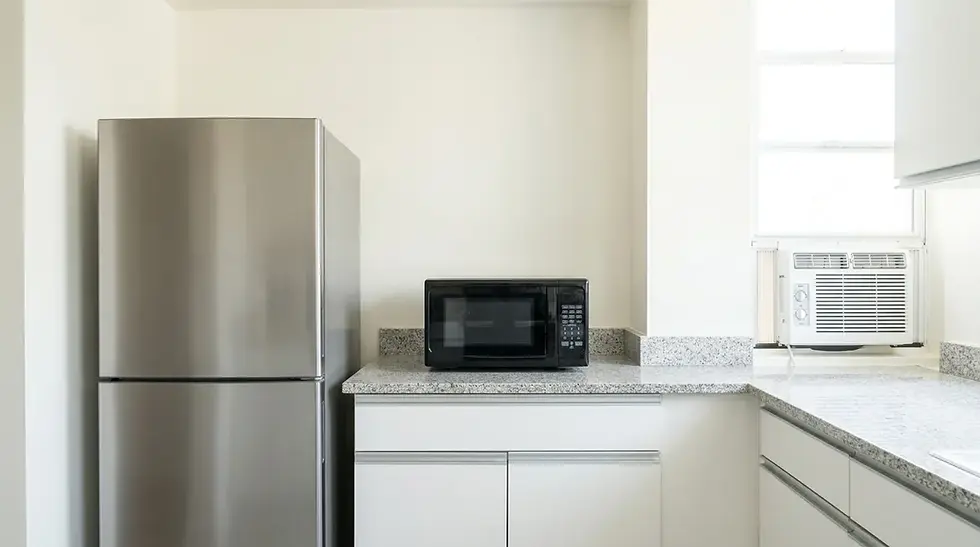
Ampacity charts are abstract. The more useful question for most people is simpler: will 12 AWG handle this specific thing I'm plugging in? Here's how common loads stack up against 12 AWG's practical 16A continuous rating (80% of a 20A breaker) and 20A cord limit.
Loads 12 AWG Handles Comfortably
Load | Typical Draw | 12 AWG Verdict |
Refrigerator | 3–6 A running, brief startup surge | Comfortable fit |
Microwave (countertop) | 8–13 A | Comfortable fit |
Garbage disposal | 5–10 A | Comfortable fit |
Level 1 EV charger (120V) | 12 A continuous | Fits, but leaves little margin — use a dedicated circuit |
Window AC, 8,000–10,000 BTU | 7–10 A | Comfortable fit |
Window/PTAC AC, 12,000+ BTU | 12–16 A | Workable on a dedicated 20A circuit; avoid long cords |
Shop vacuum / bench tool | 8–12 A | Comfortable fit on short-to-moderate cords |
1500W space heater | 12.5 A | Fits, but avoid sharing the circuit with other loads |
Loads Where 12 AWG Is Marginal or Insufficient
Load | Typical Draw | 12 AWG Verdict |
Portable air compressor (startup surge) | 15–20 A | Marginal — fine on short, dedicated runs only |
Table/contractor saw | 12–15 A running, higher on startup | Workable short-run; long cords cause nuisance voltage sag |
Detached garage/workshop subpanel feed | 30–40 A typical | Outside 12 AWG's range — this is an 8 AWG or larger feeder job |
Large window AC / mini-split condenser (240V) | 20–30 A | Outside 12 AWG's range — step up to 8 AWG |
Electric range or dryer branch | 30–50 A | Outside 12 AWG's range entirely — typically 8 AWG to 6 AWG, sometimes 4 AWG on larger ranges |
The takeaway from these tables isn't that 12 AWG is weak — it comfortably covers the majority of everyday household and light workshop loads. It's that the moment a load's running current or startup surge pushes past roughly 16–20A, or the circuit needs to feed a subpanel or a 240V appliance, 12 AWG has reached the end of its range and the honest next step is 8 AWG.
12 AWG vs 8 AWG: When the Extra Size Is Actually Worth It

Side-by-Side Comparison
Parameter | 12 AWG | 8 AWG |
Cross-section | 3.31 mm² (→ 4 mm²) | 8.37 mm² (→ 10 mm²) |
Standard ampacity (60°C) | 20 A | 40 A |
Resistance | 5.21 Ω/km | 2.06 Ω/km |
Typical role | 20A branch circuits, cords, light tools | Subpanel feeders, large 240V appliances, long high-draw runs |
Cost & handling | Light, easy to route and terminate | Heavier, stiffer, needs larger connectors and lugs |
When to Move Up to 8 AWG (or Beyond)
12 AWG remains the better choice whenever the load stays under about 16A continuous and the run is reasonably short — it's lighter, cheaper, and easier to terminate. 8 AWG earns its keep the moment any one of three things is true: the continuous load exceeds roughly 30A, the circuit is feeding a subpanel or a 240V appliance rather than a simple outlet, or the physical run is long enough that voltage drop — not ampacity — becomes the limiting factor. For the full breakdown of 8 AWG's ampacity, NEC breaker limits, and where it fits between 10 AWG and 6 AWG, see our dedicated 8 AWG wire guide.
On the higher end — large electric ranges, big dryer circuits, or long feeder runs to a detached structure — even 8 AWG can run out of headroom, at which point the conversation moves to 6 AWG or 4 AWG, which we cover separately in our 4 AWG wire guide.

Common Mistakes When Using 12 AWG Wire
• Judging a cord by its breaker size instead of its actual length — a 12 AWG cord good for 20A at 30 feet is not automatically fine at 100 feet
• Using 12 AWG for a subpanel feeder because “it's what was in the truck” — subpanel feeders almost always call for 8 AWG or larger, sized to the panel's actual load
• Ignoring startup surge on motors and compressors, which can briefly draw well above the running current shown on the nameplate
• Daisy-chaining several 12 AWG extension cords together, which compounds resistance and voltage drop far beyond what a single-length chart suggests
• Assuming a 240V appliance can use the same gauge as an equivalent 120V one, without checking its actual amperage — 240V loads often draw less current for the same wattage, but many still exceed 12 AWG's range
• Substituting 4 mm² IEC cable without checking that it's genuinely rated at or above 3.31 mm² — some regional cable is marked in ways that don't map cleanly to AWG

Quick Metric Reference
12 AWG converts to approximately 3.31 mm², with 4 mm² as the correct IEC equivalent for international sourcing — the same rounding logic used across the AWG-to-metric scale: always round up to the nearest standard size, never down.
Frequently Asked Questions
Q1: Is 12 AWG good enough for a 20A circuit?
A: Yes. 12 AWG copper is the standard, code-recognized conductor for 20A branch circuits under NEC 240.4(D), and it's the default choice for kitchen, bathroom, and garage outlets on a 20A breaker.
Q2: How long can a 12 AWG extension cord be?
A: It depends on the current draw. At 20A, a 12 AWG cord stays within a 5% voltage-drop budget out to roughly 95 feet one-way; at lighter loads around 10A, that stretches to nearly 190 feet. Beyond those lengths at higher current, 8 AWG becomes the more practical choice.
Q3: Can I use 12 AWG for a window air conditioner?
A: For most small-to-mid window units drawing under about 12–16A, yes, on a dedicated circuit with a reasonably short cord. Larger units or 240V mini-split condensers pulling 20A or more move outside 12 AWG's comfortable range.
Q4: When should I use 8 AWG instead of 12 AWG?
A: Once continuous load approaches 30A, the circuit feeds a subpanel or a 240V appliance, or the run is long enough that voltage drop becomes noticeable — 8 AWG is the more defensible choice in all three cases.
Q5: What is 12 AWG wire in mm²?
A: Approximately 3.31 mm², with 4 mm² as the standard IEC metric equivalent.
Q6: Is 12 AWG or 8 AWG better for a detached garage subpanel?
A: For nearly all subpanel feeders, 8 AWG or larger is the right call — 12 AWG is undersized for the combined load a subpanel is expected to carry. Feeder sizing should be based on the connected load, not just the distance to the structure.
Conclusion
12 AWG is the right conductor for a wide majority of everyday 20A circuits, cords, and light-to-moderate tools — its 20A ampacity and 4 mm² metric equivalent make it the practical default for kitchens, garages, and general workshop wiring. The two places people most often get it wrong are cord length, where voltage drop bites long before the breaker ever trips, and higher-draw equipment like subpanels, large 240V appliances, or heavy shop tools, where the honest answer is to move up to 8 AWG.
Knowing where that handoff happens — and reaching for 8 AWG instead of stretching 12 AWG past its comfortable range — is what separates a wiring job that works fine on day one from one that keeps working reliably for years.
Source 12 AWG and 8 AWG Building Wire from FRCABLE
FRCABLE manufactures copper conductors across the full AWG and metric range for residential, workshop, and light commercial use, including:
• 4 mm² (12 AWG equivalent) building and control wire
• 10 mm² (8 AWG equivalent) feeder and appliance cable — see our full 8 AWG wire guide for ampacity and application details
• PVC, THHN/THWN, and XLPE insulation options for indoor, outdoor, and subpanel feeder applications
• Documentation support for procurement teams sourcing across AWG and IEC standards
Our technical team can help confirm the right gauge — 12 AWG, 8 AWG, or otherwise — for your specific load and run length before you finalize a procurement order.


Comments