
AI Data Centers Need Power: Solar Energy & Solar Cable Demand

Artificial intelligence may exist in the cloud, but the cloud ultimately runs on electricity.
Behind every AI model are thousands of GPUs, servers, cooling systems, storage systems, network switches and power-conversion devices operating inside increasingly large data centers.
That creates an important connection that is often overlooked:
AI growth is not only a semiconductor story. It is becoming an energy infrastructure story.
And as technology companies search for new sources of electricity, utility-scale solar, battery storage, transmission infrastructure and the cables connecting those systems are becoming increasingly important.
The relationship can be summarized as:
AI → Data Centers → Electricity Demand → New Power Generation → Solar + Storage → DC Infrastructure → Solar Cable
Solar cable is therefore not an "AI product" in the conventional sense.
Instead, photovoltaic cable represents part of the physical infrastructure required to convert rapidly expanding digital demand into usable renewable electricity.
In other words:
Fiber carries AI's data. Power infrastructure carries the energy that makes AI possible.
Understanding this relationship may become increasingly important for solar developers, EPC contractors, cable manufacturers and investors during the next decade.

The AI Boom Is Becoming an Electricity Boom
The scale of the change is significant.
According to the International Energy Agency, global data-center electricity consumption is expected to more than double to approximately 945 TWh by 2030.
AI is expected to be the most important driver of this growth.
The IEA also projects electricity consumption from accelerated servers — the computing systems most closely associated with AI workloads — to grow around 30% annually in its base-case outlook.
To put 945 TWh into perspective, the IEA notes that it is slightly more electricity than Japan consumes today.
This fundamentally changes how we should think about AI infrastructure.
When an AI company announces another hyperscale data center, the physical investment is not limited to:
GPUs
processors
servers
cooling equipment
networking equipment
Additional infrastructure may also be required outside the building:
new generation capacity
substations
transformers
transmission lines
energy storage
switchgear
power electronics
photovoltaic arrays
DC cabling
medium-voltage distribution
The next phase of the AI industry therefore depends as much on energy availability as computing capability.
Why Electricity Could Become a Bottleneck for AI
Building computing hardware can happen relatively quickly.
Building power infrastructure often cannot.
The IEA notes that while a data center can sometimes become operational within two to three years, electricity infrastructure can require considerably longer planning and construction timelines.
That creates a potential mismatch:
AI computing demand grows quickly.
But:
generation + grid + transmission infrastructure grows more slowly.
This is why the biggest technology companies are becoming increasingly involved in energy procurement.
Instead of merely purchasing whatever electricity is already available, companies are increasingly signing long-term power agreements, investing in new generation, supporting grid infrastructure and exploring solar, wind, battery storage, geothermal and nuclear power.
The AI race is therefore beginning to influence the power sector itself.
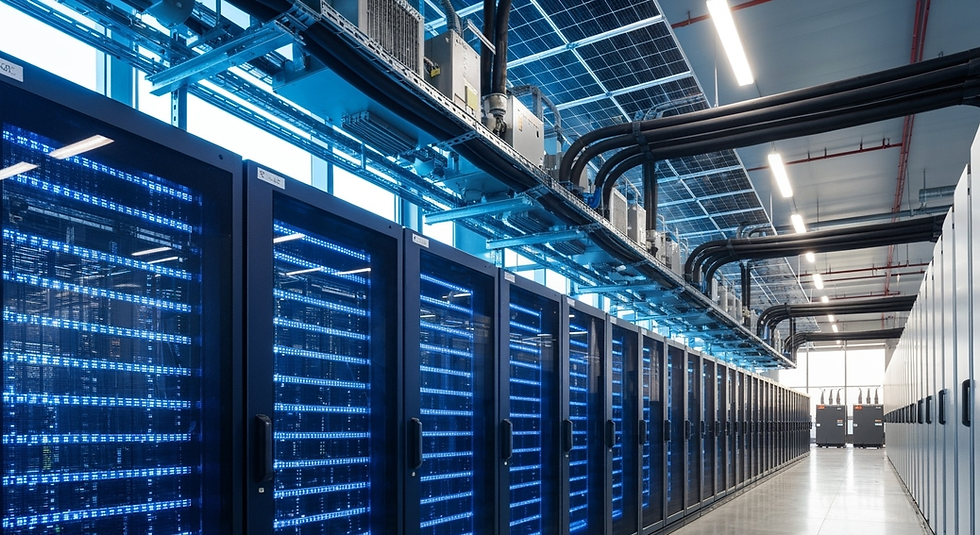
Why Solar Energy Is Important to the AI Power Equation
Solar alone will not supply every AI data center.
Data centers require reliable electricity 24 hours per day, while solar generation changes with sunlight.
The future AI energy mix is therefore likely to include combinations of:
Solar + wind + battery storage + grid power + nuclear + geothermal + natural gas + demand management.
Nevertheless, solar has several major advantages.
It can often be developed relatively quickly.
Its economics have improved dramatically.
It is highly scalable.
It can be paired with battery storage.
And large technology companies already have extensive experience financing renewable-energy projects through power purchase agreements.
The IEA projects that renewables will meet nearly half of the increase in global data-center electricity demand through 2030, with rising deployment of solar PV and wind playing major roles.
At the same time, solar itself is undergoing extraordinary expansion.
The IEA expects approximately 4,600 GW of renewable capacity to be added globally between 2025 and 2030, with solar PV accounting for nearly 80% of the increase.
So two enormous trends are developing simultaneously:
AI electricity demand is accelerating.
Solar deployment is accelerating.
The infrastructure connecting those trends deserves much more attention.
A Real 2026 Example: 2.5 GW of Solar + AI Infrastructure
The connection is no longer theoretical.
In July 2026, Google announced its involvement in the Steel River Energy Center in Arkansas.
The first two phases are expected to add:
1.6 GWdc of solar generation
and:
1.9 GWh of battery storage.
When all three phases are completed, the project is planned to provide:
2.5 GWdc of solar
and:
2.9 GWh of battery storage.
Google explicitly connected the project with its effort to source carbon-free electricity around the clock for its data centers.
That scale matters.
A multi-gigawatt solar development does not consist only of solar modules.
Behind millions of modules sits an enormous electrical network:
PV modules
↓
String cables
↓
PV connectors / harnesses
↓
Combiner architecture
↓
DC collection
↓
Inverters
↓
AC collection
↓
Transformers
↓
Grid
↓
Data-center electricity system
This is where the relationship between AI and solar cable becomes tangible.
Another Example: AI Growth Is Driving New Solar, Storage and Grid Capacity
Google's 2026 Minnesota data-center agreement provides another useful illustration.
Its agreement with Xcel Energy includes plans to add approximately:
1,400 MW of wind
200 MW of solar
and
300 MW of iron-air battery storage
to the grid supporting growing electricity requirements.
Microsoft provides another indication of the scale at which technology companies are entering electricity markets.
Microsoft reported that it had contracted approximately 34 GW of carbon-free electricity across 24 countries as it expands AI and cloud infrastructure.
These numbers do not mean every megawatt directly supplies AI servers.
Renewable PPAs and electricity markets are more complicated than that.
But they illustrate something important:
Large technology companies are increasingly becoming major participants in the development and financing of energy infrastructure.
That trend creates downstream implications for the entire solar supply chain.

Does a Solar Farm Actually Connect Directly to an AI Data Center?
Not necessarily.
This distinction is important.
When a technology company signs a solar PPA, electricity from that specific solar farm does not always travel through a dedicated wire directly into the company's data center.
In many projects, solar electricity enters the regional grid.
The data center receives electricity through the same interconnected grid.
The PPA provides the commercial structure supporting renewable generation.
Other projects may involve closer physical integration, private-wire systems, onsite generation, microgrids or dedicated generation and storage arrangements.
Therefore the correct relationship is not always:
Solar Farm → Dedicated Cable → AI Data Center
It is more often:
AI Demand → New Electricity Procurement → New Solar Capacity → New Solar Infrastructure
And every physical solar installation still requires electrical conductors to transfer energy from modules toward the inverter and onward into the electrical system.
Solar Cable Is the Physical Layer Between PV Modules and Usable Power
A photovoltaic module produces DC electricity.
But electricity generated at the module is not useful until it can be transported.
That first transportation layer is the PV cable system.
The simplified electrical path is:
Sunlight
↓
PV Module
↓
DC Solar Cable
↓
PV String
↓
Combiner / Inverter
↓
AC Power
↓
Transformer
↓
Grid / Energy Storage / Load
For AI companies purchasing renewable electricity, solar modules are therefore only one part of the energy infrastructure.
Without reliable electrical connections, there is no practical solar generation system.
IEC 62930 specifically covers electrical cables intended for the DC side of photovoltaic systems at voltages up to 1.5 kV DC.
That makes PV cable a relatively small component by cost compared with servers or solar modules, but an essential component by function.
Why Large AI-Driven Solar Projects Change the Importance of Cable Efficiency
In a residential PV system, a small difference in conductor loss may represent a relatively small amount of energy.
At utility scale, the same percentage becomes more significant.
Cable power loss can be described by:
Ploss=I2RP_{loss}=I^2R
where:
I = current
and
R = circuit resistance
This equation explains why cable design matters.
Resistance is influenced by:
conductor material
conductor cross-section
conductor length
conductor temperature
Increasing conductor cross-section generally reduces resistance.
Lower resistance reduces both:
voltage drop
and
electrical energy loss.
Consider a simplified example.
If a power path handling an instantaneous 500 MW experiences 0.5% additional electrical loss, that represents:
500MW×0.005=2.5MW500MW\times0.005=2.5MW
of instantaneous power difference under those assumed conditions.
This is only an illustration — actual PV cable losses must be calculated circuit by circuit rather than by applying one percentage to an entire plant.
But it demonstrates the economic principle:
Small efficiency differences become more important as infrastructure scales from kilowatts to megawatts and gigawatts.
For AI-related electricity infrastructure, where enormous amounts of energy may be consumed over decades, lifecycle efficiency becomes increasingly valuable.

AI Infrastructure Could Make Solar Cable Engineering More Important, Not Less
There is a common misconception that because solar technology is becoming cheaper, balance-of-system components matter less.
In reality, extremely large projects can make engineering quality more important.
Consider a 100 MW, 500 MW or multi-GW solar development.
Engineers must evaluate:
conductor resistance
ampacity
voltage drop
cable length
conductor temperature
DC voltage
connector compatibility
routing
environmental exposure
installation labor
fire performance
long-term reliability
copper versus aluminum economics
Cable selection becomes a system optimization problem.
The cheapest cable per meter is not necessarily the lowest-cost solution over the operating life of the plant.
1. Higher DC Voltage Can Reduce Transmission Losses
One major development in utility-scale solar has been the movement toward higher DC system voltages.
For electrical power:
P=V×IP=V\times I
For the same power:
higher voltage allows lower current.
Because resistive loss follows:
Ploss=I2RP_{loss}=I^2R
reducing current can significantly reduce resistive loss.
This is one reason 1500 V DC architecture has become important in utility-scale PV systems.
IEC 62930 covers photovoltaic cable systems with rated voltage up to 1.5 kV DC.
FRCABLE offers PV cable products designed for IEC 62930 applications and H1Z2Z2-K cable configurations, with its published IEC/UL product specifying 1500 V DC under TÜV-related ratings and 2000 V DC for its UL configuration.
As renewable projects supplying increasingly energy-intensive infrastructure grow, high-voltage DC design can become increasingly important to BOS optimization.
2. Copper vs Aluminum Becomes a System-Level Decision
Copper remains widely used for photovoltaic string cable because of its conductivity, flexibility and established connection technology.
However, utility-scale projects create enormous conductor requirements.
As project size increases, engineers may evaluate aluminum PV conductors for some applications because conductor weight and material economics become increasingly relevant.
The decision should not simply be:
Which metal is cheaper?
Instead engineers should compare:
conductor resistance
required cross-sectional area
termination technology
connector compatibility
installation labor
thermal behavior
corrosion protection
total installed cost
lifecycle energy loss
FRCABLE's portfolio includes both conventional photovoltaic cable and aluminum photovoltaic cable solutions for large solar applications.
That becomes particularly relevant as solar plants move deeper into the hundreds-of-megawatts and gigawatt scale.
3. Reliability Matters Because AI Loads Are Extremely Valuable
For many industrial systems, electricity interruptions are expensive.
For AI data centers they can be particularly disruptive.
The renewable generation supplying those grids therefore has to be designed for long-term reliability.
Solar cable is exposed to conditions that conventional indoor wire may never encounter:
ultraviolet radiation
ozone
high ambient temperature
temperature cycling
moisture
mechanical stress
outdoor installation
long-term DC voltage
This is why photovoltaic cable is engineered differently from ordinary building wire.
IEC 62930 specifies PV cables intended for DC photovoltaic systems, while EN 50618 covers photovoltaic cable requirements widely used in European markets.
UL Solutions notes that IEC 62930 and EN 50618 evaluate specialized photovoltaic cable constructions for international market applications.
FRCABLE manufactures photovoltaic cable solutions for applications involving standards including IEC 62930, EN 50618/H1Z2Z2-K and UL 4703, with product constructions engineered for outdoor photovoltaic environments.
Solar + Battery Storage Changes the Cable Architecture Again
Solar alone produces electricity when sunlight is available.
AI infrastructure operates continuously.
This explains why battery storage is becoming increasingly important alongside solar.
The architecture becomes more complex:
Solar Side
PV Module
↓
PV String Cable
↓
DC Collection
↓
Solar Inverter
Storage Side
Battery Module
↓
Battery Rack
↓
DC Cable
↓
Battery PCS
Grid / Load Side
PCS / Solar Inverter
↓
Transformer
↓
Medium-Voltage Network
↓
Grid / Data Center
The Steel River example makes this visible.
Google is supporting a project combining 2.5 GWdc of solar with 2.9 GWh of battery storage once fully completed.
That is not simply a solar farm.
It represents the evolution toward a much larger:
DC energy infrastructure ecosystem.
For cable manufacturers, the future opportunity may therefore extend beyond the conventional category of "solar cable."
It includes:
PV cable
solar harnesses
PV connectors
battery cable
energy-storage connections
and the broader electrical balance of system.
Solar Alone Will Not Power the AI Era — and That Is Important
It would be misleading to claim that solar will power all future AI infrastructure.
It will not.
AI data centers require dependable electricity day and night.
The IEA expects the growing electricity demand from data centers to be met by a combination of:
renewables
natural gas
nuclear
coal in some regions
geothermal
energy storage
existing grid resources
Renewables are expected to provide nearly half of incremental data-center electricity supply through 2030, but dispatchable power sources remain important.
This makes the relationship between AI and solar more interesting rather than less important.
The challenge is no longer simply:
"How do we produce more solar electricity?"
It becomes:
How do we integrate large amounts of solar into a reliable 24/7 electricity system capable of supporting critical computing infrastructure?
That requires better:
generation planning,
battery storage,
grid flexibility,
transmission,
power electronics,
forecasting,
and electrical infrastructure.

AI Will Also Begin Optimizing the Solar Infrastructure That Powers It
There is another layer to the relationship.
AI is creating electricity demand.
But AI can also improve how electricity systems operate.
Solar plants increasingly generate large datasets involving:
irradiance
module temperature
string current
string voltage
inverter performance
weather conditions
equipment temperature
battery state of charge
grid prices
maintenance history
AI systems can analyze those data streams to support:
Predictive Maintenance
AI can identify unusual electrical behavior before equipment failure becomes obvious.
Solar Generation Forecasting
Machine-learning systems can combine weather and historical production data to estimate future PV output.
Battery Dispatch Optimization
AI can determine when electricity should be stored, exported or consumed.
Cable and Connector Fault Detection
Abnormal current, voltage or thermal behavior can potentially reveal problems associated with:
connectors
conductors
modules
insulation
string circuits
Digital Twins
Large solar plants can increasingly be modeled digitally to evaluate power flows, temperature, equipment conditions and system losses.
The future solar plant therefore becomes both:
an electrical system
and
a data system.
Could AI Eventually Help Engineers Optimize Solar Cable Size?
Yes.
Traditional cable sizing requires engineers to consider variables such as:
CurrentCurrent DistanceDistance VoltageVoltage Ambient TemperatureAmbient\ Temperature Installation MethodInstallation\ Method Voltage DropVoltage\ Drop Cable CostCable\ Cost Energy LossEnergy\ Loss
Future engineering platforms could analyze thousands of cable routes simultaneously.
Instead of asking:
"Should every string use 6 mm² cable?"
software could optimize each part of the system for:
lowest lifecycle cost
rather than simply:
lowest initial cable cost.
An algorithm might determine:
Route A → 4 mm²
Route B → 6 mm²
Route C → 10 mm²
Main DC circuit → larger copper or aluminum conductor
based on actual cable distance, current, thermal environment and expected energy yield.
That would make cable engineering more data-driven.
From Solar Cable to Intelligent Electrical Infrastructure
The next evolution may go even further.
Traditional cable is largely passive.
It carries electricity.
But future energy systems can increasingly combine:
Cable + Sensors + Monitoring + AI
For example, monitoring systems may use:
current sensing
voltage measurement
thermal imaging
resistance trends
insulation monitoring
drone inspection
fault-location systems
AI can then identify abnormal patterns.
A healthy PV string might show:
13.2 A13.3 A13.1 A13.2 A
while another begins showing:
13.2 A12.5 A11.9 A11.3 A
The software may investigate whether the cause is:
module degradation,
partial shading,
connector resistance,
cable damage,
temperature,
or another electrical fault.
The cable itself does not need to contain AI.
Instead:
AI turns electrical infrastructure into measurable infrastructure.
That may become increasingly important for very large renewable assets.
What the AI Energy Boom Means for Solar Cable Buyers
For EPC contractors and solar developers, the AI-driven energy transition does not mean buying a special "AI solar cable."
It means the scale and performance requirements of future renewable infrastructure may increase.
Procurement teams should therefore pay closer attention to:
Electrical Performance
Evaluate conductor resistance, current capacity and voltage drop.
Voltage Rating
Confirm the cable is appropriate for the PV architecture, including modern 1500 V DC systems where applicable.
International Certification
Projects may require standards such as:
IEC 62930
EN 50618 / H1Z2Z2-K
UL 4703
depending on the market.
Environmental Performance
Evaluate:
UV resistance,
ozone resistance,
temperature range,
moisture resistance,
flame performance,
and mechanical durability.
System Compatibility
Cable must also match:
connectors,
glands,
terminals,
combiner boxes,
inverters,
and installation methods.
Traceability and Quality Control
Gigawatt-scale projects require consistent cable performance across enormous installation volumes.
Quality assurance therefore becomes a project-management issue, not merely a product specification.
What the AI Boom Means for the Solar Cable Industry
The biggest opportunity may not be a new type of cable.
It may be a much larger market for reliable DC infrastructure.
The traditional solar cable industry has often focused on:
Residential PV
and
Commercial PV
The next wave increasingly includes:
Utility-Scale Solar
Solar + Storage
Industrial Microgrids
Data-Center Energy Infrastructure
Large Renewable PPAs
Grid-Scale Energy Systems
That changes how solar cable manufacturers should think about their role.
The value proposition moves from:
"We manufacture 4 mm² and 6 mm² PV cable."
toward:
"We provide critical DC infrastructure for large-scale renewable energy systems."
That is a much more important position in the emerging energy economy.
The Deeper Connection: AI Is Digital Infrastructure Built on Physical Infrastructure
AI appears intangible.
A user types a prompt into a browser.
A response appears seconds later.
But underneath that simple interaction sits an enormous physical chain:
Semiconductors
↓
Servers
↓
Data Centers
↓
Cooling Systems
↓
Electricity Networks
↓
Power Generation
↓
Renewable Energy
↓
Solar Modules
↓
Electrical Conductors
The software economy does not replace physical infrastructure.
It increases its importance.
This leads to one of the most important ideas for the coming decade:
The more digital the global economy becomes, the more physical energy infrastructure it may require.
AI may be generated in the cloud.
But the cloud is built from steel, silicon, copper, aluminum, transformers, batteries and cables.
Why Solar Cable Could Become Critical Infrastructure for the AI Energy Era
Calling solar cable "AI infrastructure" directly would be an exaggeration.
But calling it part of the infrastructure supporting the AI energy transition is increasingly reasonable.
The logic is straightforward:
1. AI increases computing demand.
↓
2. Computing increases data-center electricity demand.
↓
3. Electricity demand creates pressure for new generation.
↓
4. Solar is one of the fastest-growing generation technologies.
↓
5. Utility solar requires extensive DC electrical infrastructure.
↓
6. Solar cables physically transport the electricity generated by PV modules.
Therefore:
AI growth can indirectly create demand throughout the solar electrical supply chain.
The connection is indirect.
But it is real.
And as AI infrastructure moves from megawatt-scale campuses toward increasingly large power requirements, that connection could become economically significant.
What Should EPC Contractors Look for in Solar Cable for Large Energy Projects?
For utility-scale and high-value projects, solar cable should not be selected only by price per meter.
A professional specification should consider:
Requirement | Why It Matters |
Conductor size | Determines resistance and ampacity |
Conductor resistance | Influences energy loss |
Copper or aluminum | Affects cost, weight and conductor sizing |
DC voltage rating | Must match system architecture |
IEC / EN / UL certification | Required for relevant markets |
UV resistance | Essential for outdoor exposure |
Ozone resistance | Important for long-term weathering |
Temperature performance | Solar cable can operate in harsh environments |
Water resistance | Relevant for wet locations and some ground-mounted systems |
Connector compatibility | Prevents termination and reliability problems |
Cable traceability | Important for large EPC procurement |
Quality testing | Helps maintain consistency across large projects |
UL Solutions identifies PV cable certification under standards including EN 50618 and IEC 62930 as an important part of global PV cable market access and performance assessment.
FRCABLE Solar Cable Solutions for the Next Generation of Energy Infrastructure
As solar systems scale, cable requirements become increasingly project-specific.
FRCABLE manufactures photovoltaic cable solutions for international solar projects, including products designed for:
IEC 62930
EN 50618 / H1Z2Z2-K
and
UL 4703
applications.
FRCABLE also provides multiple conductor-size options and publishes cable documentation for sizes including:
4 mm²
6 mm²
10 mm²
16 mm²
25 mm²
35 mm²
and
95 mm²
within its PV cable documentation library.
For utility-scale installations where conductor economics become increasingly important, FRCABLE also develops aluminum photovoltaic cable solutions alongside conventional copper PV cable.
The objective is not simply to provide cable.
It is to support reliable DC power transmission across increasingly large photovoltaic infrastructure.
Frequently Asked Questions
Does AI use solar power?
AI itself does not select an electricity source. AI computing runs inside data centers connected to electrical systems. However, major technology companies increasingly procure renewable electricity, including solar energy, to support their expanding operations.
Why do AI data centers need so much electricity?
AI workloads rely heavily on high-performance accelerators such as GPUs. Large clusters require electricity not only for computing but also for cooling, networking, power conversion and supporting infrastructure.
The IEA expects global data-center electricity consumption to reach approximately 945 TWh by 2030, with AI being the largest driver of the increase.
Will solar power AI data centers?
Solar will likely be an important part of the energy mix rather than the only source.
Because data centers operate continuously, solar is increasingly combined with grid electricity, battery storage and other dispatchable sources.
What does solar cable have to do with AI?
The relationship is indirect.
AI increases electricity demand. New electricity demand can stimulate renewable-energy development. Solar plants require photovoltaic cables to transfer DC electricity from PV modules toward inverters and the rest of the electrical system.
What solar cable is used in utility-scale projects?
Requirements vary by market and project, but modern PV systems commonly use cables designed according to standards such as IEC 62930, EN 50618/H1Z2Z2-K or UL 4703.
Cable size must be determined according to current, distance, voltage drop, temperature, installation conditions and applicable electrical requirements.
Why are 1500 V solar cables important?
Higher DC system voltage can allow the same power to be transmitted with lower current, potentially reducing resistive loss and conductor requirements.
IEC 62930 applies to PV cables rated up to 1.5 kV DC.
Will AI increase demand for solar cable?
AI does not directly consume solar cable.
However, if increasing data-center electricity demand results in additional utility-scale solar development, that additional generating infrastructure will require more PV cable, connectors and electrical balance-of-system components.
Conclusion: AI May Run in the Cloud, but the Cloud Runs on Electricity
The AI revolution is normally discussed in terms of:
models,
GPUs,
semiconductors,
software,
and data.
The next chapter will increasingly be about:
electricity.
The IEA expects global data-center electricity demand to more than double by 2030, while renewable energy is projected to provide nearly half of the additional electricity required.
At the same time, solar PV remains one of the fastest-growing sources of electricity worldwide, with the IEA forecasting more than 600 TWh of additional solar generation per year on average through 2030.
Those trends are beginning to converge.
AI creates new electricity demand.
Solar provides part of the new supply.
Battery storage helps bridge the time difference between generation and consumption.
And electrical infrastructure connects everything together.
That is the deeper relationship between AI and solar cable.
AI may run in the cloud, but the cloud runs on electricity.
And renewable electricity still needs a physical path.
For solar power, part of that path begins with the PV cable.
Need Solar Cable for a Utility-Scale PV Project?
FRCABLE supplies photovoltaic cable solutions for international solar projects, including IEC 62930, H1Z2Z2-K / EN 50618 and UL 4703 applications.
For cable selection, send us your:
DC system voltage
current
required conductor size
cable length
project country
required certification
copper or aluminum requirement
and
installation environment.
Our team can help identify an appropriate PV cable solution for your project.


Comments