
8 AWG Wire on a 40 Amp Breaker: Is It Safe and NEC-Compliant?

Yes. 8 AWG copper wire can generally be used on a 40 amp breaker, provided the conductor type, insulation rating, terminal temperature rating, installation conditions, and load requirements are appropriate.
Under NEC Table 310.16, 8 AWG copper has an allowable ampacity of 40A at 60°C, 50A at 75°C, and 55A at 90°C under the table's specified conditions. This means a 40A circuit breaker is normally within the allowable range for 8 AWG copper conductors.
However, wire sizing is not determined by AWG size alone. Copper versus aluminum, continuous loads, ambient temperature, conductor bundling, equipment terminals, installation method, and voltage drop can all affect the final conductor size.
This guide explains when 8 AWG wire can be used with a 40 amp breaker, how many amps 8 gauge wire can carry, and when upgrading to a larger conductor may be necessary.
Can You Put 8 AWG Wire on a 40 Amp Breaker?
For a typical installation using 8 AWG copper wire, the answer is yes.
According to NEC ampacity values:
Conductor | 60°C | 75°C | 90°C |
10 AWG Copper | 30A | 35A | 40A |
8 AWG Copper | 40A | 50A | 55A |
6 AWG Copper | 55A | 65A | 75A |
Therefore, even when the conservative 60°C ampacity column applies, 8 AWG copper is rated at 40 amps under the conditions represented by Table 310.16.
At 75°C, commonly used 8 AWG copper building conductors may have an allowable ampacity of 50A. Southwire, for example, lists 8 AWG copper at 50A in the 75°C column and 55A in the 90°C column based on NEC Table 310.16.
This does not mean every 8 AWG cable can automatically be loaded to 50 or 55 amps. The applicable ampacity must be determined from the complete installation.

How Many Amps Can 8 AWG Wire Handle?
There is no single amp rating that applies to every 8 AWG wire.
For copper conductors, a useful general reference is:
8 AWG copper at 60°C: 40A
8 AWG copper at 75°C: 50A
8 AWG copper at 90°C: 55A
For aluminum conductors, the values are lower:
8 AWG aluminum at 60°C: 35A
8 AWG aluminum at 75°C: 40A
8 AWG aluminum at 90°C: 45A
These values show why simply asking, “How many amps can 8 gauge wire handle?” does not tell the whole story.
The actual allowable current depends on several factors.
Conductor Material
Copper has higher electrical conductivity than aluminum, so the same AWG size generally carries more current when copper is used.
An 8 AWG copper conductor and an 8 AWG aluminum conductor should therefore not be treated as electrically equivalent.
Insulation Temperature Rating
Common conductor insulation systems may be rated for 60°C, 75°C, or 90°C operation.
A conductor with 90°C insulation may provide greater flexibility for adjustment and correction calculations, but that does not automatically mean equipment terminals can operate at the same temperature.
Terminal Temperature Rating
The temperature rating of breakers, terminals, connectors, and other equipment can limit which ampacity column is used.
For example, a 90°C insulated conductor connected to equipment with 75°C-rated terminals generally cannot simply be sized using the full 90°C ampacity as the final allowable load.
Ambient Temperature
High temperatures reduce a conductor's ability to dissipate heat.
Wire installed in a hot rooftop environment, enclosure, conduit, industrial facility, or solar installation may therefore require ampacity correction.
Number of Current-Carrying Conductors
Installing several current-carrying conductors together in the same raceway or cable can increase heat accumulation.
NEC ampacity adjustment requirements may therefore reduce the usable conductor ampacity when more current-carrying conductors are grouped together.
Is 8 AWG Copper Good for 40 Amps?
Yes.
For ordinary conductor sizing conditions, 8 AWG copper is a very common choice for a 40 amp circuit.
At the 60°C ampacity level, 8 AWG copper is rated at 40A. At 75°C, its table ampacity increases to 50A.
That gives 8 AWG copper a significant advantage over 10 AWG copper when designing a conventional 40A circuit.
However, the circuit load must also be considered.
A 40 amp breaker does not necessarily mean you should continuously draw 40 amps from the circuit.
Can a 40 Amp Breaker Carry 40 Amps Continuously?
Normally, a standard 40 amp branch circuit should not be designed around a 40 amp continuous load.
Under NEC rules, a continuous load is generally one expected to operate at maximum current for three hours or more. For ordinary branch-circuit sizing, continuous loads are generally calculated at 125%.
The calculation is:
Continuous Load × 125% = Required Circuit Capacity
For a 32A continuous load:
32A × 1.25 = 40A
Therefore, a standard 40A breaker commonly supports up to approximately 32 amps of continuous load.
Another way to express it is:
40A ÷ 1.25 = 32A
This requirement is especially important for equipment that may operate for long periods, such as:
EV charging equipment
Electric heating
Certain industrial equipment
Continuous power conversion systems
Some renewable-energy applications
EV charging, for example, is treated as a continuous load for circuit-sizing purposes.
There are specific exceptions and equipment configurations, including assemblies listed for 100% operation, so the actual installation should always follow the applicable electrical code and equipment instructions.
8 AWG vs 10 AWG for a 40 Amp Breaker
A frequent source of confusion is the difference between 8 AWG and 10 AWG copper wire.
The NEC ampacity table may show 10 AWG copper as:
Wire Size | 60°C | 75°C | 90°C |
10 AWG Copper | 30A | 35A | 40A |
8 AWG Copper | 40A | 50A | 55A |
Someone looking only at the 90°C column might therefore assume:
10 AWG = 40A
and conclude that 10 AWG can replace 8 AWG on a conventional 40A breaker.
That is generally incorrect.
NEC 240.4(D) normally limits 10 AWG copper conductors to 30A overcurrent protection, unless another specific NEC provision permits otherwise.
This distinction is extremely important.
The 90°C ampacity may be useful when applying temperature or conductor-count adjustment factors, but it does not automatically allow an ordinary 10 AWG copper circuit to be protected by a 40A breaker.
For a conventional 40 amp branch circuit, 8 AWG copper is therefore a much more appropriate starting point than 10 AWG copper.
8 AWG Copper vs Aluminum on a 40 Amp Breaker
Copper and aluminum should always be evaluated separately.
Consider the 8 AWG values:
8 AWG Conductor | 60°C | 75°C | 90°C |
Copper | 40A | 50A | 55A |
Aluminum | 35A | 40A | 45A |
An 8 AWG copper conductor can satisfy a 40A requirement even using the 60°C ampacity value.
An 8 AWG aluminum conductor is different. Its 60°C value is only 35A, while its 75°C value is 40A.
Therefore, the statement:
“8 AWG wire is good for a 40 amp breaker”
is too broad.
A better statement is:
8 AWG copper is generally suitable for a 40A breaker, while an 8 AWG aluminum installation requires closer evaluation of the applicable temperature rating, conductor type, terminals, and installation conditions.

What Size Wire Do You Need for a 40 Amp Breaker?
For many conventional applications:
8 AWG copper is a common conductor size for a 40 amp breaker.
A simplified comparison looks like this:
Breaker Size | Common Copper Wire Consideration |
20A | 12 AWG |
30A | 10 AWG |
40A | 8 AWG |
50A | 8 AWG or larger depending on application and conditions |
60A | Often 6 AWG depending on application and conditions |
This table should only be used as a starting reference.
Final conductor sizing should consider:
Load current
Continuous versus non-continuous load
Copper or aluminum conductor
Insulation temperature rating
Equipment termination rating
Ambient temperature
Number of current-carrying conductors
Installation method
Voltage drop
Equipment-specific NEC requirements
Local electrical codes
Does Wire Length Matter on a 40 Amp Circuit?
Yes.
Ampacity tells you whether a conductor can carry current safely under specified thermal conditions.
It does not tell you how much voltage will be lost between the power source and the load.
Every conductor has electrical resistance. As wire length and current increase, voltage drop increases.
A simplified relationship is:
Voltage Drop = Current × Circuit Resistance
This means an 8 AWG conductor may be fully acceptable from an ampacity perspective but still produce undesirable voltage drop on a long circuit.
For example, two installations could both use a 40A breaker:
Installation A
Short conductor run
Moderate ambient temperature
8 AWG copper
Low voltage drop
Installation B
Long conductor run
High current
High ambient temperature
Multiple conductors grouped together
Installation B may justify upgrading from 8 AWG to 6 AWG, even though 8 AWG might initially appear sufficient from a basic breaker-size chart.
Increasing conductor size reduces electrical resistance and therefore helps reduce voltage drop and power losses.
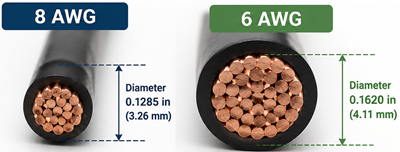
When Should You Use 6 AWG Instead of 8 AWG?
Using a larger conductor than the minimum ampacity requirement is sometimes beneficial.
You may consider 6 AWG instead of 8 AWG when:
The cable run is long
Voltage drop is too high
Ambient temperatures are elevated
Multiple current-carrying conductors are grouped together
The equipment has significant continuous current demand
Future system expansion is expected
Lower conductor resistance is desirable
Project specifications require additional design margin
However, larger wire also increases material cost, cable diameter, bending requirements, termination size, and installation difficulty.
The best conductor is therefore not simply the largest cable available. It is the conductor that satisfies electrical, thermal, mechanical, regulatory, and economic requirements for the application.
Can You Use 8 AWG Wire on a 50 Amp Breaker?
Sometimes — but this requires more caution than using 8 AWG on a 40A breaker.
NEC Table 310.16 lists 8 AWG copper at 50A in the 75°C column and 55A in the 90°C column.
Therefore, some properly designed installations can use 8 AWG copper with a 50A overcurrent protective device.
But this does not mean:
Every 8 AWG wire can go on every 50A breaker.
For example, conductor type, equipment terminals, cable construction, temperature, installation environment, and application-specific requirements can change the answer.
A common example is cable whose allowable ampacity is restricted to the 60°C column. In that situation, 8 AWG copper may be limited to 40A.
Always evaluate the complete wiring system rather than selecting a breaker from wire gauge alone.
Is 8 AWG Wire Overkill for a 40 Amp Circuit?
No.
In many installations, 8 AWG copper is exactly the expected size for a 40A circuit, not unnecessary oversizing.
It provides:
Suitable ampacity
Lower resistance than 10 AWG
Reduced voltage drop
Better thermal margin
Greater suitability for higher-current applications
Whether a larger 6 AWG conductor is worthwhile depends mainly on cable length, environmental conditions, required voltage-drop performance, and project specifications.
What About 8 AWG Wire for Solar Installations?
Solar and renewable-energy systems require additional attention because conductor sizing may involve more than conventional breaker-to-wire matching.
Solar installations can involve:
Continuous current
High DC voltage
Rooftop temperature exposure
Outdoor UV exposure
High ambient temperatures
Multiple conductors grouped in raceways
Long cable runs
Inverter input or output circuits
Combiner boxes
Battery energy storage systems
Application-specific electrical codes
Therefore, a statement such as:
“8 AWG wire handles 40 amps”
should not be used by itself to design a photovoltaic circuit.
For solar applications, engineers and installers should evaluate the applicable PV circuit current, conductor ampacity adjustments, voltage drop, insulation system, voltage rating, environmental resistance, connector compatibility, and the relevant requirements of NEC Article 690 or other applicable local standards.
The conductor must also be designed and certified for the intended application. A building wire, PV wire, battery cable, and flexible industrial cable may all use an 8 AWG conductor, but they are not automatically interchangeable.
Why Cable Construction Matters as Much as AWG Size
AWG describes conductor size, but a cable is much more than its conductor.
Two cables using 8 AWG copper can have very different:
Voltage ratings
Insulation materials
Temperature ratings
Flame-retardant performance
UV resistance
Ozone resistance
Oil resistance
Water resistance
Mechanical flexibility
Abrasion resistance
Certification standards
Intended applications
For procurement professionals, system designers, EPC contractors, distributors, and installers, conductor size should therefore be considered together with the complete cable specification.
For example, specifying simply:
“8 AWG cable”
is usually insufficient for an industrial or renewable-energy project.
A better specification may include:
8 AWG copper conductor + required voltage rating + insulation material + temperature rating + application standard + environmental requirements + certification requirements.
Frequently Asked Questions
Can 8 gauge wire handle 40 amps?
Yes. 8 AWG copper wire can generally handle a 40 amp circuit under standard NEC Table 310.16 conditions. Its listed ampacity is 40A at 60°C, 50A at 75°C, and 55A at 90°C.
Is 8 AWG good for a 40 amp breaker?
Yes. 8 AWG copper is a common conductor size for a 40A breaker. The final installation must still account for conductor material, temperature ratings, derating, load characteristics, and equipment requirements.
Can I use 10 AWG wire on a 40 amp breaker?
Generally not for an ordinary branch circuit. Although 10 AWG copper has a 40A value in the 90°C ampacity column, NEC 240.4(D) normally limits 10 AWG copper to 30A overcurrent protection unless a specific exception applies.
Can 8 AWG copper handle 50 amps?
It can in some installations. 8 AWG copper is listed at 50A in the 75°C column of NEC Table 310.16. However, conductor type, terminals, installation conditions, equipment requirements, and applicable codes must support the design.
What is the maximum ampacity of 8 AWG copper?
NEC Table 310.16 shows 8 AWG copper at 40A for 60°C, 50A for 75°C, and 55A for 90°C under the conditions covered by the table. Correction, adjustment, termination, and application requirements may reduce usable ampacity.
Can 8 AWG aluminum be used on a 40A breaker?
Possibly, but not under every condition. The 2026 NEC Table 310.16 reference values for 8 AWG aluminum are 35A at 60°C, 40A at 75°C, and 45A at 90°C. The applicable conductor and termination temperature ratings therefore need to be verified.
How many continuous amps can a 40 amp breaker handle?
A standard circuit subject to the 125% continuous-load rule commonly allows approximately 32A of continuous load:
32A × 125% = 40A
A continuous load is generally one expected to operate at maximum current for three hours or more.
Should I use 8 AWG or 6 AWG for 40 amps?
8 AWG copper is normally sufficient from a basic ampacity standpoint for a 40A circuit. 6 AWG may be beneficial for long cable runs, voltage-drop reduction, high temperatures, derating conditions, or future expansion.
Final Answer
Yes, 8 AWG copper wire can generally be used on a 40 amp breaker.
Under NEC Table 310.16, 8 AWG copper is rated at:
40A at 60°C
50A at 75°C
55A at 90°C
That makes 8 AWG copper a common and appropriate conductor size for many 40A circuits.
However, conductor size should never be selected from breaker amperage alone.
Always consider:
conductor material + insulation rating + termination rating + load type + ambient temperature + conductor grouping + cable length + voltage drop + equipment requirements + local electrical code.
For renewable-energy and industrial projects, the cable's construction, certification, voltage rating, and environmental performance are just as important as its AWG size.
FRCABLE supplies cable solutions for solar and renewable-energy applications with multiple conductor sizes and cable configurations available for different system requirements. If you are selecting 8 AWG solar cable or evaluating conductor sizes for a photovoltaic project, contact FRCABLE with your system voltage, current, cable length, application, and required standard to determine the appropriate cable specification.
Disclaimer: This article provides general technical information and is not a substitute for project-specific electrical engineering, manufacturer instructions, or local electrical-code requirements.


Au88 làm tôi chú ý đến thông tin pháp lý vì nội dung giới thiệu nhắc đến PAGCOR, MGA và Isle of Man. Mình thường xem tên cơ quan, phạm vi và vị trí thông tin trước khi tự kiểm tra nếu cần. Nếu chỉ liệt kê chứng nhận mà thiếu ngữ cảnh, tôi sẽ xem đó là dữ liệu tham khảo. Mình cũng để ý cách phần này được tách khỏi nội dung quảng bá. Với tôi, thông tin pháp lý dễ tiếp cận khi trình bày ngắn, dễ đọc, có nguồn rõ và giúp người dùng hiểu nền tảng đang tự giới thiệu theo tiêu chuẩn nào