
4 AWG Wire Ampacity Chart: Copper vs Aluminum

Updated: Sep 2

What is 4 AWG Wire Ampacity and Why It Matters
When working with electrical projects, understanding 4 AWG wire ampacity is crucial for safety and compliance. Ampacity refers to the maximum current a wire can carry without exceeding its temperature rating, impacting circuit efficiency and reliability.
1. Core Definition
1.1 Basic Concept
Ampacity is influenced by factors such as wire gauge, insulation type, and installation conditions. For a 4 AWG wire, ampacity can be affected by ambient temperature and proximity to other conductors.
According to the National Electrical Code (NEC), 4 AWG copper wire has a typical ampacity of 85 amps in residential applications.
1.2 Definition Box
Definition: Ampacity is the maximum current a conductor can safely carry, which is essential for preventing overheating and potential electrical fires.
2. Why It Matters
2.1 Safety Impact
Understanding 4 AWG wire ampacity is vital for preventing electrical hazards. Using the correct wire gauge ensures optimal performance and reduces the risk of fire due to overheating.
For example, underestimating ampacity can lead to equipment failure and costly repairs.
2.2 Compliance Requirements
Adhering to NEC guidelines is mandatory for safe electrical installations. These regulations ensure that wires can handle intended loads without compromising safety.
Failure to comply may result in legal liabilities and safety violations.
3. Calculating Ampacity
3.1 Factors Influencing Ampacity
Wire Gauge: Thicker wires have higher ampacities
Insulation Type: Different materials offer varying heat resistance
Ambient Temperature: Higher temperatures reduce ampacity
Installation Conditions: Bundled wires may have lower ampacity
3.2 Safety Warning
Warning: Always verify ampacity to avoid overheating and fire hazards. Overloading wires can lead to serious safety risks.
In summary, understanding 4 AWG wire ampacity is essential for safe electrical practices and compliance with standards. Whether for residential or commercial use, proper calculations and adherence to guidelines help ensure reliable performance.

4 AWG Copper Wire Ampacity at Different Temperatures
Understanding the ampacity of 4 AWG copper wire is crucial for safe electrical installations. This article details the ampacity ratings for copper wire at different temperature ratings, aiding in the selection of appropriate wire types for various applications. The ratings provided here will help ensure compliance with safety standards.
1. Ampacity Ratings Overview
1.1 Temperature Ratings Explained
Ampacity refers to the maximum amount of electric current a conductor can safely handle. For 4 AWG copper wire, typical ampacity values vary with insulation ratings at different temperatures: 60°C, 75°C, and 90°C.
At 60°C, the rating is 65 amps, while it increases to 75 amps at 75°C, and reaches 95 amps at 90°C.
1.2 Comprehensive Ampacity Table
Temperature (°C) | Ampacity (Amps) | Insulation Type |
60 | 65 | THW/THWN |
75 | 75 | TW |
90 | 95 | UF/BX |
2. Insulation Types and Their Impact
2.1 Key Insulation Types
Insulation types affect the wire's ampacity by influencing heat dissipation and environmental durability. Common types include THW, THWN, and TW, with each suited for specific conditions.
For example, THNW can withstand higher temperatures, allowing higher ampacity ratings compared to TW.
2.2 Ampacity Comparison by Insulation Type
THW: Suitable for wet areas; ampacity at 75°C, 75 amps
THWN: Higher temperature ratings; ampacity at 90°C, 95 amps
TW: Lower ratings; ampacity at 60°C, 65 amps
Pro Tip: FR-CABLE engineers recommend using THWN insulation for outdoor applications to maximize safety and efficiency at elevated temperatures.
Choosing the correct ampacity rating for 4 AWG copper wire is essential to maintaining electrical safety. Always consider both temperature ratings and insulation types when specifying wire for your projects.
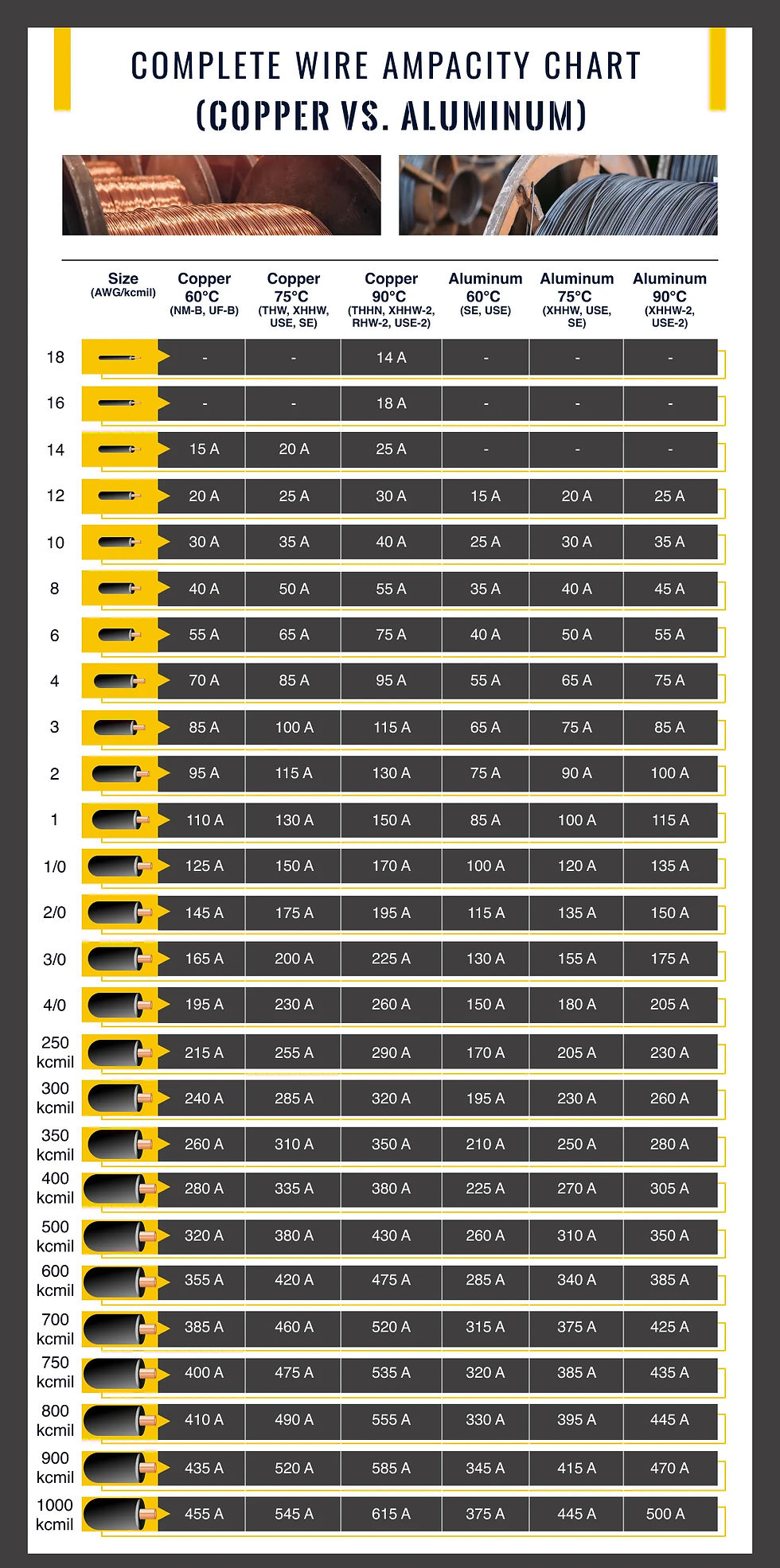
How Does 4 AWG Aluminum Wire Ampacity Compare to Copper?
Understanding the ampacity of 4 AWG aluminum wire compared to copper is essential for selecting the right wire for your project's needs. Generally, aluminum wires are lighter and less expensive than copper, but their ampacity differs significantly.
1. Ampacity Overview
1.1 Definition and Importance
Ampacity refers to the maximum amount of electrical current a wire can carry without overheating. This is crucial for safety and efficiency in electrical installations.
For 4 AWG wires, copper typically has a higher ampacity, making it preferable in many applications.
1.2 Aluminum vs. Copper Ampacity
4 AWG aluminum wire has an ampacity of about 75% of that of copper, which translates to approximately 75 amps compared to copper's 95 amps. This percentage difference impacts the choice of wire for various applications.
While aluminum is less conductive, it's essential to note that it is still suitable for many residential and commercial applications.
2. Comparison Table of Ampacity
Wire Type | Ampacity (Amps) |
4 AWG Aluminum | 75 |
4 AWG Copper | 95 |
3. Pros and Cons
3.1 Advantages of Aluminum
Lower cost than copper
Lighter weight makes installation easier
Corrosion-resistant when properly treated
3.2 Disadvantages of Aluminum
Lower conductivity, affecting efficiency
Requires larger diameter for the same ampacity
More susceptible to thermal expansion and contraction
Pro Tip: For installations requiring 4 AWG wire, consult FR-CABLE to determine whether aluminum or copper is more suitable for your electricity load requirements.
In conclusion, while 4 AWG aluminum wire can be a cost-effective choice, it is vital to consider its lower ampacity compared to copper. This comparison is crucial for ensuring the safety and reliability of electrical systems.
4 AWG Wire Ampacity Chart for Different Installation Methods
Understanding the ampacity ratings for 4 AWG wire is essential for safe and efficient electrical installations. This article provides a comprehensive chart displaying ampacity based on various installation methods including conduit, direct burial, and free air.
1. Installation Methods Overview
1.1 Conduit Installation
In conduit installations, 4 AWG wire can handle a maximum of 85 amps. This method provides a protective pathway, reducing exposure to environmental factors.
The NEC (National Electrical Code) recommends proper spacing to prevent overheating in conduit systems.
1.2 Direct Burial Installation
When buried directly in the ground, the ampacity rating for 4 AWG wire increases to 75 amps. This installation method requires adequate insulation to withstand soil moisture and temperature variations.
Refer to the NEC for buried application guidelines that specify insulation types needed for safe usage.
1.3 Free Air Installation
In free air applications, 4 AWG wire can carry up to 95 amps. This method demonstrates the best cooling capacity, minimizing heat buildup.
Make sure to install wires at a safe distance from other conductive materials to maintain efficiency.
2. Ampacity Chart
Pro Tip: FR-CABLE recommends always double-checking local codes and standards to ensure compliance and safety in your installations.
Choosing the right installation method significantly impacts the ampacity of 4 AWG wire. For further guidance, consulting the NEC guidelines is advisable to ensure safety and efficiency in your electrical projects.
What Factors Affect 4 AWG Wire Ampacity Ratings?
When evaluating the ampacity of 4 AWG wire, several critical factors must be considered. Understanding these variables helps ensure proper application and compliance with safety standards.
1. Environmental Conditions
1.1 Ambient Temperature
Ambient temperature significantly impacts wire ampacity ratings. Higher temperatures decrease the ability of the wire to carry current effectively.
According to the NEC, for every 10°C increase above 30°C, the ampacity must be corrected, often using a correction factor.
1.2 Bundling Effects
When multiple wires are bundled together, heat dissipation decreases. This can lead to a rise in temperature and a subsequent reduction in ampacity.
It's essential to apply proper derating factors when calculating the capacity of bundled wires.
1.3 Altitude Considerations
In high-altitude locations, air cooling is less effective, impacting wire heat management. This must be considered when determining ampacity.
The NEC suggests using specific adjustment factors for altitudes over 3,300 feet to ensure safe operations.
2. Correction Factors and Calculations
2.1 Adjustment Calculation Examples
To calculate the effective ampacity, apply correction factors based on the environmental conditions. For instance, a 4 AWG copper wire rated at 95 A at 30°C has adjustments for temperature and bundling.
Using the correction factor for 35°C (0.88) may reduce the effective capacity to approximately 84 A.
2.2 Correction Factor Table
Condition | Correction Factor |
30°C | 1.00 |
35°C | 0.88 |
40°C | 0.78 |
Bundled (3+ wires) | 0.75 |
Pro Tip: FR-CABLE's experts recommend regularly reviewing environmental conditions to adjust your wire selection accurately, ensuring long-term reliability.
3. Additional Factors to Consider
3.1 Wire Material
The type of material—copper or aluminum—affects ampacity. Copper typically has a higher ampacity compared to aluminum for the same gauge.
Choosing the right material is crucial for performance in varying environmental conditions.
3.2 Insulation Types
The insulation surrounding the wire can also influence ampacity. Different materials offer varying thermal resistance and can affect heat dissipation.
Proper insulation selection enhances safety and performance, particularly in extreme conditions.
Understanding the factors affecting the ampacity of 4 AWG wire ensures safe and efficient electrical installations. Always account for environmental conditions and material properties to select the appropriate wire for your application.

When to Choose 4 AWG Wire for Your Electrical Project
Choosing the appropriate wire gauge is crucial for electrical safety and performance. 4 AWG wire is often recommended for various applications due to its ampacity and load requirements.
1. Understanding 4 AWG Wire Ampacity
1.1 Basic Definition
Ampacity refers to the maximum current a wire can safely carry without overheating. For 4 AWG wire, the typical ampacity is around 85-95 amps depending on insulation type and installation conditions.
Choosing a wire with the correct ampacity ensures system reliability and safety.
1.2 Key Applications
Powering subpanels in residential buildings
Feeding circuits for heavy machinery
Electrical service entrance applications
Outdoor lighting and landscape projects
2. Decision Criteria for Selecting 4 AWG Wire
2.1 Load Calculation Formula
To determine the necessary wire gauge, use the formula: Load (Amps) = Power (Watts) / Voltage (Volts). Ensure the calculated load aligns with the 4 AWG ampacity.
This calculation helps prevent overheating and potential fire hazards.
2.2 Distance Considerations
Consider wire length when selecting the gauge; longer runs may require a larger gauge to compensate for voltage drop. For runs over 100 feet, 4 AWG is often recommended.
Check the NEC guidelines to ensure compliance for distances involved.
Pro Tip: FR-CABLE's engineers advise considering future load increases when selecting wire to avoid the need for replacement later.
3. Conclusion and Recommendations
3.1 Choosing the Right Wire
Evaluating your project's unique requirements will dictate the appropriate wire gauge. For most applications where 4 AWG wire is suitable, remember to factor in ampacity and distance.
Your local building codes may further guide gauge selection to ensure compliance and safety.
Common Mistakes to Avoid with 4 AWG Wire Ampacity
When working with 4 AWG wire ampacity, it's crucial to avoid common mistakes that can lead to unsafe situations. Awareness of potential errors, such as oversizing breakers or ignoring temperature ratings, can significantly enhance safety and compliance with electrical codes.
1. Common Mistakes
1.1 Oversizing Breakers
Oversizing breakers can result in inadequate protection from overcurrent. This can cause overheating and even fire hazards.
According to the National Electrical Code (NEC), the appropriate breaker size for 4 AWG copper wire is typically 50 amps.
1.2 Ignoring Temperature Ratings
It's vital to consider temperature ratings when selecting wire. Higher temperatures can lead to ampacity derating, potentially causing wire damage.
Use temperature ratings specified by the manufacturer
Account for ambient temperatures in installations
Refer to NEC guidelines for derating factors
1.3 Mixing Different Wire Sizes
Mixing 4 AWG wire with smaller gauges can lead to excessive current, risking failure. Ensure that all wires in a circuit match or are rated appropriately.
Maintaining consistency in wire sizes aids in circuit reliability and adherence to safety codes.
2. Safety Tips
2.1 Regular Inspection
Conduct regular inspections to ensure connections are secure and free from corrosion. This practice can prevent many electrical issues before they escalate.
Utilize an electrical tester to verify connections' integrity during inspections.
2.2 Consultation with Experts
Seek expert advice for installations involving 4 AWG wire. Industry professionals can provide insights into best practices and compliance standards.
Pro Tip: FR-CABLE recommends consulting local electrical codes to ensure compliance with ampacity requirements specific to 4 AWG wire.
3. Code Violation Examples
3.1 Ampacity Code Violations
Failing to adhere to ampacity standards can result in dangerous violations. For instance, using a 70 amp breaker on 4 AWG wiring without proper justification violates NEC.
3.2 Improper Installation Techniques
Improper installation can lead to costly mistakes. Make sure all connections are made according to professional standards to stay code compliant.
Follow local electrical codes for installations
Ensure correct wire type is used for the application
Document all electrical work for future reference
Being aware of these common mistakes, safety tips, and code violations can significantly improve your handling of 4 AWG wire ampacity. Always stay informed and take the necessary precautions to ensure safety in your electrical projects.
FAQs
1. What is the ampacity of 4 AWG wire at 25°C?
At 25°C, the ampacity ratings generally mirror those at 60°C, which is around 65 amps for 4 AWG copper wire.
2. Can 4 AWG wire be used for residential electrical systems?
Yes, 4 AWG wire is often used in residential applications, particularly for sub-panels and large appliances.
3. What factors affect wire ampacity?
Key factors include ambient temperature, insulation type, and the installation method (e.g., in conduit or bundled with other wires).
4. Are there safety standards for wire ampacity?
Yes, standards such as the National Electrical Code (NEC) provide guidelines to ensure safe electrical installations and prevent hazards.
5. How do I choose the right insulation type for my project?
Consider factors such as environmental exposure, temperature ratings, and the specific electrical load requirements of your application.


Comments