
Length vs. AWG vs. Ampacity: How Do These Parameters Influence Cable Selection?

You pull 150 feet of standard 12/2 Romex to power a new heavy-duty air compressor in an outbuilding. You wire it up, flip the breaker, and hit the power switch. The lights dim, the compressor motor groans, stalls, and immediately trips the breaker. What went wrong?
You looked at a standard wire gauge chart, saw that 12 AWG is rated for 20 amps, and called it a day. But you ignored the silent thief of electrical power: length.
Selecting the right cable isn't just about matching an amperage number to a wire size. It is a balancing act between three parameters: American Wire Gauge (AWG), electrical ampacity, and the physical length of the cable run.
Physics dictates that as a wire gets longer, its resistance increases. That resistance converts your voltage into waste heat before it ever reaches your equipment.
To prevent burnt-out motors, failed inspections, and potential fire hazards, you have to understand how distance forces you to change your cable choice.
Key Takeaways for Conductor Sizing
Before we get into the math and National Electrical Code (NEC) requirements, here are the ground rules for cable selection:
Ampacity is a heat limit, not just a power rating. It dictates how much current a wire can carry before its insulation melts.
AWG is inversely proportional. A smaller AWG number (e.g., 6 AWG) means a thicker, heavier wire with lower electrical resistance than a larger number (e.g., 14 AWG).
Distance breeds resistance. The longer the wire, the harder it is to push current through it.
Upsizing is the only cure for voltage drop. To deliver the same power over a long distance, you must use a thicker gauge cable than standard charts recommend.

The Problem with Standard Wire Gauge Charts
If you walk into a hardware store, the packaging on a roll of 12 AWG copper wire will proudly state it is rated for 20 amps. That rating is true—but conditionally. It assumes a relatively short run (usually under 50 feet) in standard room temperatures. To understand why that rating falls apart on longer runs, we need to look at the three core parameters.
AWG (American Wire Gauge): The Highway Width
Think of AWG as the width of a highway. The lower the gauge number, the larger the cross-sectional area (measured in Circular Mils or mm²). A wider highway allows more traffic (electrons) to flow smoothly without congestion.
Ampacity: The Thermal Speed Limit
Ampacity isn't about how much power the copper can physically conduct; it's about how much heat the insulation wrapped around the copper can survive. When current flows through the resistance of a wire, it generates heat. Ampacity limits ensure the wire operates below the melting point of its jacket (typically 60°C, 75°C, or 90°C depending on the material).
Length: The Friction Factor
This is where installations fail. Copper and aluminum are excellent conductors, but they are not perfect. They have inherent electrical friction. A 10-foot piece of wire has very little friction. A 200-foot piece of wire has twenty times that friction.
The Physics of the Run: How Length Destroys Voltage
When someone asks, "How does wire length affect ampacity?" the answer technically is that it doesn't change the wire's physical tolerance for heat. Instead, length destroys the efficiency of the circuit.
Ohm’s Law and Conductor Resistance
To understand this, look at Ohm’s Law:
V=IxR
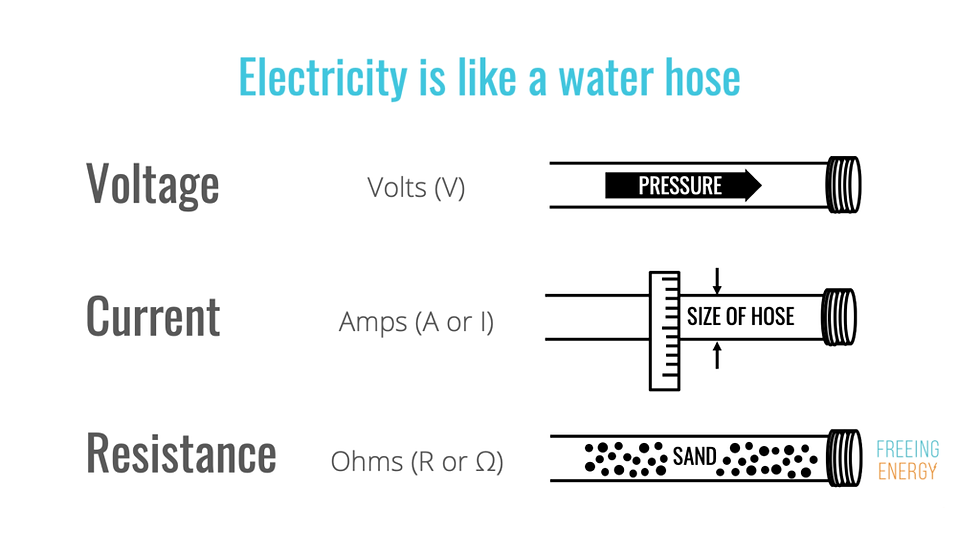
Voltage (V) equals Current (I) multiplied by Resistance (R).
Because your power source is fixed (say, a 120V breaker panel), and your equipment demandsa fixed current (I), any increase in Resistance (R) forces the circuit to "spend" voltage just topush the electricity through the wire.
Voltage Drop and the NEC 3% Rule
This loss of electrical pressure is known as voltage drop.
The NEC (Informational Note in Section 210.19(A)) strongly recommends that the maximum voltage drop for a branch circuit should not exceed 3% of the supply voltage. For a 120V circuit, that means you cannot afford to lose more than 3.6 volts from the panel to the plug.
If you use a wire that is too thin for a long run, you might experience a 10% or 15% drop. When motors (like in AC units, saws, or pumps) receive 105 volts instead of 120 volts, they experience voltage sag. To compensate for the lack of "pressure," the motor pulls more current (amps). This excess current overheats the motor windings, severely shortening the life of your equipment and potentially tripping breakers.

Beyond Length: Two More Factors That Kill Ampacity
Before you calculate your wire size based on distance, be aware that the NEC requires you to "derate" (reduce) the working ampacity of a cable based on two environmental factors.
Ambient Temperature Derating
Wire ampacity ratings are strictly based on an ambient temperature of 30°C (86°F). If you are running cable through a commercial kitchen, a boiler room, or a scorching summer attic that hits 49°C (120°F), the wire cannot dissipate its own heat effectively. The NEC requires you to apply a correction factor. A 12 AWG THHN wire rated for 30 amps in standard conditions might only be allowed to carry 24 amps in a hot environment.
Conduit Fill Limits
When you pack multiple current-carrying conductors into a single PVC or metal conduit, they heat each other up. If you have more than three conductors in a pipe, NEC Table 310.15(C)(1) requires you to derate the cable. Running 9 wires in a conduit? You must reduce their allowable ampacity to 70% of the baseline chart.
Step-by-Step Cable Selection and Load Calculation
Don't guess. Follow the same workflow electrical engineers use to size conductors safely.
Step 1: Calculate the Continuous Load
Determine the amperage of the equipment. If the load is "continuous" (expected to run for 3 hours or more, like commercial lighting or an EV charger), the NEC requires you to multiply the amperage by 125%. A continuous 40-amp load requires a wire rated for at least 50 amps.
Step 2: Run the Voltage Drop Math
This is where we factor in the length. The standard formula for single-phase voltage drop is:

K = The specific resistance constant (12.9 for Copper, 21.2 for Aluminum).
I = Current (Amps).
D = One-way distance in feet.
CM = Circular Mils (the cross-sectional area of the wire, found in NEC Chapter 9, Table 8).
Step 3: Match the Insulation to the Environment
THHN / THWN-2: The commercial standard. Pulled through conduit, rated for 90°C in dry and wet locations, offering high ampacity for its size.
XHHW-2: Thicker, thermoset insulation. Harder to pull, but incredibly resistant to chemicals, heat, and moisture. Ideal for industrial settings.
NM-B (Romex) / UF-B: Residential sheathed cables. The NEC limits NM-B to the 60°C ampacity column to prevent it from overheating inside insulated walls.
Step 4: Weigh Copper vs. Aluminum Conductivity
Copper is highly conductive and flexible. Aluminum is roughly 30% to 50% cheaper and much lighter, making it the go-to choice for long, heavy feeder runs (like utility drops to a subpanel).
However, because aluminum has higher resistance (K = 21.2), you almost always have to upsize an aluminum cable by one or two AWG sizes to match copper's performance. Furthermore, aluminum expands and contracts with heat differently than copper, requiring specialized anti-oxidant paste (like Noalox) and strict torque specifications on the lugs to prevent arcing and fires.
Real-World Example: Sizing a 150-Foot Shop Compressor Circuit
Let's revisit the failed compressor from the beginning of this article.
The Load: A 120V compressor drawing a full 20 Amps.
The Distance: 150 feet one-way.
The Rule: Max 3% voltage drop (3.6V maximum drop allowed).
Let's run the math using standard 12 AWG copper wire (CM = 6530):
Vdrop = 2 × 12.9 × 20 × 150 / 6530 = 11.85 Volts
An 11.85V drop leaves the compressor running on less than 109 volts. That is nearly a 10% drop — a catastrophic failure waiting to happen. The motor will overheat and stall.
To fix this, we have to find a wire with a large enough CM to keep the drop under 3.6V. Let's flip the formula to find the minimum CM:
CM = 2 × 12.9 × 20 × 150 / 3.6 = 21,500 Circular Mils
Looking at the NEC tables, 8 AWG has a CM of 16,510 (still too small for a full 20A continuous draw at that distance). You actually need 6 AWG copper (CM = 26,240) to guarantee a flawless 120V delivery of 20 amps over 150 feet.
Note: In reality, most 20A circuits don't draw a continuous 20A, so an 8 AWG or 10 AWG might suffice depending on the specific equipment's starting surge and running load, but the math proves how drastically length impacts the requirement.
Baseline Wire Gauge Chart (Short Runs Only)
Use this chart only as a starting point for copper wire under 50 feet at 30°C ambient temperatures. Always calculate for voltage drop on longer runs.
AWG Size | Cross-Sectional Area | Ampacity (60°C Romex/NM-B) | Ampacity (90°C THHN in Conduit) | Common Applications |
14 AWG | 4,110 CM / 2.08 mm² | 15 Amps | 15 Amps* | Basic residential lighting |
12 AWG | 6,530 CM / 3.31 mm² | 20 Amps | 20 Amps* | Outlets, small appliances |
10 AWG | 10,380 CM / 5.26 mm² | 30 Amps | 30 Amps* | Water heaters, AC compressors |
8 AWG | 16,510 CM / 8.37 mm² | 40 Amps | 55 Amps | Electric ovens, small subpanels |
6 AWG | 26,240 CM / 13.30 mm² | 55 Amps | 75 Amps | Hot tubs, large EV chargers |
4 AWG | 41,740 CM / 21.15 mm² | 70 Amps | 95 Amps | Main service feeds, large panels |
(Note: The NEC caps the usable breaker size for 14, 12, and 10 AWG at 15A, 20A, and 30A respectively for standard branch circuits, regardless of the 90°C insulation rating).
Final Thoughts: Why Thicker is Cheaper in the Long Run
The relationship between length, AWG, and ampacity is unforgiving. Wire sizing is never the place to cut project costs. Buying a thinner wire might save you a few hundred dollars on the initial materials, but running equipment on starved voltage will cost you thousands in premature motor failures, inflated electrical bills due to thermal waste, and potentially catastrophic fire risks.
When designing your power distribution at FRCABLE, run the calculations. Factor in the distance. Account for the heat. When in doubt, upsizing the conductor is the cheapest insurance policy you can buy for an electrical system.
FAQ
1. Does a longer wire reduce the ampacity of the cable?
Strictly speaking, the physical heat tolerance (ampacity) of the copper and insulation remains the same. However, a longer wire increases resistance, which causes unacceptable voltage drop. To push the same amperage over a long distance safely and efficiently, you must upsize the cable gauge.
2. How far can I run a 20-amp circuit on 12 AWG wire?
For a 120V circuit drawing a full 20 amps, you should limit a 12 AWG run to approximately 50 feet. Going further risks exceeding the NEC’s 3% recommended voltage drop limit, which can damage sensitive equipment or cause motors to overheat.
3. Why do I have to use a thicker wire for aluminum than for copper?
Aluminum is roughly 61% as conductive as copper. Because it has higher natural electrical resistance, it generates more heat and drops more voltage over the same distance. You typically have to choose an aluminum cable one or two AWG sizes larger to match the performance of a copper cable.
4. Does running wire through a hot attic affect my cable choice?
Yes. Cable ampacity ratings are based on a 30°C (86°F) baseline. If you run cable through an area with high ambient heat, the wire cannot shed its own operational heat effectively. The NEC requires you to apply a derating multiplier, which often forces you to use a thicker AWG to carry the same load safely.
5. What happens if my voltage drop is 10% instead of the recommended 3%?
Your equipment will experience severe voltage sag. Incandescent lights will dim significantly, but more importantly, motorized equipment (refrigerators, table saws, AC units) will draw excessive current to compensate for the lack of voltage. This creates massive heat in the motor windings, leading to premature burnout and tripped breakers.


Comments