
What Is 20 AWG Wire? Size, mm² Conversion, Amp Rating & Solar Cable Guide
- Vicky

- 3 hours ago
- 22 min read
Quick Answer: What Is 20 AWG Wire?
20 AWG wire is a small-diameter electrical wire with a conductor cross-sectional area of approximately 0.519 mm² and a bare copper conductor diameter of about 0.812 mm.
It is commonly used for low-current electrical applications, including control wiring, sensors, monitoring systems, automotive electronics, battery management connections, and small DC devices.
The typical ampacity of 20 AWG copper wire is approximately 5A at 60°C, 7A at 75°C, and up to around 8–11A at 90°C under reference conditions, although the actual safe current depends on cable length, installation environment, insulation rating, and voltage drop requirements.
For solar applications, 20 AWG wire is usually suitable for auxiliary circuits such as monitoring, communication, and sensor connections, but it is generally not recommended for high-current applications such as PV power cables, inverter connections, or battery cables.
Introduction

Choosing the correct wire size is an important decision in electrical, solar, and industrial projects. A cable that is too small may cause excessive voltage drop, overheating, or reduced system reliability, while a cable that is unnecessarily large can increase cost and make installation more difficult.
Among commonly used wire sizes, 20 AWG occupies a specific position between small signal wires and larger power conductors. It is not designed for heavy electrical loads, but it provides a practical balance of size, flexibility, and electrical performance for many low-current applications.
However, many buyers and installers misunderstand AWG sizing. A smaller AWG number does not always mean a cable is better, and the AWG value alone does not determine the complete performance of a wire.
To select the right 20 AWG cable, it is important to understand:
what 20 AWG actually means;
how it compares with larger wire sizes;
how much current it can safely carry;
where it should and should not be used.
This guide explains the size, electrical characteristics, applications, and selection considerations of 20 AWG wire to help buyers and engineers choose the right cable for their projects.
What Is 20 AWG Wire?

20 AWG wire refers to a conductor size defined by the American Wire Gauge (AWG) system.
AWG is a standardized wire sizing method commonly used in North America and many international cable markets. It identifies conductor diameter through a numerical scale, allowing manufacturers and buyers to compare wire sizes consistently.
A key characteristic of the AWG system is that the numbering works in reverse:
A smaller AWG number means a larger conductor.
A larger AWG number means a smaller conductor.
For example:
Wire Size | Approximate Conductor Area | Relative Size |
12 AWG | 3.31 mm² | Large conductor |
14 AWG | 2.08 mm² | Medium-large conductor |
16 AWG | 1.31 mm² | Medium conductor |
18 AWG | 0.823 mm² | Smaller conductor |
20 AWG | 0.519 mm² | Small conductor |
This means 18 AWG is larger than 20 AWG, even though the number is smaller.
Understanding this basic rule is important because many wire selection mistakes happen when users assume the opposite.
Understanding the American Wire Gauge (AWG) System
The AWG system is based on conductor diameter rather than the total outside size of the finished cable.
This distinction matters because a complete cable includes more than just the copper conductor.
A typical cable consists of:
Cable Component | Function |
Conductor | Carries electrical current |
Insulation | Provides electrical protection |
Jacket or shielding | Improves environmental durability |
The AWG number only describes the conductor portion.
For example, two cables may both be labeled as 20 AWG, but their finished dimensions may differ because they use different:
insulation materials;
insulation thicknesses;
shielding layers;
jacket designs.
This is why professional cable selection should not rely only on the AWG label.
For electrical performance, the conductor size is important. However, for installation and durability, the complete cable construction must also be considered.
Where 20 AWG Fits in the Wire Size Range
20 AWG is generally considered a low-current wire size.
Compared with larger conductors such as 18 AWG, 16 AWG, or 14 AWG, it has:
a smaller conductor area;
higher electrical resistance;
lower current capacity;
greater voltage drop over long distances.
However, these characteristics do not mean 20 AWG is unsuitable. The correct wire size depends on the purpose of the circuit.
A larger wire is not always the better choice.
For example:
A temperature sensor connected close to a controller may work perfectly with 20 AWG wire because it only needs to transmit a small signal.
Using a much larger cable in this situation may provide little practical benefit while increasing:
material cost;
installation difficulty;
space requirements.
The position of 20 AWG can be summarized as:
Application Type | Suitable Wire Size Direction |
Sensors and monitoring | 20 AWG commonly suitable |
Control circuits | 20 AWG commonly suitable |
Small DC devices | Depends on current and distance |
Larger power loads | Requires larger wire sizes |
In a professional electrical design, wire selection is based on the actual function of the cable rather than simply choosing the largest available conductor.
20 AWG Wire Size: mm² Conversion, Diameter and Dimensions
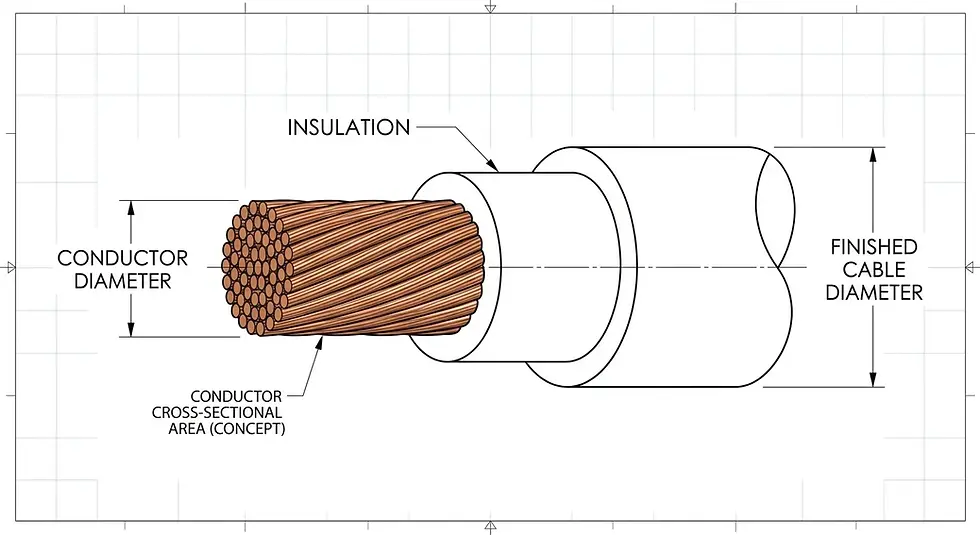
Understanding the physical size of 20 AWG wire is essential when selecting cables for electrical and industrial applications.
While the AWG number provides a standard way to identify conductor size, many projects require metric measurements such as mm² conductor area or actual cable diameter. These specifications are especially important when matching cables with terminals, connectors, cable glands, or installation equipment.
For professional buyers, the AWG designation should always be confirmed together with the technical datasheet because the conductor size alone does not describe the complete cable structure.
How Many mm² Is 20 AWG Wire?
20 AWG wire has a conductor cross-sectional area of approximately 0.519 mm².
In metric cable markets, 20 AWG is often compared with 0.5 mm² wire, although the two sizes are not exactly identical.
The comparison is:
Specification | 20 AWG Wire | 0.5 mm² Wire |
Measurement System | American Wire Gauge | Metric system |
Conductor Area | 0.519 mm² | 0.5 mm² |
Difference | Slightly larger | Slightly smaller |
For many low-current applications, these two sizes may be considered practical equivalents. However, they should not be treated as identical in every situation.
A cable’s actual performance also depends on:
conductor material;
strand construction;
insulation type;
operating temperature;
applicable standards.
For example, a 20 AWG copper cable and a 0.5 mm² aluminum cable may have the same approximate conductor area but different electrical performance because copper has lower resistance.
20 AWG Wire Diameter Explained
The bare copper conductor diameter of 20 AWG wire is approximately 0.812 mm.
This measurement refers only to the metal conductor and does not include insulation.
The conductor diameter is important because it affects:
electrical resistance;
current-carrying capability;
cable flexibility;
mechanical strength.
Compared with larger wire sizes, 20 AWG has a smaller conductor diameter:
Wire Size | Approximate Bare Conductor Diameter |
16 AWG | 1.29 mm |
18 AWG | 1.02 mm |
20 AWG | 0.812 mm |
Because 20 AWG contains less copper than 18 AWG or 16 AWG, it has higher resistance. This is why larger wires are preferred for longer cable runs or higher-current applications.
However, the smaller diameter of 20 AWG also provides advantages:
easier routing through compact spaces;
better flexibility;
lower material usage;
easier installation in electronic equipment.
This makes 20 AWG a practical choice for applications where space and flexibility are important.
What Is the Overall Diameter of 20 AWG Cable?
The overall diameter of a finished 20 AWG cable depends on the complete cable construction.
Unlike conductor diameter, the outside diameter includes:
copper conductor;
insulation thickness;
protective jacket;
shielding layers (if included).
Therefore, two cables with the same 20 AWG conductor size may have different overall diameters.
For example:
Cable Type | Factors Affecting Overall Diameter |
Basic insulated wire | Insulation thickness |
Outdoor cable | Additional protective jacket |
Shielded cable | Shielding layer and drain wire |
Solar or industrial cable | Higher insulation requirements |
This difference is important during installation.
A cable may have a 20 AWG conductor that fits an electrical terminal, but the complete insulated cable may not fit:
cable glands;
connectors;
conduit systems;
equipment entry points.
For this reason, professional installations should check both conductor size and finished cable diameter before selecting accessories.
Why Cable Construction Matters Beyond AWG Size
AWG size is only one factor that determines cable performance.
A high-quality 20 AWG cable depends on several construction details, including conductor material, strand design, insulation performance, and environmental resistance.
The main factors include:
Cable Feature | Impact on Performance |
Conductor material | Determines electrical conductivity |
Stranding method | Affects flexibility and durability |
Insulation material | Determines temperature and environmental resistance |
Jacket design | Protects against mechanical and external damage |
For example, stranded copper 20 AWG wire is often preferred in applications where the cable experiences movement or vibration, such as automotive systems or portable equipment.
In contrast, solid 20 AWG wire may be suitable for fixed installations where flexibility is less important.
For outdoor or solar-related applications, insulation performance becomes especially important. A cable must be able to withstand conditions such as:
UV exposure;
temperature changes;
moisture;
long-term outdoor installation.
Therefore, selecting a 20 AWG cable should involve more than checking the gauge number. The complete cable construction determines whether it will perform reliably in the intended environment.
20 AWG Wire Amp Rating: How Much Current Can It Handle?

One of the most common questions about 20 AWG wire is how much current it can safely carry.
However, there is no single amp rating that applies to every installation. The current capacity of a wire depends on more than the conductor size. Factors such as insulation temperature rating, installation method, ambient temperature, and cable length all influence the actual safe operating current.
For this reason, ampacity values should always be treated as reference data rather than a universal limit.
A properly selected 20 AWG cable must consider both current capacity and voltage performance.
How Many Amps Can 20 AWG Wire Handle?
The ampacity of 20 AWG copper wire varies depending on operating conditions.
Under common reference conditions, 20 AWG copper wire is often rated approximately as follows:
Temperature Rating | Approximate Ampacity |
60°C | Around 5A |
75°C | Around 7A |
90°C | Around 8–11A |
These values are general references. The actual allowable current may be lower or higher depending on the application.
Important factors include:
Factor | Effect on Current Capacity |
Insulation rating | Higher temperature insulation may allow higher operating limits |
Installation environment | Poor heat dissipation can reduce allowable current |
Cable bundling | Multiple cables together can increase heat buildup |
Cable length | Longer runs increase voltage drop |
Continuous load | Long-term operation requires careful consideration |
For example, a short 20 AWG connection inside electronic equipment may safely handle a certain current, while the same wire used outdoors over a long distance may require a larger conductor.
This is why professional cable selection does not rely only on an amp chart.
Can 20 AWG Wire Handle 3 Amps?
Yes, 20 AWG wire can typically handle a 3 amp load under suitable conditions.
For many low-current applications, 3 amps is within the practical operating range of 20 AWG copper wire.
Common examples include:
small DC devices;
LED lighting systems;
control circuits;
monitoring equipment;
electronic accessories.
However, current capacity is only part of the calculation.
The cable length and operating voltage are equally important.
For example:
A 3A load on a short 12V connection may work well with 20 AWG wire.
But if the same 3A load is connected through a long cable run, the voltage drop may become significant and affect equipment performance.
This is especially important in low-voltage systems because even a small voltage loss represents a larger percentage of the total system voltage.
Why Voltage Drop Matters in Low-Voltage Systems
Voltage drop occurs because every electrical conductor has resistance.
When current flows through a cable, part of the electrical energy is lost as heat. The longer the cable and the smaller the conductor, the greater the voltage loss.
The basic relationship is:
Higher Current + Longer Distance + Smaller Wire = Greater Voltage Drop
This issue is particularly important in:
12V systems;
24V solar applications;
battery-powered equipment;
LED lighting systems;
control circuits.
For example, losing 1V in a 120V system may have limited impact.
However, losing 1V in a 12V system represents a much larger percentage of the available voltage and may cause:
reduced equipment performance;
unstable operation;
dim lighting;
inaccurate sensor readings.
For low-voltage projects, choosing a larger wire size can sometimes improve reliability even when the smaller wire technically meets the current requirement.
When Should You Upgrade From 20 AWG to a Larger Wire Size?
20 AWG is suitable for many low-current applications, but there are situations where moving to a larger conductor is the better choice.
You should consider upgrading to a larger wire size when:
Situation | Recommended Consideration |
Longer cable distance | Use a larger conductor to reduce voltage drop |
Higher current demand | Consider 18 AWG or larger |
Voltage-sensitive equipment | Select lower-resistance cable |
Future system expansion | Allow additional capacity |
Common comparisons:
Wire Size | Compared With 20 AWG | Typical Advantage |
18 AWG | Larger conductor | Lower resistance, higher current capability |
16 AWG | Significantly larger | Better for longer or higher-load circuits |
14 AWG | Much larger conductor | Used for higher-power applications |
For example, if a control system requires only a short connection, 20 AWG may be the most practical choice.
However, if the same circuit needs to run tens of meters or operate continuously under higher load, upgrading to 18 AWG or 16 AWG may provide better long-term performance.
The goal is not to choose the largest cable available. The goal is to select a wire size that provides sufficient electrical performance while maintaining installation efficiency and cost control.
20 AWG Wire Applications: Where Is It Commonly Used?

20 AWG wire is widely used in applications where low current, flexibility, and compact cable size are more important than high power transmission capability.
Because 20 AWG has a smaller conductor area than common power wire sizes such as 18 AWG, 16 AWG, or 14 AWG, it is generally selected for circuits that require reliable signal transmission, control functions, or small amounts of electrical power.
Typical applications include:
Application Area | Why 20 AWG Is Suitable |
Sensors and monitoring systems | Low current requirements and easy installation |
Control circuits | Compact size and good flexibility |
Automotive electronics | Handles vibration and limited-space installations |
Small DC devices | Suitable for low-power connections |
However, choosing 20 AWG wire should always be based on the actual electrical requirements.
It is important to distinguish between supporting circuits and main power circuits. While 20 AWG can perform well in monitoring or control applications, it is generally not designed for high-current power transmission.
20 AWG Wire for Solar Applications

In solar systems, 20 AWG wire is typically used for auxiliary and control-related connections rather than the main power path.
A photovoltaic system contains many low-current components that require electrical connections but do not carry the full output current of solar panels.
Common uses of 20 AWG wire in solar applications include:
Solar Application | Function |
Temperature sensors | Monitor module or battery temperature |
Communication wiring | Transfer data between devices |
Monitoring equipment | Connect sensors and controllers |
Control circuits | Support system operation |
For example, a solar monitoring device may only transmit measurement data between sensors and a controller. In this situation, 20 AWG can provide sufficient performance while remaining easy to install.
However, 20 AWG is generally not recommended for:
Application | Reason |
PV module output cables | Current is usually too high |
Solar string wiring | Requires larger conductors |
Inverter connections | Higher power demand |
Battery cables | High current requires much larger sizes |
For the main electrical path of a solar system, larger PV cables are normally required because they must handle higher current while minimizing energy loss.
The correct approach is to use 20 AWG where it is designed to perform: monitoring, control, and low-current connections.
20 AWG Wire for Automotive and Battery Management Systems
Automotive systems often contain many electronic components that require reliable low-current connections.
20 AWG wire is commonly used in automotive applications because it provides a good balance between:
flexibility;
vibration resistance;
space efficiency;
sufficient electrical performance.
Typical uses include:
Automotive Application | Purpose |
Sensors | Collect operating data |
Control modules | Connect electronic systems |
Signal wiring | Transmit information |
Battery management systems | Monitor battery conditions |
Battery management systems (BMS) are a good example.
Although batteries can deliver high current, not every connection inside a battery system carries power. Many BMS wires are used for:
voltage monitoring;
temperature measurement;
communication signals.
These circuits usually require much less current than the main battery cables, making 20 AWG a practical choice.
However, the main battery power connection should always use appropriately sized larger conductors.
20 AWG Wire for Control and Automation Systems
Industrial control systems often contain many low-current circuits where cable size, flexibility, and organization are important.
20 AWG wire is frequently used for:
control panels;
sensors;
switches;
relay circuits;
automation equipment.
In these environments, using a smaller wire size can provide practical advantages.
For example:
Advantage | Benefit |
Smaller diameter | Easier cable routing |
Flexible construction | Simplifies installation |
Lower material usage | Reduces unnecessary cost |
Compact design | Helps organize control cabinets |
However, industrial applications require careful consideration of environmental conditions.
Depending on the installation location, the cable may need additional protection against:
temperature changes;
oil exposure;
chemicals;
mechanical stress.
The conductor size alone does not determine whether a cable is suitable for industrial use.
20 AWG Wire for LED Lighting and Small DC Applications
20 AWG wire is also commonly used in small DC electrical systems where current requirements are relatively low.
Examples include:
LED lighting;
electronic accessories;
small motors;
hobby equipment;
portable devices.
Its flexibility makes it especially useful where cables need to fit into compact spaces.
For LED lighting applications, 20 AWG can often be a suitable choice for shorter cable runs. However, longer LED installations may require a larger wire size because voltage drop can affect brightness and performance.
A simple guideline:
Application Condition | Recommended Consideration |
Short LED connection | 20 AWG may be suitable |
Long LED strip installation | Consider larger wire size |
Higher-power DC device | Check current requirement first |
As with other applications, the correct choice depends on the combination of current, distance, and operating voltage.
20 AWG vs Larger Wire Sizes: Which Gauge Should You Choose?

Choosing between different wire gauges is one of the most common decisions during cable selection.
Although 20 AWG wire is suitable for many low-current applications, larger wire sizes such as 18 AWG, 16 AWG, and 14 AWG provide lower resistance and higher current capacity.
The correct choice depends on the electrical requirements of the project rather than simply selecting the largest available wire.
In general:
20 AWG is commonly used for low-current circuits, sensors, and control applications.
18 AWG provides a higher current capacity and is often used when additional power capability is needed.
16 AWG and larger are typically selected for higher loads or longer cable runs.
Understanding the differences between these wire sizes helps avoid both undersizing and unnecessary oversizing.
20 AWG vs 18 AWG Wire
18 AWG is larger than 20 AWG because the AWG system uses smaller numbers for larger conductors.
The main differences are:
Specification | 20 AWG | 18 AWG |
Conductor Area | 0.519 mm² | 0.823 mm² |
Bare Conductor Diameter | Approx. 0.812 mm | Approx. 1.02 mm |
Resistance | Higher | Lower |
Current Capacity | Lower | Higher |
Flexibility | Generally more flexible | Slightly less flexible |
Because 18 AWG contains more copper, it has lower electrical resistance.
This gives it several advantages:
reduced voltage drop;
better performance over longer distances;
higher current capability;
improved power transmission efficiency.
However, 18 AWG is not automatically the better choice for every application.
For example:
A sensor connection inside a control system may only require 20 AWG. Using 18 AWG may increase cost and cable size without providing a meaningful benefit.
On the other hand, if a circuit is approaching the practical limit of 20 AWG, upgrading to 18 AWG can improve reliability.
20 AWG vs 16 AWG Wire
16 AWG is significantly larger than 20 AWG and is generally used for applications requiring more current capacity.
The comparison is:
Specification | 20 AWG | 16 AWG |
Conductor Area | 0.519 mm² | 1.31 mm² |
Relative Copper Content | Lower | Higher |
Voltage Drop | Higher | Lower |
Typical Use | Control and signal circuits | Higher-load electrical circuits |
Compared with 20 AWG, 16 AWG provides:
much lower resistance;
better performance in longer cable runs;
greater ability to handle power loads.
Typical applications for 16 AWG may include:
larger DC equipment;
automotive power connections;
higher-power lighting systems;
longer low-voltage circuits.
However, selecting 16 AWG when the circuit only requires 20 AWG may create unnecessary disadvantages:
larger cable diameter;
higher material cost;
more difficult installation in tight spaces.
The best choice is the smallest wire size that safely meets the electrical requirements.
20 AWG vs 14 AWG and 12 AWG Wire
14 AWG and 12 AWG are much larger conductors compared with 20 AWG and are commonly associated with higher-current applications.
The comparison:
Wire Size | Approximate Conductor Area | Typical Application Range |
20 AWG | 0.519 mm² | Low-current control and electronics |
14 AWG | 2.08 mm² | Higher-power circuits |
12 AWG | 3.31 mm² | Higher-current branch circuits |
Compared with 20 AWG, both 14 AWG and 12 AWG provide:
significantly lower resistance;
higher current capability;
better performance over long distances.
This is why applications involving larger electrical loads often require these sizes.
For example, a 12 AWG wire is commonly associated with circuits designed around higher current requirements, while 20 AWG would typically be unsuitable for those applications.
However, using 12 AWG wire does not make sense for every project.
A small sensor or communication cable does not benefit from a much larger conductor because the circuit does not require that level of current capacity.
Selecting between 20 AWG and larger wire sizes should always consider:
Selection Factor | Why It Matters |
Current requirement | Determines minimum conductor size |
Cable length | Longer runs may require larger wire |
Voltage level | Low-voltage systems are more sensitive to voltage drop |
Installation space | Larger cables require more room |
Future expansion | Additional capacity may justify upsizing |
The goal is not to choose the largest wire, but to choose the correct wire size for the application.
Common Mistakes When Choosing 20 AWG Wire
Selecting 20 AWG wire may appear simple because the conductor size is already defined. However, many installation problems occur because buyers focus on only one specification and ignore the complete operating conditions.
A wire that is suitable for one application may not perform well in another environment.
For example, a 20 AWG cable used for a short indoor control circuit may work reliably, while the same cable used for a long outdoor DC power connection may experience excessive voltage drop or premature aging.
Understanding common selection mistakes helps ensure that 20 AWG wire is used where it can provide reliable performance.
Assuming AWG Number Equals Amp Rating
One of the most common misunderstandings is assuming that the AWG number directly represents the current capacity of the wire.
For example:
20 AWG does not mean 20 amps.
18 AWG does not mean 18 amps.
12 AWG does not mean 12 amps.
The AWG number only identifies the conductor size.
The actual current capacity depends on multiple factors:
Factor | Impact on Performance |
Conductor material | Copper and aluminum have different resistance values |
Insulation temperature rating | Determines maximum operating temperature |
Installation method | Affects heat dissipation |
Cable length | Influences voltage drop |
Operating conditions | Determines practical limits |
A common mistake is selecting a cable based only on an amp chart without considering the actual installation environment.
Professional cable selection requires evaluating the complete electrical system rather than relying on a single number.
Ignoring Voltage Drop in DC Systems
Voltage drop is one of the most overlooked issues when selecting small wire sizes.
This is especially important in low-voltage applications such as:
solar monitoring systems;
battery-powered devices;
LED lighting;
control equipment.
Because 20 AWG has a relatively small conductor area, it has higher resistance compared with larger cables such as 18 AWG or 16 AWG.
When current travels through a long cable, this resistance causes voltage loss.
For example:
A short 20 AWG connection carrying a small load may work perfectly.
However, the same cable used for a long-distance 12V connection may cause:
reduced equipment performance;
unstable operation;
insufficient voltage at the load.
The solution is not always to reduce current. In many cases, selecting a larger conductor is the better approach.
Choosing the Wrong Insulation for the Environment
The conductor size determines electrical capacity, but the insulation system determines whether the cable can survive the installation environment.
A 20 AWG wire designed for indoor use may not be suitable for outdoor or industrial applications.
Different environments create different requirements:
Environment | Important Cable Characteristics |
Indoor installation | Basic insulation performance |
Outdoor installation | UV and moisture resistance |
Solar applications | Weather-resistant insulation |
Automotive use | Temperature and vibration resistance |
Industrial environments | Additional mechanical or chemical protection |
For example, a cable installed near solar equipment may experience years of:
direct sunlight;
temperature changes;
humidity;
outdoor exposure.
Using a cable without appropriate insulation protection can reduce service life even if the conductor size is correct.
Selecting Accessories Based Only on AWG Size
Another common mistake is choosing connectors, terminals, or installation components based only on the AWG number.
AWG describes the conductor size, but accessories usually need to match the complete cable dimensions.
Important factors include:
Component | Dimension Requirement |
Terminal blocks | Conductor size and clamping range |
Cable glands | Finished cable outer diameter |
Connectors | Insulated cable diameter |
Conduit | Available internal space |
For example, two cables may both use 20 AWG conductors but have different outside diameters because of different insulation thicknesses or cable structures.
A connector that fits one 20 AWG cable may not fit another.
Before installation, always confirm:
conductor size;
cable outer diameter;
insulation type;
accessory compatibility.
This simple step can prevent problems such as poor connections, insufficient strain relief, and reduced moisture protection.
How to Choose the Right 20 AWG Cable for Your Project
Choosing the correct 20 AWG cable requires more than confirming the wire gauge.
Although AWG size determines the approximate conductor dimensions, a reliable cable selection process should also consider electrical requirements, cable construction, installation conditions, and compliance requirements.
For professional buyers and project engineers, the objective is not simply to select a cable that works during initial installation. The goal is to choose a cable that can maintain stable performance throughout its expected service life.
Before purchasing 20 AWG cable, it is important to evaluate three key areas:
electrical requirements;
cable construction;
application standards.
Calculate Current, Voltage, and Cable Length Requirements
The first step in selecting 20 AWG wire is understanding the actual requirements of the circuit.
A cable must be suitable for the expected:
current load;
operating voltage;
cable length;
acceptable voltage drop.
Many sizing mistakes happen because users only consider current and ignore cable distance.
For example, a short 20 AWG connection may perform well in a low-current control circuit. However, the same cable used over a long distance may experience excessive voltage loss.
A practical selection approach:
Project Condition | Recommended Consideration |
Short sensor connection | 20 AWG is often suitable |
Short control circuit | 20 AWG can provide reliable performance |
Longer low-voltage connection | Consider larger wire size |
Higher current application | Evaluate 18 AWG or larger |
For low-voltage systems, especially 12V and 24V applications, voltage drop should be calculated before finalizing the cable size.
A slightly larger conductor may provide better long-term performance by reducing resistance and improving voltage stability.
Select the Right Conductor Material and Construction
After confirming the required wire size, the next step is selecting the appropriate cable construction.
A 20 AWG label does not describe the complete cable quality. Two cables with the same AWG rating may have very different performance depending on the materials used.
Important construction factors include:
Cable Feature | Why It Matters |
Conductor material | Determines conductivity and resistance |
Strand structure | Affects flexibility and mechanical durability |
Insulation material | Determines environmental protection |
Shielding design | Protects sensitive signals when required |
For most electrical and electronic applications, copper is commonly preferred because it provides:
lower electrical resistance;
reliable conductivity;
better connection performance.
The choice between solid and stranded conductors also depends on the application.
Conductor Type | Typical Characteristics |
Solid 20 AWG | More rigid, suitable for fixed installations |
Stranded 20 AWG | More flexible, suitable for movement and vibration |
For applications such as solar monitoring systems, automotive electronics, and portable equipment, stranded copper 20 AWG wire is often the more practical choice because it can better withstand repeated bending.
Verify Cable Standards and Certifications
For commercial and industrial projects, cable selection should also consider applicable standards and certifications.
A professional supplier should be able to provide technical documentation confirming the cable specifications.
Important information to verify includes:
Specification | Why It Matters |
Conductor size | Confirms actual wire dimensions |
Conductor material | Ensures expected electrical performance |
Temperature rating | Defines operating limits |
Insulation properties | Confirms environmental suitability |
Certification information | Supports market compliance |
For solar and outdoor-related applications, buyers should pay particular attention to:
UV resistance;
moisture resistance;
temperature range;
flame performance.
A cable may have the correct 20 AWG conductor size but still be unsuitable if the insulation system cannot withstand the installation environment.
When sourcing from manufacturers, reviewing the datasheet before purchase helps avoid differences between product descriptions and actual cable specifications.
Selecting the right 20 AWG cable is ultimately about matching the cable design with the application requirements.
The best choice balances:
electrical performance;
installation convenience;
environmental durability;
compliance requirements;
long-term reliability.
Frequently Asked Questions
Q1: What size is 20 AWG wire?
A: 20 AWG wire has a conductor cross-sectional area of approximately 0.519 mm².
The bare copper conductor diameter is approximately 0.812 mm.
In metric cable markets, 20 AWG is often compared with 0.5 mm² wire, although the two specifications are not exactly identical.
The actual cable performance also depends on factors such as conductor material, insulation type, and cable construction.
Q2: What is 20 AWG wire used for?
A: 20 AWG wire is commonly used for low-current electrical applications where flexibility and compact size are important.
Typical applications include:
control circuits;
sensors;
monitoring systems;
automotive electronics;
battery management connections;
small DC devices.
In solar systems, 20 AWG is usually used for supporting functions such as monitoring, communication, and sensor wiring rather than main power transmission.
It is generally not suitable for high-current applications such as inverter connections, battery power cables, or PV output cables.
Q3: Is 20 AWG thicker than 18 AWG?
No. 18 AWG is thicker than 20 AWG.
The AWG system works in reverse:
Wire Size | Conductor Area |
18 AWG | 0.823 mm² |
20 AWG | 0.519 mm² |
Because 18 AWG contains more copper, it has:
lower resistance;
higher current capability;
better performance over longer distances.
However, 20 AWG may still be the better choice for applications where the current requirement is low and installation space is limited.
Q4: Can 20 AWG wire handle 3 amps?
A: Yes, 20 AWG wire can typically handle a 3 amp load when used under suitable conditions.
However, the actual performance depends on:
cable length;
operating voltage;
installation environment;
acceptable voltage drop.
For a short low-voltage connection, 20 AWG may work well.
For a longer cable run, a larger conductor may be needed to reduce voltage loss and maintain stable equipment operation.
Q5: Is 20 gauge wire strong?
A: The answer depends on whether you mean electrical strength or mechanical strength.
Electrically, 20 AWG is designed for low-current applications rather than high-power transmission.
Mechanically, it is smaller and less robust than larger wire sizes such as 18 AWG or 16 AWG.
However, 20 AWG provides practical advantages:
easy installation;
good flexibility;
compact size;
suitability for small electronic systems.
For applications involving movement or vibration, stranded 20 AWG copper wire is usually preferred because it provides better flexibility and durability.
Q6: Which is stronger, 18 or 20 gauge wire?
A: 18 AWG wire is stronger than 20 AWG wire in terms of both electrical capacity and conductor size.
The comparison:
Feature | 18 AWG | 20 AWG |
Conductor size | Larger | Smaller |
Resistance | Lower | Higher |
Current capacity | Higher | Lower |
Flexibility | Slightly lower | Higher |
18 AWG is usually preferred when:
more current is required;
cable runs are longer;
lower voltage drop is important.
20 AWG is often preferred when:
space is limited;
flexibility is important;
the circuit only requires low current.
Q7: Can 20 AWG wire be used for solar panels?
A: 20 AWG wire can be used in solar systems, but its application is usually limited to low-current auxiliary circuits.
Suitable solar applications include:
temperature sensors;
monitoring equipment;
communication wiring;
control connections.
It is generally not recommended for:
solar panel output cables;
PV string wiring;
inverter connections;
battery cables.
Main solar power circuits typically require larger conductors because they carry significantly higher current.
Q8: What is the difference between 20 AWG and 0.5 mm² wire?
A: 20 AWG and 0.5 mm² wire are very close in conductor size, but they use different measurement systems.
Specification | 20 AWG | 0.5 mm² |
Measurement System | AWG | Metric |
Conductor Area | 0.519 mm² | 0.5 mm² |
For many low-current applications, they may be considered similar.
However, when purchasing cable for professional projects, buyers should also confirm:
conductor material;
insulation performance;
certification requirements;
temperature rating.
Q9: Should I use solid or stranded 20 AWG wire?
The choice depends on the installation environment.
Type | Characteristics |
Solid 20 AWG | Rigid, suitable for fixed installations |
Stranded 20 AWG | Flexible, suitable for movement and vibration |
Stranded wire is commonly preferred for:
automotive applications;
solar equipment connections;
portable devices;
industrial control systems.
Solid wire may be suitable for permanent installations where the cable will remain stationary.
Q10: When should I use a larger wire instead of 20 AWG?
A: A larger wire size should be considered when the application requires:
higher current capacity;
longer cable distances;
lower voltage drop;
additional future capacity.
Common upgrades include:
Existing Need | Possible Upgrade |
Slightly higher load | 18 AWG |
Longer low-voltage run | 18 AWG or 16 AWG |
Higher power requirement | 16 AWG or larger |
The correct choice depends on electrical calculations rather than simply choosing a larger cable.
A properly sized wire provides the best balance between safety, performance, installation convenience, and cost.
Conclusion
20 AWG wire is a practical choice for many low-current electrical applications where flexibility, compact size, and reliable performance are more important than high power transmission capability.
With a conductor area of approximately 0.519 mm² and a bare conductor diameter of about 0.812 mm, 20 AWG sits between small signal wiring and larger power conductors such as 18 AWG, 16 AWG, and 14 AWG.
Its most common applications include:
control circuits;
sensor wiring;
monitoring systems;
automotive electronics;
small DC applications.
For solar systems, 20 AWG wire is typically suitable for auxiliary connections such as monitoring, communication, and temperature sensing. However, it is generally not the correct choice for high-current paths such as PV power cables, inverter connections, or battery cables.
When selecting 20 AWG wire, the conductor size should only be the starting point. A complete evaluation should also consider:
current requirements;
cable length;
voltage drop;
conductor material;
insulation performance;
installation environment.
For applications requiring more current capacity or longer cable runs, upgrading to larger sizes such as 18 AWG or 16 AWG may provide better electrical performance and long-term reliability.
The key to choosing the right wire is not selecting the largest conductor available, but matching the cable specifications with the actual needs of the project.
By understanding where 20 AWG wire performs best and when a larger wire size is required, engineers, installers, and buyers can make better decisions and build safer, more reliable electrical systems.


Comments