
#6 AWG Wire Ampacity Chart: Copper vs. Aluminum at 60°C, 75°C, and 90°C

How many amps can #6 AWG wire safely carry? Is #6 copper wire rated for 55, 65, or 75 amps? And why does #6 aluminum wire have a different ampacity rating?
These are common questions when selecting electrical conductors for residential, commercial, and industrial applications.
The ampacity of #6 AWG wire depends on several factors, including conductor material, insulation temperature rating, equipment terminal limitations, ambient temperature, and installation conditions.
According to NEC Table 310.16, #6 AWG copper wire has a base ampacity of 55 amps at 60°C, 65 amps at 75°C, and 75 amps at 90°C. For #6 aluminum wire, the corresponding ratings are 40 amps, 50 amps, and 55 amps.
This guide provides a detailed #6 AWG wire ampacity chart, explains the differences between copper and aluminum conductors, and shows how to select the appropriate wire for your electrical project.

What Is the Ampacity of #6 AWG Wire?
Ampacity is the maximum current a conductor is permitted to carry continuously under specified conditions without exceeding its allowable temperature.
The ampacity of #6 AWG wire is not a single fixed number. It changes depending on the conductor material and applicable temperature rating.
Here are the standard reference ratings for #6 AWG copper and aluminum conductors:
These values are based on NEC Table 310.16 and assume:
An ambient temperature of 30°C (86°F).
No more than three current-carrying conductors in the applicable raceway, cable, or installation.
Conductors rated for the corresponding temperature column.
No additional correction or adjustment factors that reduce allowable ampacity.
These are reference ampacity values, not automatic breaker-size recommendations. The allowable ampacity for an actual installation must also account for equipment terminations and applicable electrical code requirements.
What Does 6 AWG Mean?
AWG stands for American Wire Gauge, a standardized system used to identify the size of electrical conductors in North America.
The AWG system works in reverse: a smaller gauge number represents a larger conductor diameter.
For example:
14 AWG is smaller than 12 AWG.
10 AWG is smaller than 8 AWG.
8 AWG is smaller than 6 AWG.
4 AWG is larger than 6 AWG.
A typical #6 AWG conductor has a nominal cross-sectional area of approximately 13.3 mm².
Its relatively large cross-sectional area makes it suitable for many applications requiring higher current-carrying capacity than smaller branch-circuit conductors.
#6 AWG Copper Wire Ampacity Chart
Copper is widely used in electrical systems because of its high electrical conductivity, mechanical reliability, and established installation practices.
The ampacity of #6 copper wire varies according to its temperature classification.
#6 Copper Wire Ampacity at Different Temperatures
Temperature Rating | Ampacity | Common Conductor Types |
60°C (140°F) | 55A | TW, UF |
75°C (167°F) | 65A | THW, THWN, XHHW |
90°C (194°F) | 75A | THHN, THWN-2, XHHW-2 |
60°C Rating: 55 Amps
At 60°C, #6 copper wire has a base ampacity of 55 amps.
This rating is relevant to certain conductor insulation types and equipment with 60°C termination limitations.
For example, NM-B cable is subject to the 60°C ampacity limitation under NEC 334.80.
75°C Rating: 65 Amps
At 75°C, #6 copper wire has a base ampacity of 65 amps.
This rating is commonly used when the connected equipment, such as circuit breakers and other electrical devices, is listed and identified for 75°C conductors.
A 65-amp conductor ampacity can satisfy the conductor ampacity requirement for many 60-amp circuit applications, provided all other requirements are met.
90°C Rating: 75 Amps
At 90°C, #6 copper wire has a base ampacity of 75 amps.
THHN, THWN-2, and XHHW-2 are examples of conductor types that may carry a 90°C insulation temperature rating.
However, a 90°C insulation rating does not automatically permit the conductor to carry 75 amps in every installation.
Equipment terminal limitations, ambient temperature, conductor grouping, and other applicable code rules must still be considered.
#6 AWG Aluminum Wire Ampacity Chart
Aluminum is another widely used electrical conductor material, particularly in certain feeders, service conductors, and larger electrical installations.
Compared with copper, aluminum has higher electrical resistance for the same conductor dimensions. Therefore, an aluminum conductor generally requires a larger cross-sectional area than copper to achieve comparable electrical performance.
#6 Aluminum Wire Ampacity at Different Temperatures
Temperature Rating | Ampacity | Common Conductor Types |
60°C (140°F) | 40A | TW, UF |
75°C (167°F) | 50A | THW, THWN, XHHW |
90°C (194°F) | 55A | THHN, THWN-2, XHHW-2 |
60°C Rating: 40 Amps
At 60°C, #6 aluminum wire has a base ampacity of 40 amps.
This lower rating must be considered when selecting conductors for equipment with 60°C termination limitations.
75°C Rating: 50 Amps
At 75°C, #6 aluminum wire has a base ampacity of 50 amps.
This is lower than the 65-amp rating of #6 copper wire at the same temperature.
As a result, #6 aluminum should not be treated as a direct replacement for #6 copper in a 60-amp circuit.
90°C Rating: 55 Amps
At 90°C, #6 aluminum has a base ampacity of 55 amps.
Even at this higher insulation temperature rating, #6 aluminum does not have the same ampacity as #6 copper.
When selecting aluminum conductors, also ensure that terminals and connectors are specifically listed for aluminum conductors and that manufacturer-specified preparation and torque requirements are followed.
Copper vs. Aluminum Wire: What Are the Differences?
Choosing between copper and aluminum conductors requires more than comparing their ampacity ratings.
Both materials have advantages, and the appropriate choice depends on electrical requirements, installation conditions, project budget, and equipment compatibility.
1. Electrical Conductivity
Copper has higher electrical conductivity than aluminum.
For conductors of the same AWG size and length, copper generally has lower electrical resistance.
This means that #6 copper can carry more current than #6 aluminum under the same reference conditions.
For example:
The difference in electrical conductivity is one of the primary reasons copper and aluminum conductors have different ampacity ratings.
2. Weight and Material Cost
Aluminum is significantly lighter than copper.
This can make aluminum conductors attractive for larger electrical installations where conductor weight and material cost are important considerations.
Copper generally costs more per unit of conductor material, although actual project costs depend on conductor size, market prices, installation labor, and accessory requirements.
3. Connection Requirements
Copper and aluminum conductors cannot always be connected using the same terminals.
Aluminum wiring requires terminals and connectors specifically identified for aluminum conductors.
Proper installation procedures are essential, including following the manufacturer's specified torque values and conductor preparation instructions.
Incorrect connections can increase contact resistance and create localized heating.
4. Choosing the Right Conductor
Copper is often selected when higher conductivity, smaller conductor dimensions, or particular equipment requirements are priorities.
Aluminum can be a practical option for certain larger electrical installations where weight and material economics are important.
The final selection should be based on the required electrical performance, conductor ampacity, equipment listing, and applicable electrical code.
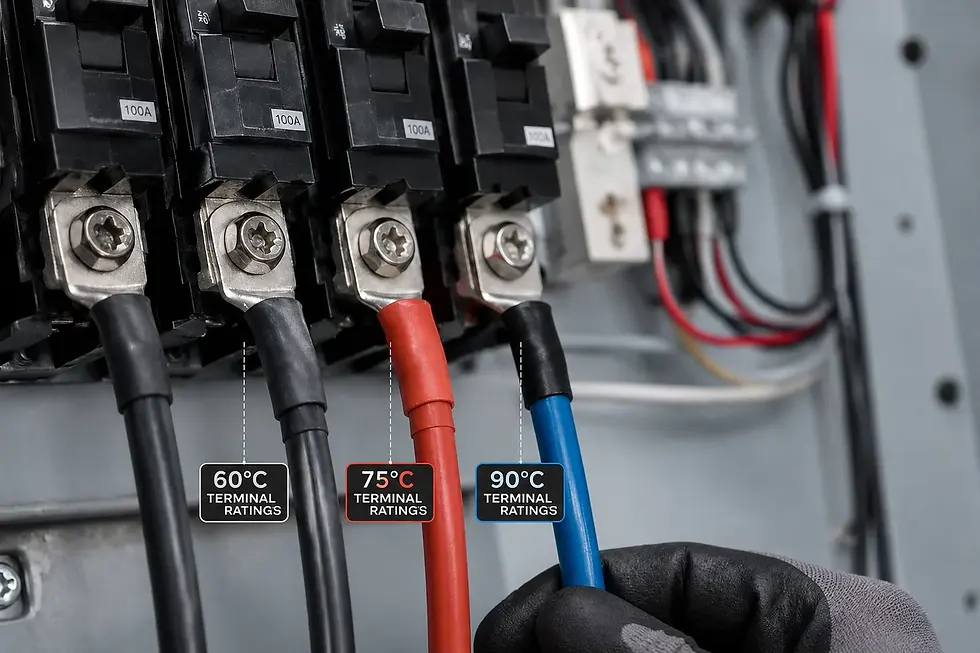
How Do Temperature Ratings Affect Wire Ampacity?
Temperature rating is one of the most important factors when interpreting an electrical wire ampacity chart.
The 60°C, 75°C, and 90°C columns represent different allowable conductor operating temperatures under specified conditions.
They do not mean that every conductor can automatically operate at its highest listed temperature after installation.
Understanding 60°C Wire
A 60°C-rated conductor is suitable for applications where the conductor and connected equipment have the corresponding temperature limitations.
Certain older wiring systems and NM-B cable applications are associated with this rating.
For example, #6 copper has a base ampacity of 55 amps in the 60°C column.
Understanding 75°C Wire
The 75°C column is commonly used for modern electrical equipment when the equipment is listed and identified for 75°C conductors.
For example, #6 copper has a 65-amp ampacity at 75°C.
This rating is frequently relevant when evaluating feeders and larger branch circuits.
Understanding 90°C Wire
Many modern building wire types, including THHN and THWN-2, carry 90°C insulation ratings.
These higher temperature ratings can provide additional flexibility when performing conductor adjustment and correction calculations.
However, the final allowable ampacity may be limited by the temperature rating of the connected equipment.
Why Terminal Temperature Ratings Matter
Under NEC 110.14(C), conductor ampacity must be evaluated in relation to the equipment's termination temperature limitations.
For equipment rated 100 amps or less, the general rule requires consideration of the 60°C column unless the equipment is listed and identified for higher-temperature conductors or another applicable provision permits otherwise.
For example, #6 copper THHN has a 90°C ampacity of 75 amps, but equipment with 75°C-rated terminations generally requires the final allowable ampacity to be limited to the applicable 75°C value.
That value is 65 amps before any additional correction or adjustment.
This is why wire insulation temperature and equipment terminal temperature must always be evaluated together.
THHN vs. NM-B: Does Cable Type Affect Ampacity?
Yes. The cable or conductor type can significantly affect the allowable ampacity of an electrical installation.
Two conductors with similar copper cross-sectional areas may have different allowable ampacities because of their insulation classifications and installation methods.
THHN Wire
THHN is a common insulated building wire used in approved raceway installations.
Many THHN conductors are also marked THWN-2, allowing their use in wet locations when installed according to their listing and applicable requirements.
For #6 copper THHN, the 90°C reference ampacity is 75 amps.
The final allowable ampacity must still comply with applicable terminal temperature limitations and correction or adjustment requirements.
NM-B Cable
NM-B is a nonmetallic-sheathed cable commonly used in residential wiring.
Although its individual conductors may have insulation rated for 90°C, NEC 334.80 limits its allowable ampacity to the 60°C column.
For #6 copper NM-B, the reference ampacity is therefore 55 amps.
The 90°C conductor rating can be used for applicable adjustment and correction calculations, but the final calculated ampacity cannot exceed the 60°C limitation.
THHN vs. NM-B Ampacity Comparison
Wire Type | Applicable Ampacity Reference | #6 Copper Ampacity |
THHN copper with 75°C-rated terminations | 75°C column | 65A |
THHN copper with 60°C-rated terminations | 60°C column | 55A |
NM-B copper | 60°C limitation | 55A |
This comparison shows why the wire gauge alone does not determine the allowable ampacity.
The conductor type, equipment rating, and installation method are equally important.
What Factors Can Reduce Wire Ampacity?
The values in an ampacity chart are based on specific reference conditions.
Actual electrical installations may require additional calculations because of environmental and installation-related factors.
1. Ambient Temperature
NEC Table 310.16 uses a standard ambient temperature of 30°C (86°F).
When conductors are installed in hotter environments, their allowable ampacity may need to be reduced using the applicable temperature correction factors.
For example, a conductor installed in an environment with an ambient temperature of 40°C may have a lower allowable ampacity than the same conductor installed at 30°C.
This is particularly relevant for industrial facilities, outdoor electrical equipment, and installations near heat-producing machinery.
2. Number of Current-Carrying Conductors
When multiple current-carrying conductors are installed together in the same raceway or cable, heat dissipation can become more difficult.
Under applicable NEC conditions, adjustment factors may be required when more than three current-carrying conductors are installed together.
For example, common adjustment factors include:
Number of Current-Carrying Conductors | Adjustment Factor |
1–3 | 100% |
4–6 | 80% |
7–9 | 70% |
10–20 | 50% |
21–30 | 45% |
These percentages are general conductor adjustment factors. The actual conductor count must be determined according to NEC definitions and applicable exceptions.
3. Installation Method
Electrical conductors may be installed in raceways, cable assemblies, direct-buried systems, or other approved wiring methods.
Different installation methods can introduce different heat-dissipation conditions and code requirements.
The ampacity chart must therefore be interpreted according to the specific conductor installation.
4. Voltage Drop and Wire Length
Wire length does not directly change a conductor's base ampacity rating.
However, longer wire runs increase electrical resistance and voltage drop.
Excessive voltage drop can affect motor performance, electrical equipment operation, and system efficiency.
How to Choose the Right AWG Wire Size
Selecting the correct wire size requires a systematic evaluation of the electrical load and installation conditions.
The following steps provide a practical starting point.
Step 1: Determine the Required Current
Identify the equipment's operating current and calculate the expected electrical load.
For continuous loads, apply the applicable continuous-load sizing requirements.
Step 2: Select the Conductor Material
Determine whether copper or aluminum is appropriate for the project.
Compare their electrical performance, installation requirements, and material costs.
Step 3: Check the Wire Insulation Rating
Confirm the conductor type, temperature classification, and approved installation method.
Common options include THHN, THWN-2, XHHW-2, and NM-B, each with different application requirements.
Step 4: Confirm Equipment Terminal Ratings
Check the circuit breaker, panelboard, and connected equipment for their permitted conductor sizes, materials, and termination temperature ratings.
Step 5: Apply Correction and Adjustment Factors
Consider ambient temperature and the number of current-carrying conductors installed together.
Calculate the corrected and adjusted ampacity when necessary.
Step 6: Check Voltage Drop
For long conductor runs, calculate voltage drop to determine whether a larger conductor is needed.
Step 7: Verify Overcurrent Protection
Ensure that the selected conductor, breaker, and connected equipment meet the applicable NEC requirements.
A wire ampacity chart is an important reference tool, but it cannot replace a complete electrical load and conductor-sizing calculation.
Frequently Asked Questions
1. How many amps can #6 AWG copper wire handle?
According to NEC Table 310.16, #6 AWG copper has a base ampacity of 55 amps at 60°C, 65 amps at 75°C, and 75 amps at 90°C. The actual allowable ampacity depends on equipment terminations and installation conditions.
2. How many amps can #6 aluminum wire handle?
#6 AWG aluminum has a base ampacity of 40 amps at 60°C, 50 amps at 75°C, and 55 amps at 90°C under the standard reference conditions.
3. Is #6 AWG wire suitable for a 60 amp breaker?
#6 copper can be suitable for many 60-amp circuit applications when the applicable ampacity, termination ratings, load calculations, and installation conditions are satisfied. #6 aluminum should not be assumed suitable for a standard 60-amp circuit. NM-B cable also has a separate 60°C ampacity limitation.
4. What is the difference between 6 AWG and 6 mm² wire?
6 AWG and 6 mm² are not the same conductor size.
#6 AWG has a nominal cross-sectional area of approximately 13.3 mm², while 6 mm² metric wire has a smaller cross-sectional area.
They should not be treated as interchangeable when selecting electrical conductors.
5. Is 90°C wire always rated for 75 amps?
No. The 90°C temperature rating indicates the insulation's temperature classification, not the universal allowable current of the installed circuit.
Equipment termination ratings and applicable correction and adjustment factors can limit the final ampacity.
6. Does a longer wire run reduce ampacity?
Wire length does not directly change the base ampacity listed in NEC Table 310.16.
However, longer conductors produce greater voltage drop. A larger wire may be necessary to maintain acceptable voltage at the connected equipment.
For the same AWG size, copper generally provides higher electrical conductivity and greater ampacity.
Aluminum is lighter and can offer material-cost advantages, particularly in larger electrical installations.
The better choice depends on the required current, installation requirements, equipment compatibility, and project economics.
Final Thoughts
Understanding #6 AWG wire ampacity is essential when selecting electrical conductors for residential, commercial, and industrial projects.
Although copper and aluminum conductors share the same AWG designation, their current-carrying capacities are different.
According to NEC Table 310.16, #6 copper has reference ampacities of 55A, 65A, and 75A at 60°C, 75°C, and 90°C, respectively. #6 aluminum has corresponding values of 40A, 50A, and 55A.
However, these numbers should never be used without considering conductor insulation, equipment termination ratings, ambient temperature, conductor grouping, and installation methods.
Always verify the locally adopted National Electrical Code, equipment specifications, and applicable installation requirements before selecting or installing electrical conductors.


Comments